
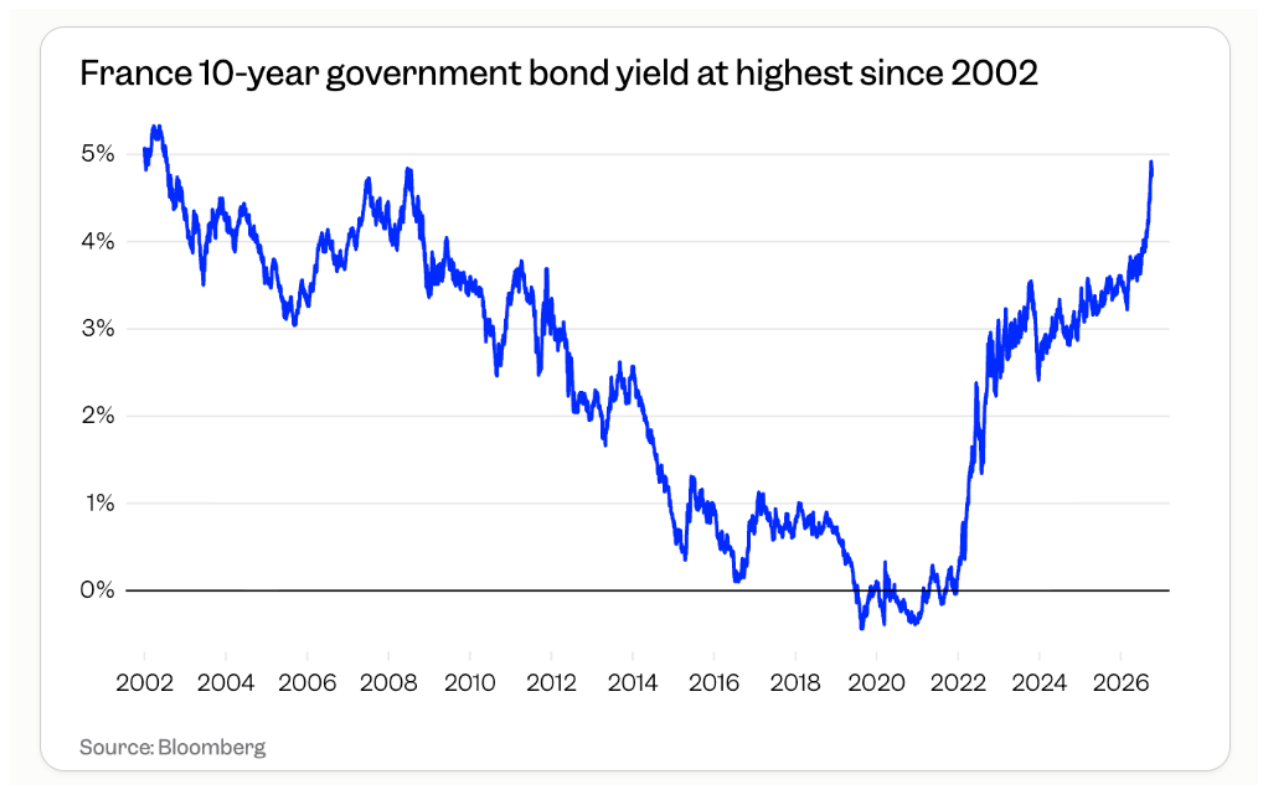
France's 10-year government bond yield just touched its highest level since 2002, and the speed of the move is what stands out. Look at the chart: the yield spent most of the last decade near zero or negative, and it has climbed to just under 5% in a few short years, with the steepest part coming recently.
Why France stands out
Fiscal worries have been building across Europe, in the UK, Italy and Germany among others, but France has been repriced fastest. France has a big debt load, a sizable annual deficit, weak growth, and now much higher interest costs.
France also lacks the cushions the U.S. has. The U.S. issues debt in its own currency, and the dollar is the world's reserve currency.
The U.S. isn't France, but the playbook rhymes
The differences are real: the dollar, the deepest government bond market in the world, and consistent demand for Treasuries. Nobody is saying the U.S. is about to face a French-style scare.
But look at what we've been covering here:
- The debt math. With U.S. debt above $40 trillion, every 1 percentage point of interest costs now works out to roughly $401 billion a year, versus about $89 billion in 2007.
- The term premium. When a president suggested higher inflation could "pay off" the debt, yields hit a new high of the day on words alone, which showed how sensitive the market is to confidence.
- The demand side. Foreign net purchases of Treasuries fell from roughly $707 billion to $296 billion over the last year, with official institutions swinging from buyers to sellers. Private foreign investors were still buying, but the marginal bid weakened.
How it could reach U.S. markets
The French yield won't directly raise U.S. mortgage rates, but there are several indirect channels:
- Global borrowing costs. The bond market is connected, and a rise in yields across developed markets pushes the whole level higher.
- Foreign demand. When European investors can earn close to 5% at home, the case for buying Treasuries weakens at the margin. That would add to the cooling foreign bid we already noted.
- A stronger dollar and safe-haven flows. A European flare-up tends to send money toward the dollar and Treasuries. That can help U.S. bonds in the short run, though it also tightens financial conditions.
- Stocks. A European flare-up could rattle equities as well, which fits the late-cycle picture from the record-low cash allocations we covered.
What this could mean for fixed income investors
Don't assume Treasuries are immune to global moves. The 10-year has been trading around 5.2%, and it can rise with global yields even if U.S. data is soft.
Build duration gradually. The 2022 and French episodes show that rate repricing can come in sharp bursts. A ladder or barbell avoids committing everything at once.
Watch the spread between countries. French premium over German bonds is a good gauge of stress. If it keeps widening, expect more pressure on other sovereign debt.
Know who holds your bonds. If you own funds with leveraged strategies or heavy exposure to long duration, understand how they might behave in a fast move.
Keep dry powder in T-bills. Liquidity gives you flexibility when repricing happens quickly.
The bottom line
France is not on the brink of default, and the U.S. has advantages France doesn't. But the French bond market is a useful reminder that fiscal credibility can disappear much faster than it takes to build. The U.S. has huge deficits, rising interest costs and political gridlock around taxes and spending. The French experience suggests that markets give countries the benefit of the doubt right up until they don't.