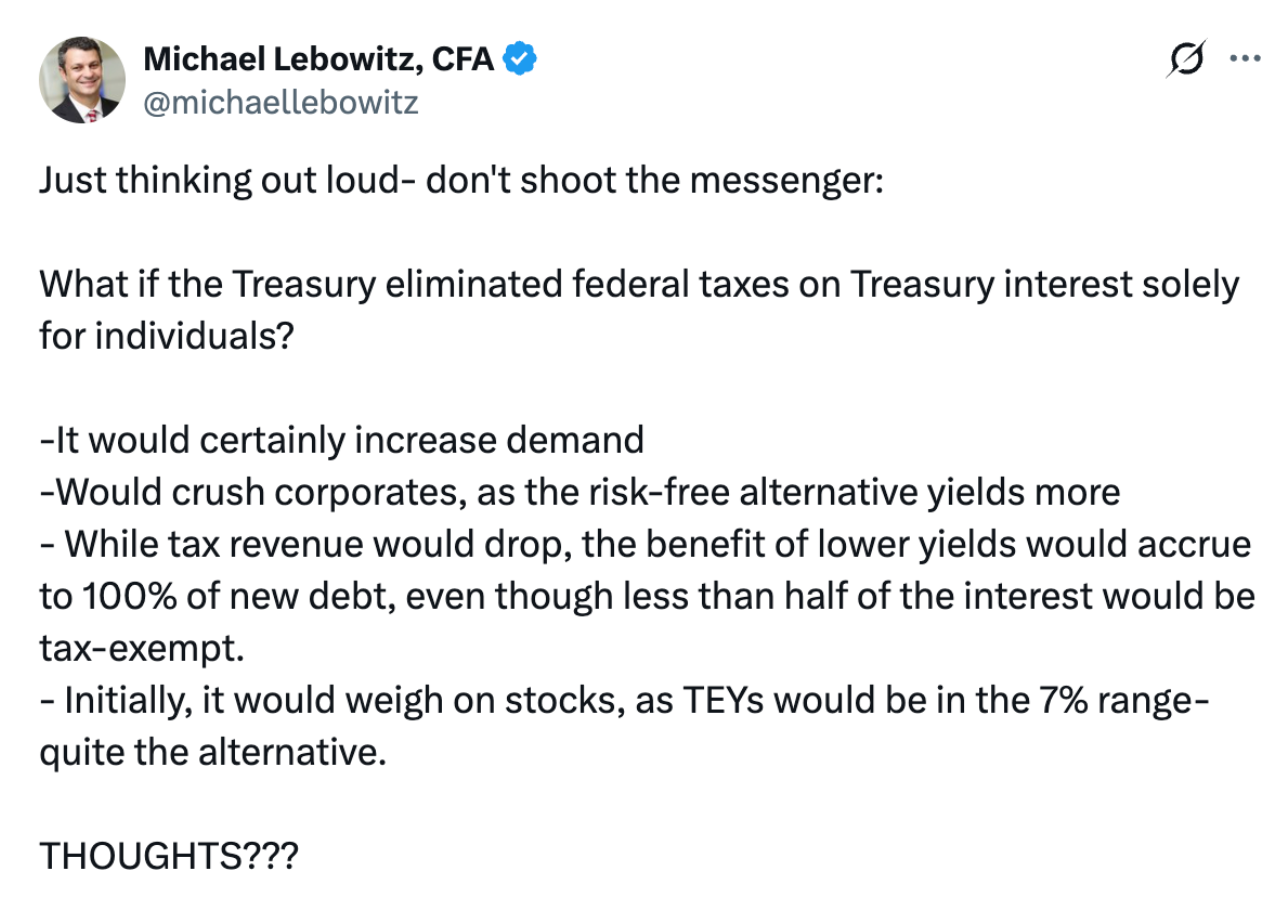
This is hypothetical, and as far as I know it would take Congress to change the tax code. Here are my thoughts:
The tax treatment today
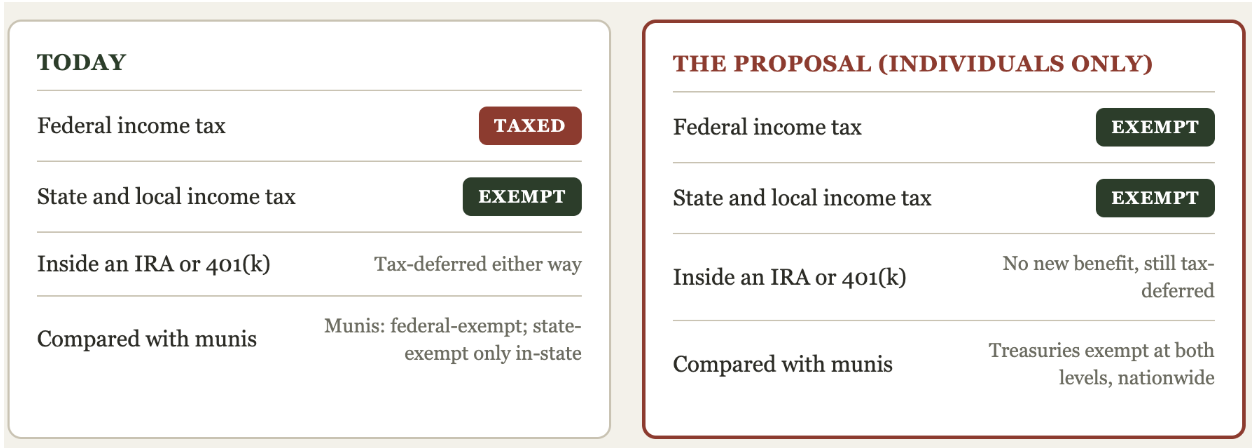
Treasury interest is taxed by the federal government and exempt from state and local income tax. Munis are the mirror image: federal-exempt, and state-exempt only if you buy your own state's bonds. Under Lebowitz’s proposed scenario, Treasuries would be exempt at both levels, for individuals. That would make them better than munis on tax at every income level, which is a big deal I'll come back to.
I put the comparison in a visual, with a bracket table and a breakdown of who holds Treasuries and where they are typically held.
The math behind "the 7% range"
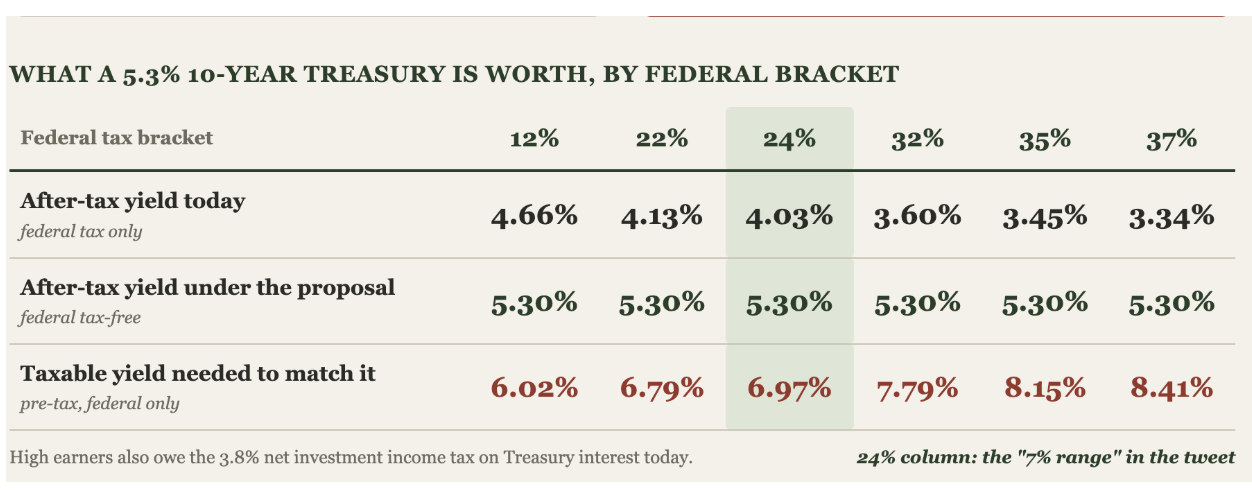
Take a 10-year Treasury at about 5.3%. Today a 24% bracket investor keeps about 4.03% after federal tax. Under the proposal they keep all 5.30%. To match that from a taxable bond, they'd need roughly 6.97% before tax. At the 37% bracket it's about 8.41%.
A corporate bond paying 6% leaves a 24% bracket investor with about 4.56% after tax. A tax-free Treasury pays 5.30% with basically no credit risk.
How each market would react
Treasuries. Demand from taxable individuals would jump, and yields would fall. HForeign holders (about 24% of the $39 trillion), the Fed and government trust funds don't care about the exemption. Individuals hold only about $3.0 trillion directly, roughly 8%. The new buyers would come from somewhere else: CDs, savings accounts, money funds, munis, corporates and dividend stocks. Yields would fall until those buyers were satisfied, and the market would do most of that repricing on announcement, long before any law took effect.
Bills and bank deposits. Don't overlook the short end. A 3.72% T-bill would be worth about 4.89% to a 24% bracket investor. A 4% CD nets about 3.0% for that same investor. That's a big gap, and it would pull money out of bank deposits and into Treasury money funds. Banks would have to pay more to keep deposits.
Corporates. Lebowitz says it would crush them. I'd say it depends on who owns them. Insurers, pensions and foreign buyers hold much of the market, and a tax-free Treasury doesn't change their math. But taxable individuals, and the funds and ETFs they own, are an important part of the buyer base, especially in high yield. Spreads would likely widen, with the most pain in retail-heavy corners. That adds pressure to what we covered in the CFO's debt-issuance piece, when borrowing costs are already rising.
Munis. This is the market Lebowitz didn't mention, and I think it's the biggest casualty. A muni's entire appeal is its tax exemption. If Treasuries get the same break at the federal level plus state exemption, munis have to offer higher yields to compete. That means falling muni prices and higher borrowing costs for states, cities and school districts. Because individuals own so much of the muni market, the repricing could be large.
Mortgages. A lower 10-year Treasury yield would pull mortgage rates down, which matters for the frozen housing market we talked about. But mortgage spreads could widen if individual investors rotate out of mortgage-backed securities, so the net effect is less certain than the headline.
Stocks. Lebowitz thinks stocks would initially suffer, and I agree on the direction. A stock yielding 4% with dividends taxed at 15% nets about 3.4%. The government would be offering 5.3% tax-free with no market risk. Dividend payers, utilities and REITs compete most directly with that.
Foreign buyers. Foreign holders get no tax break and would receive lower yields on new purchases. That could cool some foreign demand at the margin, which would partly offset the drop in yields.
Lebowitz's fiscal point
His most interesting argument is the third one. The Treasury would lose tax revenue on interest paid to individuals, but lower yields would apply to every new dollar it borrows, including the share held by foreigners, the Fed and pensions.
Here's a rough sense of scale, using my own back-of-envelope numbers. Individuals hold about $3.0 trillion. At an average rate of 3.5% to 4%, that's $105 to $120 billion of interest a year. Taxed at about 24%, the revenue at stake is somewhere around $25 to $29 billion annually. Meanwhile, every 10 basis points lower on the roughly $31 trillion of debt held by the public is worth about $31 billion a year once it all rolls over. So a modest decline in yields could pay for the exemption on paper. The catch is that the revenue loss would be immediate, while the interest savings arrive gradually as debt rolls, and the yield decline might not materialize.
The other side of the argument
Supporters would say the proposal lowers borrowing costs for the entire government and rewards people for lending to it. Critics would point out who benefits most. Look at the table: a 37% bracket investor gets an 8.41% equivalent yield, while a 12% bracket investor gets 6.02%.
What fixed income investors need to know
Don't trade a tweet. Nothing here is a proposal anyone has introduced. If it ever became real, the market would move on the announcement.
Duration would matter. The 10-year has a duration of about 7.75 years. A 50 basis point drop would mean a gain of roughly 3.9% in price. Those holding longer Treasuries would benefit first.
Asset location would get even clearer. Treasuries belong in a taxable account, since an IRA gets no benefit. Corporate bonds belong in the IRA. This is the same conclusion as our asset location piece, only stronger.
Watch muni-to-Treasury ratios. Those are the best gauge of how relatively attractive each tax break is.
Credit would feel it at the margin. Corporate and high yield buyers in taxable accounts would face a much higher hurdle.
The bottom line
Michael Lebowitz is right about the direction. It would be a massive boost to Treasury demand and a headwind for everything that competes with a risk-free, tax-free yield. However, I see the biggest loser being munis, not corporates, and the fiscal math only works if yields fall by more than a modest amount. How much of the bond market comes down to what you keep after tax.