
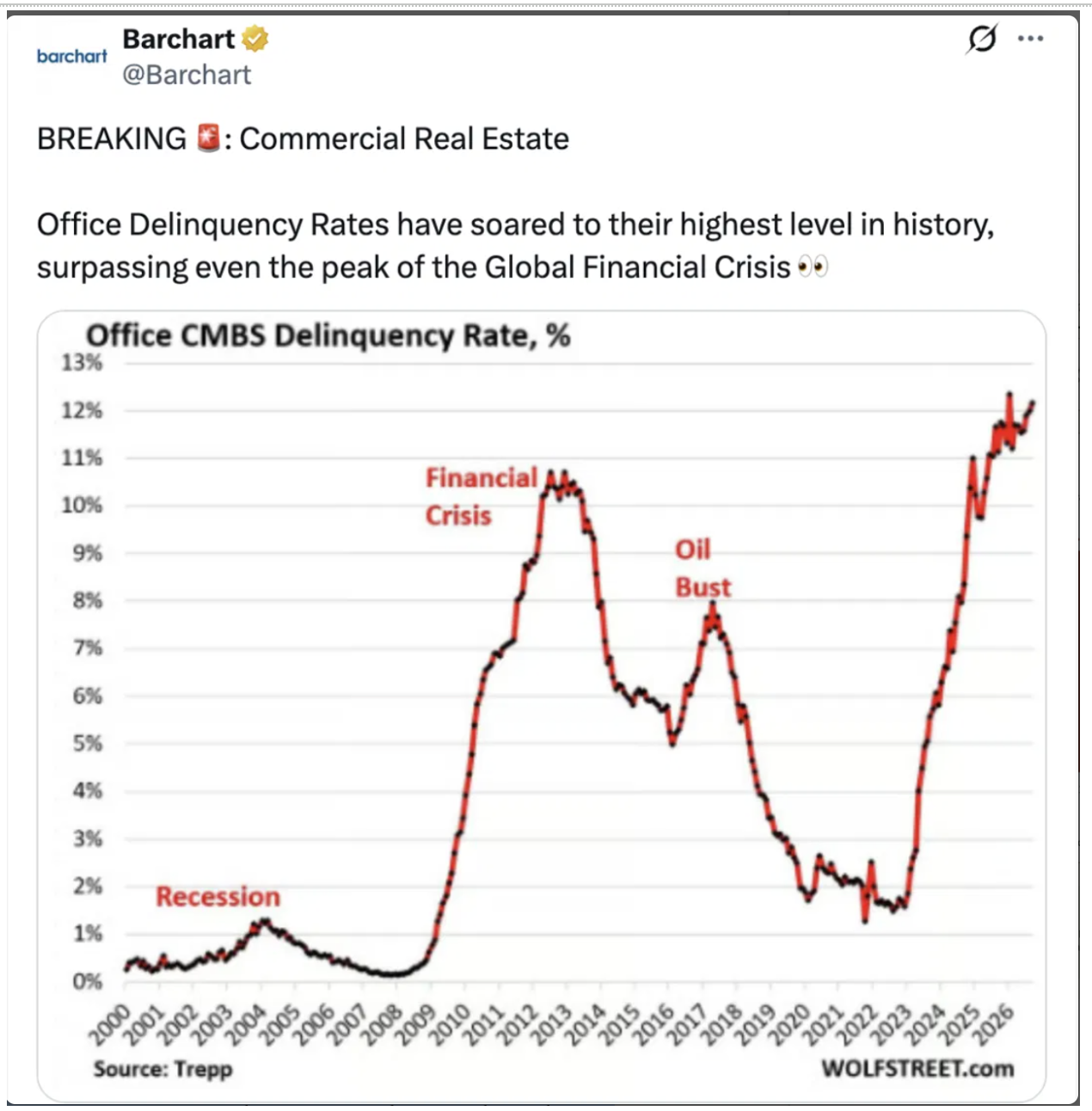
Trepp put the September rate at 12.16%. The record is 12.3%, set in January 2026. So the viral claim of a new all-time high is a hair off: we are at the second-highest reading.
Why this is a bond market story
Offices have been struggling since remote work took hold. But the delinquency spike of the last few years comes from the loan side. Commercial real estate (CRE) loans are mostly short-term, interest-only, and meant to be refinanced when they come due. Nobody pays them off from cash. They roll them into a new loan at whatever rates prevail that day.
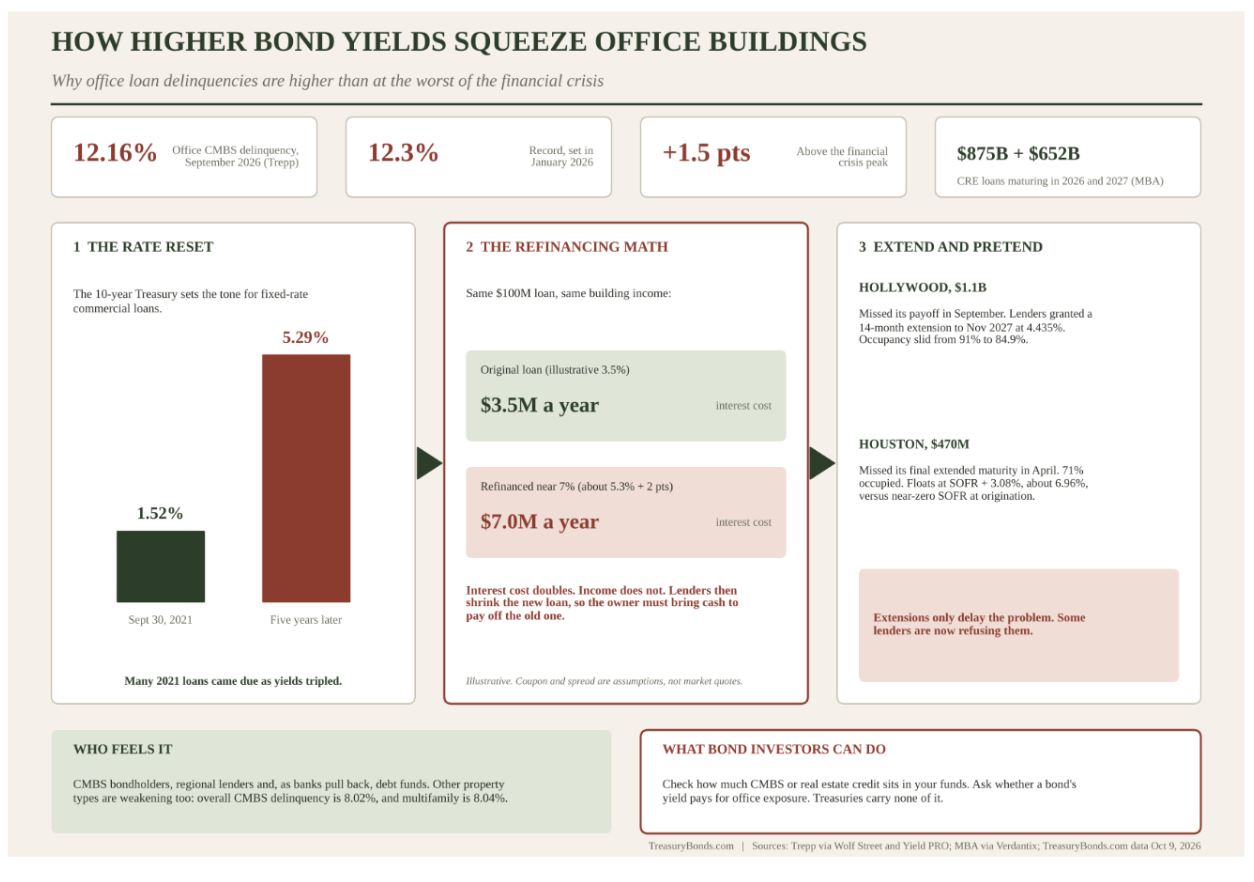
The 10-year Treasury was 1.52% on September 30, 2021. Five years later it was 5.29%. A loan made when money was nearly free now has to refinance when it isn't.
The refinancing math, in plain language
Take a $100 million loan at an illustrative 3.5%. That is $3.5 million a year in interest. Refinance near 7%, about the 10-year plus a couple of points, and it is $7 million. The building's income didn't double. Lenders also size the new loan to the income, so they offer less than the old one. The owner has to write a check to pay off the difference, or hand the keys back.
What it looks like in real deals
A $1.1 billion Hollywood office portfolio missed its payoff in September. Lenders gave a 14-month extension to November 2027 at 4.435%. Occupancy fell from 91% to 84.9%, and Fitch moved its outlook to negative.
A $470 million Houston loan missed its final extended maturity in April. It's 71% occupied and floats at SOFR plus 3.08%, about 6.96%. When it was made, SOFR was near zero.
That's what "extend and pretend" means: lenders keep delaying and hope rates fall enough to make refinancing work. Some have stopped. Bisnow's editor calls refinancing "all but dead," and originators report lenders more willing to take losses than at any point in the past five or six years.
It's bigger than just offices
The Mortgage Bankers Association estimates about $875 billion of CRE loans mature in 2026 and another $652 billion in 2027. Overall CMBS delinquency is 8.02%, and multifamily, at 8.04%, now exceeds the overall rate for the first time since the Covid shutdown. Retail is the only major property type that improved last month.
What this could mean for fixed income investors
- Know your CMBS exposure. Check whether your bond funds or income funds hold commercial mortgage bonds, and which tranches. The lowest-rated tranches take losses first.
- Don't confuse yield with safety. Ask whether the extra yield on real estate credit pays you for office risk.
- Watch the 10-year more than the Fed. The Fed's quarter-point matters less than the long end, which prices fixed-rate loans.
- Expect lenders to keep extending, until they don't. A drop in yields would buy time. More auctions like the 5.3% 10-year keep the pressure on.
- Treasuries are the other side of this trade. At 5.24% on the 10-year and 4.48% on the 1-year, you are paid without holding any building.
Bottom line
Higher yields took away the cheap refinancing that had been holding loans together. The reckoning is arriving in the one market that sets the price of money.