The Nasdaq hit a record high on September 22, and on that same day Wells Fargo fell almost 4%, JPMorgan 3.4% and Bank of America 3%. Stocks at record highs and the biggest banks getting sold is not how a healthy market usually behaves.
JPMorgan is in correction territory, Bank of America and Wells Fargo are almost in a bear market, Citigroup is in a major correction, and Goldman Sachs is well into a bear market. The KBW Bank Index sits about 14% below its mid-August peak. Truist's Brian Foran says this extends a bear market in financials that stretches back to April 2025.
Banks are some of the biggest borrowers - and bond holders.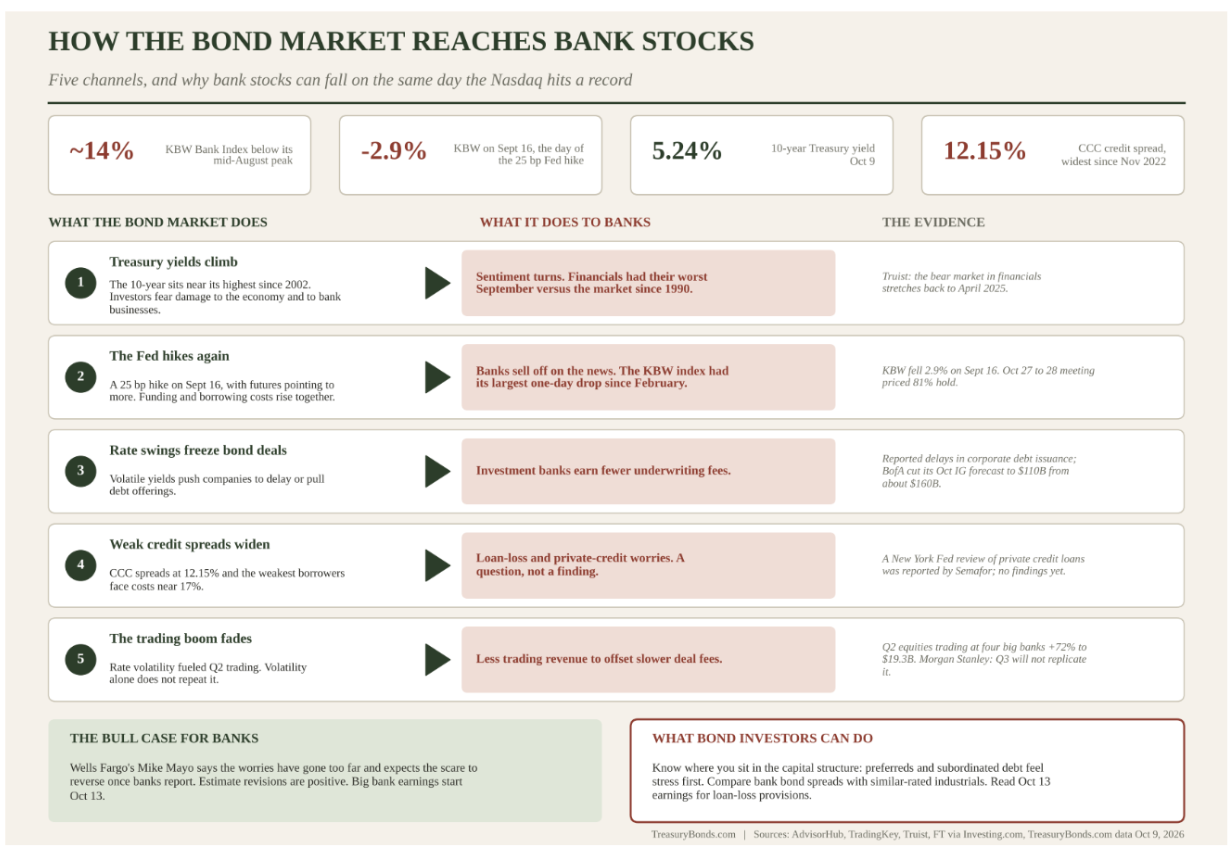
Bank stocks normally like higher rates, since banks earn more on loans. This time the reporting points the other way. Coverage on October 1 cited climbing Treasury yields as the pressure, with investors worried about what higher rates will do to the economy and to banks' businesses. The 10-year is at 5.24% and the 30-year at 5.61%.
If yields rise because the economy is strong, banks can cope. If they rise because buyers are demanding more to lend to the government, borrowers get squeezed, credit quality gets questioned, and deal activity slows.
The Fed is in the mix too
The Fed raised rates 25 basis points on September 16, and the KBW index fell 2.9% that day, its largest one-day drop since February.
The investment banking angle
Rate volatility is delaying corporate debt issuance, which hurts underwriting fees. And as we have discussed, borrowers face a tougher time issuing at all with the weakest credits looking at costs near 17%. Morgan Stanley has already warned that the third quarter will not repeat the second quarter's trading boom, when equities trading revenue at four big banks rose 72% to $19.3 billion. Banks lived on trading in Q2. Q3 looks thinner.
The credit question nobody can answer yet
One widely shared post says the New York Fed is reviewing bank loans to private credit firms, citing a Semafor report. With CCC spreads at 12.15%, the widest since 2022, it is fair to ask where the weak credit risk is sitting.
The other side
Wells Fargo's Mike Mayo says the worries about AI, the midterms and rising rates have gone too far. He expects the scare to reverse once banks report, arguing that trust at banks is a moat for deposits. Foran notes estimate revisions are positive, which is unusual in a weak year. Earnings start October 13, with JPMorgan among the first to report. How the market responds will give us a tell.
What this could mean for fixed income investors
- Watch the order of the capital structure. Preferred shares and subordinated debt feel stress first. Senior debt from the largest banks tends to hold up better. If you own bank preferreds for income, know which one you hold.
- Use bank earnings as a credit report. Provisions for loan losses, private credit exposure and deposit trends matter more to bond holders than trading revenue.
- Watch financials as the early warning. If banks keep sliding while Treasury yields keep rising, that combination matters more than either alone. Pair it with the CCC spread and auction results.
- Do not treat Treasuries and bank paper as one bucket. The 5.24% 10-year and the 5% 5-year pay you without taking bank credit risk. If stock-market stress spreads, that is the part of your portfolio doing its job.
- Keep some dry powder. Short Treasuries at 4.16% for one month and 4.48% for one year let you wait for a better price on riskier bonds.
Bottom line
The bond market is leaning on bank stocks, and bank stocks behavior is telling us something about credit, deal activity and rates. Not a reason to panic, but know what you own and to check bank credit exposure before earnings start October 13.