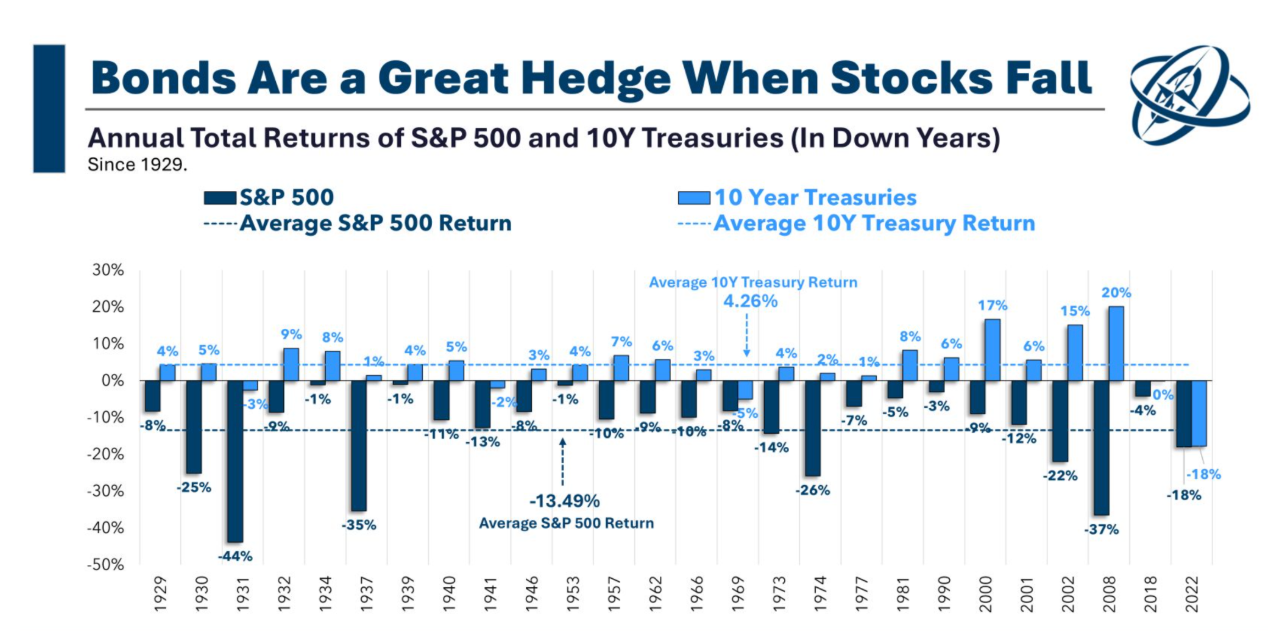
Here's a great chart from Ritholtz Wealth Management. It lists every calendar year since 1929 in which the S&P 500 lost money, and next to each one it shows what the 10-year Treasury did that same year.
What the chart shows
In those 26 down years, the S&P 500 lost an average of 13.49%.
The 10-year Treasury gained an average of 4.26% in those same years.
Counting the labels on the chart, Treasuries finished higher in about 21 of the 26 down years. They were flat in one (2018) and lost money in four: 1931, 1941, 1969 and 2022.
That's roughly four out of five times that the hedge worked, and some of those years were spectacular. In 2008, stocks fell 37% and the 10-year gained 20%. In 2002 it was -22% for stocks and +15% for Treasuries. In 2000, -9% and +17%.
Bonds cushion the fall.
The average Treasury gain of 4.26% doesn't come close to the average stock loss of 13.49%. If you held 60% stocks and 40% 10-year Treasuries through an average down year, you'd still lose about 6.4%. A good hedge softens the drop. It doesn't erase it.
Then there's 2022
Look at the far right of the chart. In 2022, the S&P 500 fell 18% and the 10-year Treasury also fell 18%. It wasn't an accident, and it wasn't the first time. Stocks and bonds fell together in 1969 (-8% and -5%), in 1941 (-13% and -2%), and in 1931 (-44% and -3%).
Why the hedge works, and when it doesn't
- Treasuries hedge stocks when the problem is growth. A recession scare or a financial panic sends investors into safe assets, the Fed eventually cuts rates, and yields fall. When yields fall, bond prices rise. That is 2000, 2002 and 2008.
- The hedge fails when the problem is inflation. If prices are rising and the Fed has to raise rates to fight it, stocks fall because borrowing gets more expensive, and bonds fall because yields go up. That is 2022. Both assets are being hit by the same force.
Where we are now
This is the question for today's market, and the answer is mixed.
The 10-year yields 5.24% and the 30-year 5.61%.
The Fed raised rates on September 16 and markets see more hikes possible.
Oil is back above $102 a barrel.
CCC credit spreads, the extra yield on the weakest borrowers, are at 12.15%, the widest since 2022.
An inflation-and-rates shock is exactly the setup that broke the hedge in 2022.
The thing that has changed since 2022
At the start of 2022, the 10-year Treasury yielded about 1.5%. That is almost no income to cushion any price drop. A 10-year bond has a duration of roughly 7 years, meaning a one-point rise in yields cuts its price by about 7%. Back then, a rise of just 0.2 of a point wiped out a full year of interest. Yields rose more than 2 points that year, and the damage followed.
Today the 10-year yields 5.24%. It would take a rise of around 0.7 of a point to wipe out a year of income. That is more than three times the cushion. The same bond that was fragile in 2022 has a lot more room now. It is the best argument for owning Treasuries today, and it doesn't depend on predicting the cause of the next selloff.
What this could mean for fixed income investors
- Own Treasuries for the job they do. They are the part of the bond market that has historically offset stock losses, most reliably when the cause is a growth scare.
- Don't count on corporate or high-yield bonds as a hedge. With CCC spreads at 12.15%, credit risk is showing up in the bond market already.
- Use intermediate maturities for the hedge. Five to ten years gives real protection in a growth scare, without the very long duration that hurts most if yields keep rising. The 5-year yields 5.00%.
- Add TIPS for the inflation regime. If the next shock is inflation, they are the piece that holds up better than regular Treasuries.
- Keep some short Treasuries. The 1-year at 4.48% and 1-month at 4.16% provide stability and let you rebalance into weakness.
- Rebalance. The hedge only pays you if you sell what held up to buy what fell.
- Size it to your life. A hedge you can sit through is worth more than a better one you sell before the duration end.
Bottom line
Bonds have been a great hedge in the years that stocks fell, about four times out of five, and in a few of those years it wasn't close. The better reason to own Treasuries now iis that at 5%-plus, you are paid to wait, and the cushion is far bigger than the last time the hedge failed.