
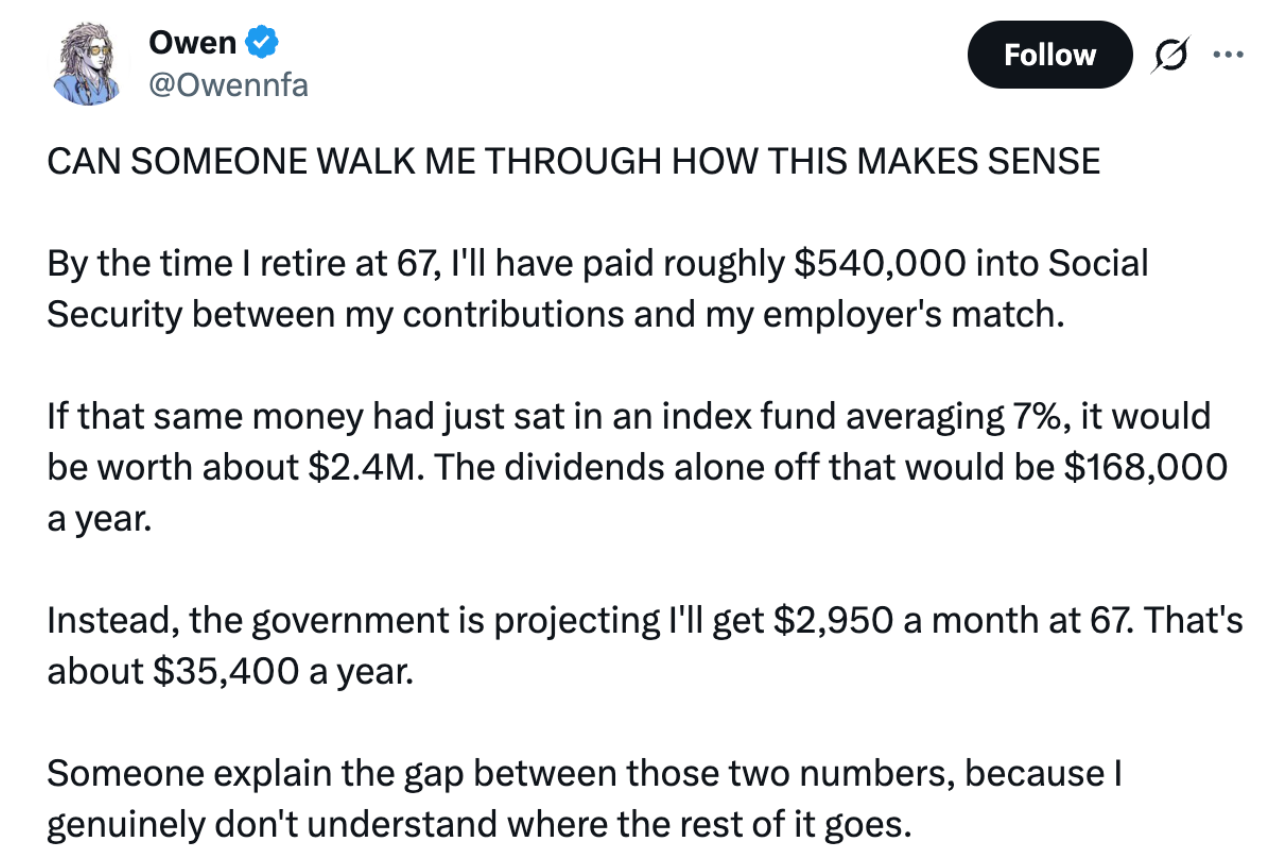
An investor posted a question on X recently that a lot of people have asked themselves privately. Over his career he’ll pay about $540,000 into Social Security, counting his share and his employer’s. If that money had sat in an index fund earning 7%, he figures it would be about $2.4 million. He says the dividends alone would pay $168,000 a year. Instead the government projects $2,950 a month at 67, or about $35,400 a year. Where did the rest go?
Michael Komorous replied with three points, and they’re good ones. I’ll add a bond angle to this perspective.
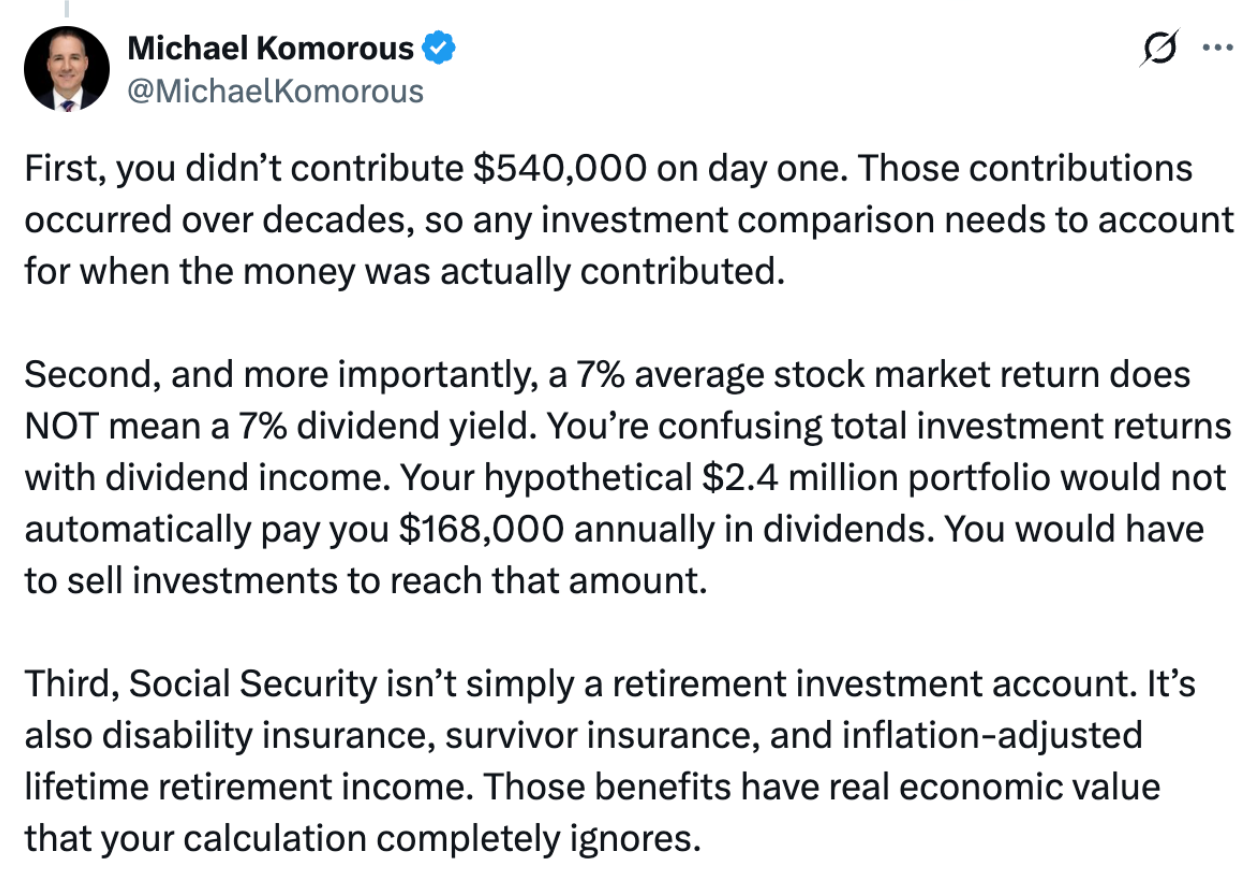
Point 1: You didn’t contribute $540,000 on day one
Komorous is right that timing matters. A dollar paid in at 25 has 42 years to compound. A dollar paid in at 60 has seven.
If he had put the whole $540,000 in on day one and earned 7% for 37 years, he’d have about $6.8 million. His $2.4 million is far lower, which is what you’d expect if the contributions came in gradually over a career. So his math appears to account for timing, at least roughly.
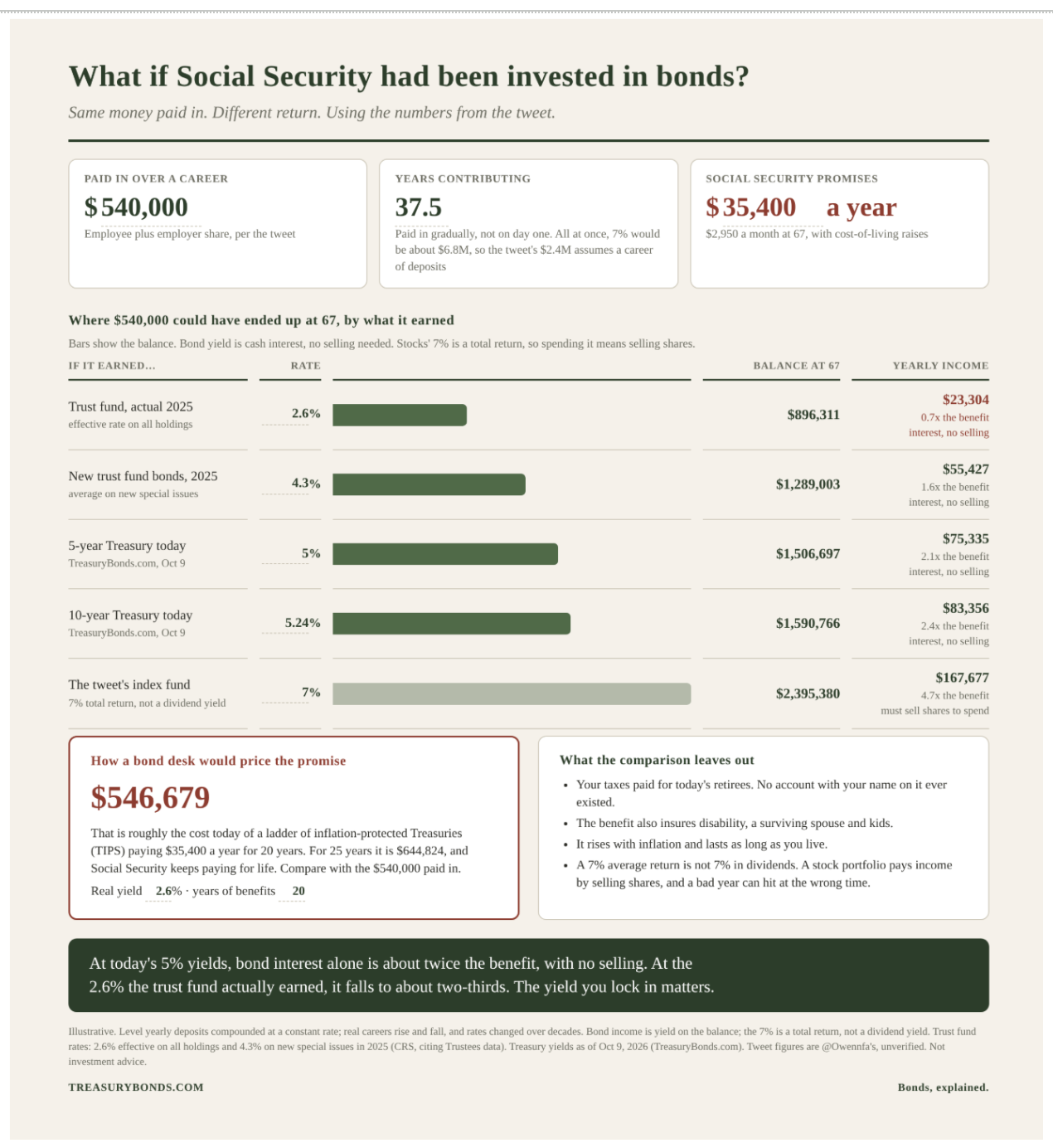
I spread $540,000 evenly over 37.5 years. That lands near his $2.4 million at 7%, so I used it as the base case for everything below.
Timing also matters for bonds, in a way people overlook. Contributions earn whatever yields were available when each dollar came in. Many of Owen’s working years were low-rate years. The trust fund shows the effect: it earned an effective 2.6% on all its holdings in 2025, while new special-issue bonds that year averaged 4.3%. Older, lower-rate bonds were still pulling the average down.
Point 2: A 7% return is not a 7% dividend yield
Komorous is right. A 7% average return is a total return, which includes price gains. It isn’t income. A $2.4 million stock portfolio wouldn’t hand Owen $168,000 a year in dividends. To spend that much, he’d have to sell shares, and he’d be selling in whatever market he got.
Bonds are different, and it’s one of the cleanest differences between the two. A bond’s yield is cash coming in. A 5% Treasury pays you 5% in interest without you selling anything, and if you hold to maturity you get your principal back. That’s why I showed bond income as interest only. It’s the same shortcut the tweet used for stocks, but with bonds it’s actually closer to reality.
Here is Owen’s $540,000 under different returns:
| Annual return | Total value | Annual investment income |
|---|---|---|
| 2.6% (trust fund, 2025 actual) | about $896,000 | about $23,000 |
| 4.3% (new trust fund bonds, 2025) | about $1.29M | about $55,000 |
| 5.0% (5-year Treasury now) | about $1.51M | about $75,000 |
| 5.24% (10-year Treasury now) | about $1.59M | about $83,000 |
| 7% (Owen's index fund) | about $2.40M | about $168,000 (a total-return figure, not dividends) |
At today’s yields, bond interest alone is about twice the $35,400 benefit. At the 2.6% the trust fund earned, it’s about two-thirds. The 7% row is the one to be careful with, because that income would have to come from selling.
Point 3: Social Security is insurance, not just an account
Komorous’s third point is the biggest one. Social Security also pays disability benefits, survivor benefits for a spouse and children, and an inflation-adjusted income for life. Owen’s calculation counts none of that.
Bonds can help put a price on it. A bond desk would treat the $35,400 as a liability and ask what it costs to fund. A ladder of inflation-protected Treasuries (TIPS) paying $35,400 a year costs about $547,000 today for 20 years, at a 2.6% real yield. For 25 years it’s about $645,000.
Owen says he paid in about $540,000. The 20-year price lands right next to it, and it only gets bigger if you live past 87, because Social Security doesn’t stop.
What about the trust fund?
The system isn’t a personal account, because it’s mostly pay-as-you-go. The payroll tax you pay this year funds this year’s retirees. What the system keeps in reserve, about $2.56 trillion, sits in special-issue Treasuries sold only to the trust funds, with rates set by formula at the average market yield on longer-dated Treasuries.
That reserve is shrinking. It fell $160 billion in 2025. The Trustees project the old-age fund runs out in late 2032 and the combined funds in 2034, at which point about 83% of scheduled benefits would be payable from incoming taxes.
A fixed income investor perspective
- Count Social Security as your biggest bond. It’s inflation-linked and covers longevity. Include it in your allocation, and you may need less in TIPS than you think.
- Delaying is a cheap way to buy more of it. Each year you wait past full retirement age, up to 70, raises your benefit about 8%. Few bond products pay that.
- Don’t confuse return with income. Komorous’s point applies to your own plan. A bond’s yield is cash you collect, and a stock fund’s average return is something you may have to sell to realize. Know which one you’re counting on.
- Plan on a bond-style number, not 7%. With the 10-year at 5.24%, a 5% baseline has a visible anchor in the market.
- Watch the trust fund headlines. As reserves are drawn down, the Treasury borrows more from the public to cover the gap. More supply could matter at the long end of the curve over time.
Could the government manage the bonds better?
Probably yes, though not by simply owning more of them. The trust fund already holds bonds. A few ideas worth debating:
Match the bonds to the promise. Benefits rise with inflation, so a TIPS-heavy ladder would fit better than a pile of fixed-rate special issues.
Allow marketable Treasuries. The Treasury has authority to buy them only when it’s “in the public interest,” and that has been rare.
Roll into today’s yields. A fund holding bonds that kept up with 5% yields would have earned more than 2.6%.
Bottom line
Komorous is right that timing, total return versus income, and the insurance value all change the math. On the bond side, the trust fund’s 2.6% versus the 4.3% on new bonds shows that the yield you lock in matters. If you want a number to plan around, use the Treasury market, not a stock average.