
They’d love to move closer to the kids, but selling would turn their cheapest housing option into their biggest monthly expense. Her words: a paid-off house can feel less like wealth and more like a golden handcuff.
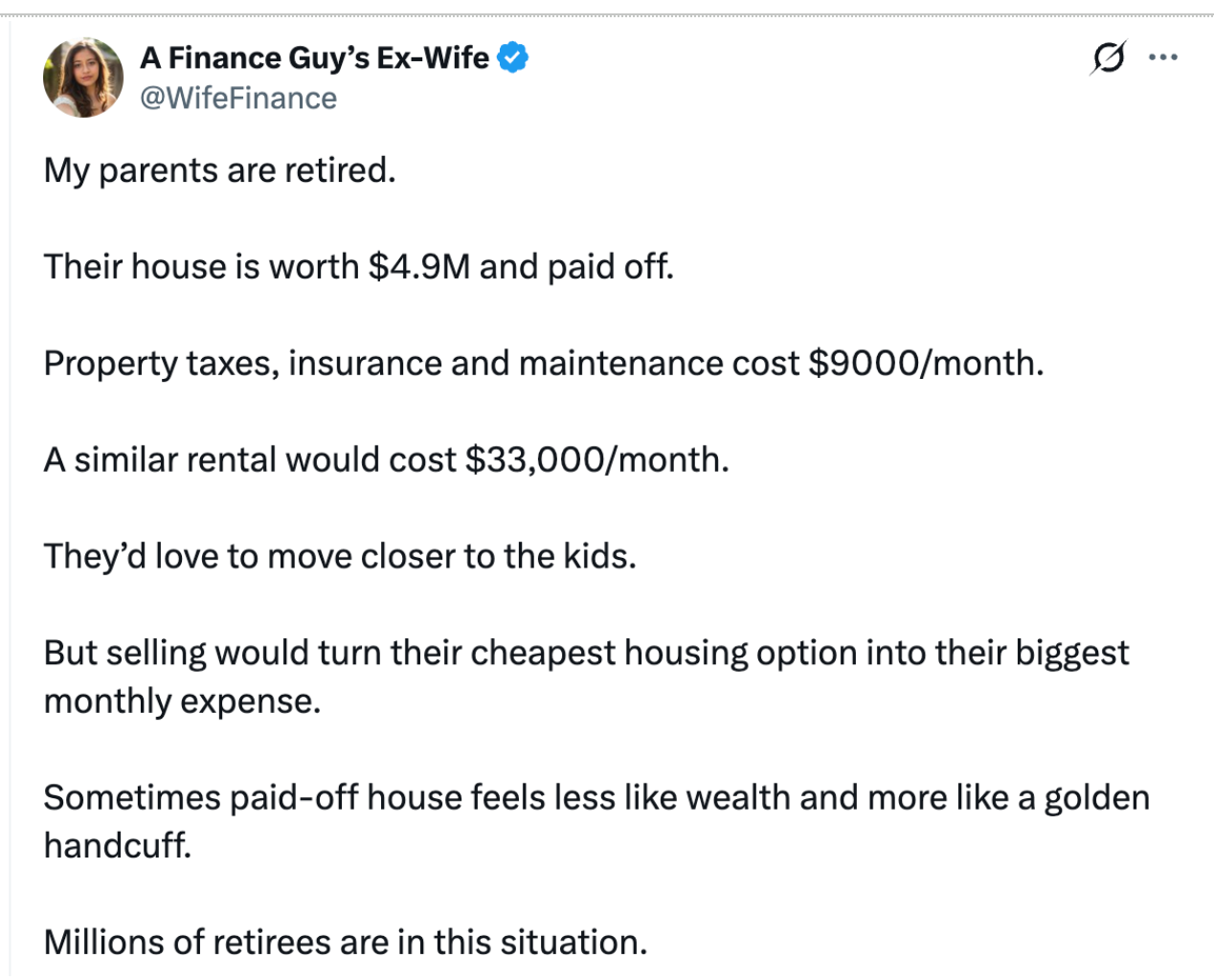
She’s right about the trap. But I think there’s a way out, and it runs through the bond market.
First, the tweet’s math holds up
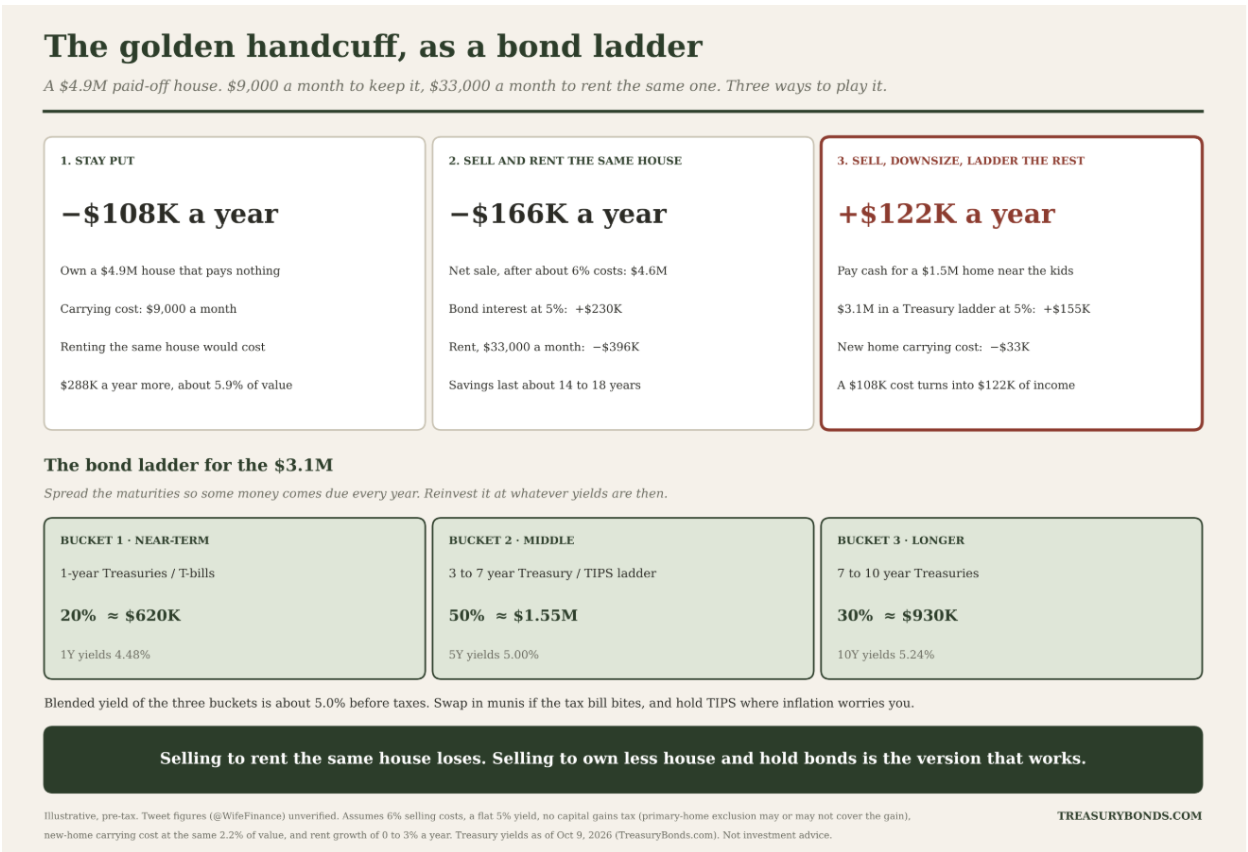
If they sell and rent a similar house, the numbers are ugly. After about 6% selling costs they’d have roughly $4.6 million. At a 5% bond yield, that earns about $230,000 a year in interest. Rent at $33,000 a month is $396,000. The gap is about $166,000 a year, drawn from principal, and the money would last roughly 14 to 18 years depending on how fast rent rises.
Staying put looks better by comparison. Keeping the house costs $108,000 a year, and renting the same one costs $288,000 more. Measured against a $4.9 million house, that saving works out to about 5.9% a year, tax-free. That’s competitive with what Treasuries pay today.
The alternative: swap square footage for a bond ladder
Here is the plan I’d put in front of them:
Sell the $4.9 million house. Net proceeds, after costs, are about $4.6 million.
Buy a smaller home near the kids for cash, about $1.5 million. Paying cash matters, because the 30-year mortgage rate is 7.40%, the highest since November 2023. Borrowing at 7.4% to hold bonds at 5% is a losing trade.
Put the remaining $3.1 million in a Treasury ladder.
Live off the interest.
At roughly 5%, $3.1 million earns about $155,000 a year. If the new home costs about the same share of its value to carry as the old one (about 2.2%), that’s roughly $33,000 a year. Net: about $122,000 a year of income, versus a $108,000 a year cost for staying. That’s a swing of about $230,000 a year, and they’ve moved closer to the kids.
The handcuff comes off because the house stops being their largest holding that earns nothing.
What the ladder looks like
A ladder spreads maturities so something comes due every year. I’d split the $3.1 million like this:
- 20% in 1-year Treasuries or T-bills (about $620,000). The 1-year yields about 4.48%. This is the near-term cash bucket.
- 50% in a 3 to 7 year Treasury and TIPS ladder (about $1.55 million). The 5-year yields about 5.00%.
- 30% in 7 to 10 year Treasuries (about $930,000). The 10-year yields about 5.24%.
Blended, that’s about 5.0% before taxes. When a rung matures, reinvest it at the current yield, so the ladder rolls forward on its own. Nobody has to guess where rates go next.
I’d resist the pull of the 20-year and 30-year, which yield 5.66% and 5.61%. A few extra basis points isn’t worth locking up money for decades at an age when flexibility matters.
The trade-offs
A paid-off house is a zero-coupon asset. It pays you to avoid rent and nothing else. When Treasuries yield 5%, it’s worth asking what an equal amount of bonds would earn.
Don’t sell to rent the same thing. Compare what you’re giving up (rent saved) with what you’d earn (bond yield). In this case the house wins that comparison, unless you also shrink the footprint.
Treat yield as paycheck, not bonus. Interest from bonds is cash you collect without selling anything. That’s the difference between this plan and living off a stock portfolio.
Mind the taxes. Treasury interest is federally taxable but exempt from state income tax. Munis can be tax-free federally. For a couple in a high bracket, compare after-tax yields before choosing. This is what the tax tools on TreasuryBonds.com are built for.
Keep some inflation protection. Rent and living costs rise. TIPS in the middle rungs help the income keep up.
Keep the ladder short enough to rebalance. Don’t be forced to sell a long bond at a loss when you need cash.
The catch
Taxes on the sale. A couple can generally exclude a large portion of the gain on a primary home, but a $4.9 million house may well exceed it. I haven’t estimated that, and it could change the plan.
The $33,000 rent looks very high. It’s about 8% of the house’s value a year, which is steep. If the real market has cheaper alternatives, the “rent” version improves.
Income depends on yields. If rates fall, new rungs will earn less. That’s the reinvestment risk every ladder carries.
Bottom line
The tweet got it right: selling a paid-off house to rent a copy of it is a bad trade. But owning more house than you need and earning nothing on $4.9 million isn’t the only alternative. Sell it, buy something smaller near the kids with cash, and put the rest in a Treasury ladder, and the same house goes from a $108,000 a year cost to about $122,000 a year of income. At 5% bond yields, that’s a trade worth a hard look!