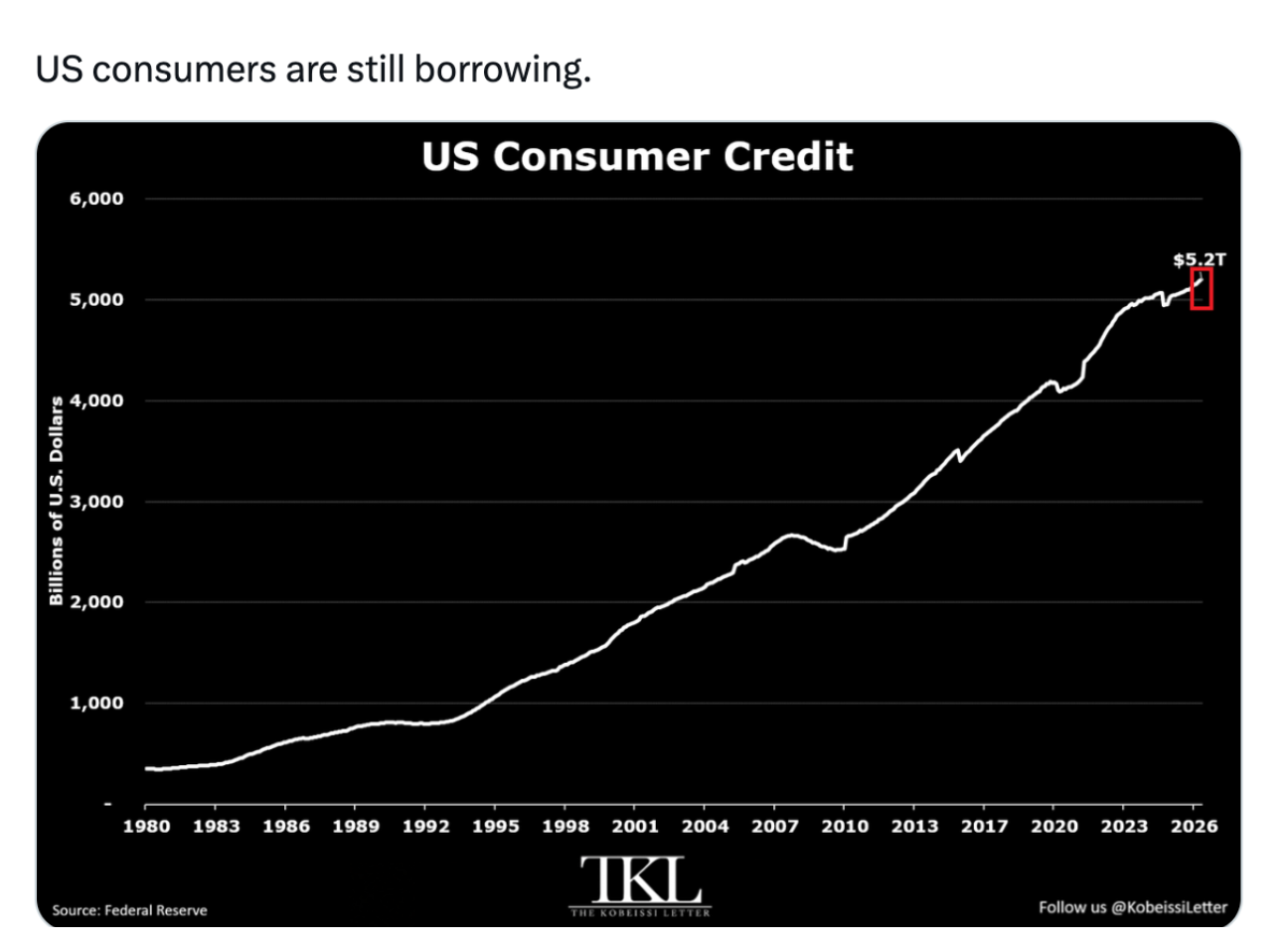
The most recent total U.S. consumer credit rose $8.3 billion in August to a record $5.19 trillion. It was the 14th straight monthly increase.
What the number actually is
The figure comes from the Federal Reserve’s monthly consumer credit report, known as the G.19. It covers most of what people borrow outside of their home: car loans, student loans, credit cards and personal loans. Mortgages and home equity loans aren’t included.
The Fed splits consumer credit into two buckets:
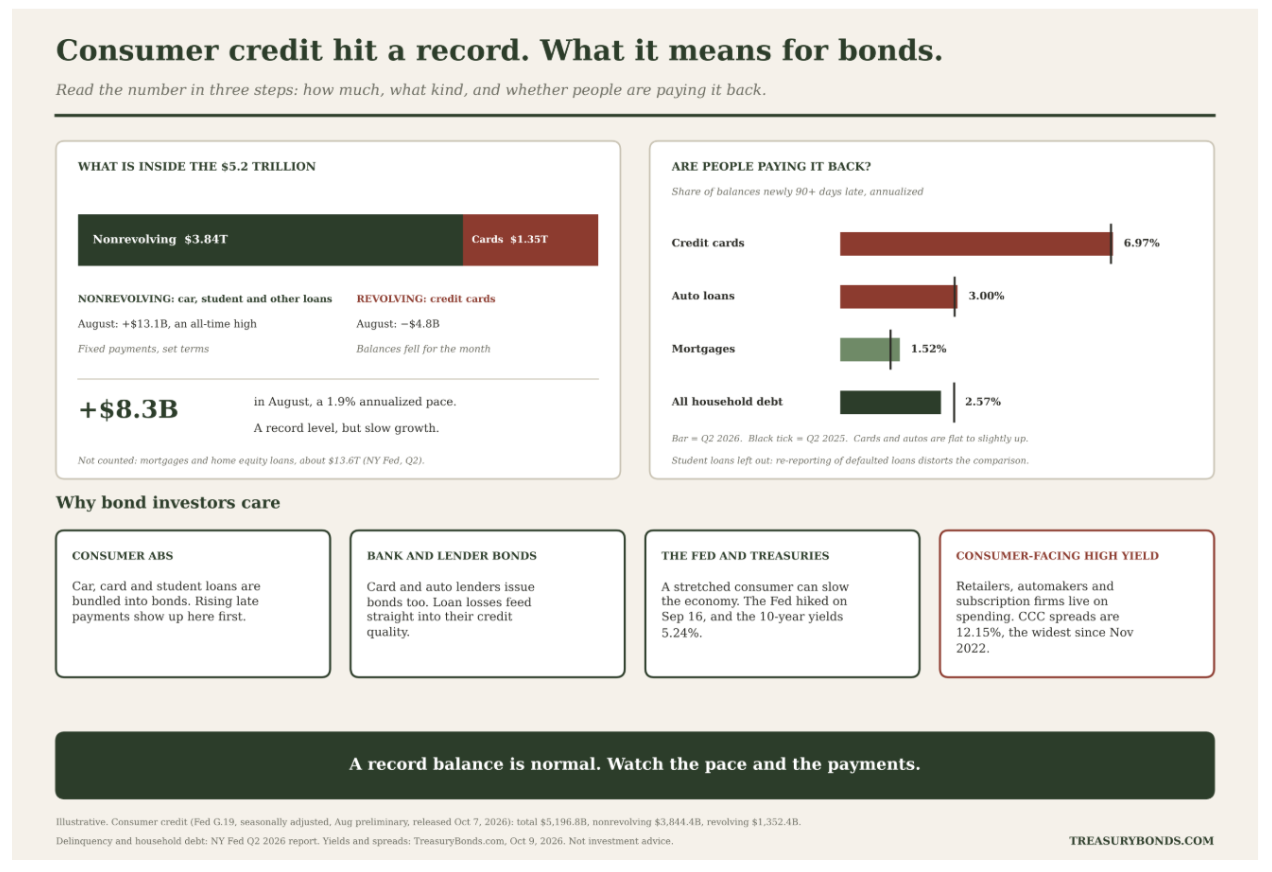
- Nonrevolving credit is loans with set terms and payments, like car and student loans. It rose $13.1 billion in August to $3.84 trillion, an all-time high.
- Revolving credit is mostly credit cards. It fell $4.8 billion in August to $1.35 trillion.
The record isn’t the story
Debt in dollars almost always sets records. Prices rise, incomes rise, the economy grows, and the balance follows. That’s why every chart of consumer credit climbs from the lower left to the upper right. A record balance is normal. It doesn’t tell you whether borrowers are in trouble.
What matters more
The pace. A 1.9% annualized increase isn’t a borrowing binge. It’s slow growth.
The mix. Card balances fell in August while auto and student loan balances rose. One month isn’t a trend, but the direction matters. Falling card balances could mean careful consumers. It could also mean tighter lending or maxed-out limits. One report can’t tell you which.
Whether people are paying. This is the part that matters most to bond investors.
Are people paying it back?
The New York Fed’s second-quarter report gives the best picture. Total household debt was $18.771 trillion, down $13 billion from the first quarter. The share of balances newly 90 or more days late (annualized):
- Credit cards: 6.97%, versus 6.93% a year earlier.
- Auto loans: 3.00%, versus 2.93%.
- Mortgages: 1.52%, versus 1.29%.
- All household debt: 2.57%, versus 2.91%.
So the overall picture improved slightly, but the NY Fed said new delinquencies for auto loans and credit cards “remain at elevated levels.” Student loans show a big drop, from 12.88% to 7.83%, but the NY Fed says that reflects distortions from the re-reporting of defaulted student debt, so I wouldn’t read it as a real improvement.
Why this matters for fixed income investors
Consumer borrowing shows up in the bond market in several places.
Asset-backed securities like auto, credit card and student loans are bundled into bonds. When more borrowers fall behind, the cash flows to those bonds weaken, and spreads widen.
Banks and finance companies issue corporate bonds, and their credit quality depends on how their loans perform.
Fed policy and Treasury yields react to consumer spending, which is a large share of the economy. If borrowers get stretched, growth slows, and that eventually matters for rate expectations. The Fed hiked 25 basis points on Sept. 16 to 3.75% to 4%, and the market sees 81% odds of a hold at the Oct. 27 to 28 meeting. The 10-year yields 5.24%.
Consumer-facing high yield bonds from retailers, automakers, and subscription companies live on household spending. CCC spreads are at 12.15%, the widest since November 2022. That’s a sign credit markets are already getting crankier & pickier.
What investors can do
Don’t react to the record. Watch the pace, the mix and the delinquency numbers.
Know what your fund holds. Aggregate bond funds can include consumer ABS, and corporate funds include banks and card lenders. Look at the holdings.
Seniority matters. In an ABS deal, senior tranches usually have more cushion than the lower ones. If you reach for yield, know which slice you’re buying.
Don’t reach for yield in consumer credit. With the 10-year at 5.24%, Treasuries pay you without relying on someone’s credit card payment.
Watch the next data. The next G.19, the NY Fed’s third-quarter report, bank earnings (look for card and auto charge-offs), and the Oct. 27 to 28 Fed meeting.
Think about the Fed’s bind. Rate hikes make revolving debt more expensive. If consumers crack, the Fed may have to change course, and that would move Treasury yields.
Bottom line
“US consumers are still borrowing” is true. For bond investors, the question isn’t how much people owe. It’s whether they can keep paying, and whether the bonds you own depend on the answer.