
Most people think of a TIPS ladder as a way to protect spending money from inflation. There’s a second use for it that I think is smarter than it first sounds: using it to fund a series of Roth conversions in the years before required withdrawals start.
The strategy
Say you’re 65 with money in a traditional IRA. Eventually the IRS will force you to start taking required minimum distributions (RMDs), and those withdrawals are taxed as ordinary income. A Roth conversion lets you move money from the traditional IRA into a Roth IRA now, paying the tax today, so the money grows tax-free afterward and has no RMDs.
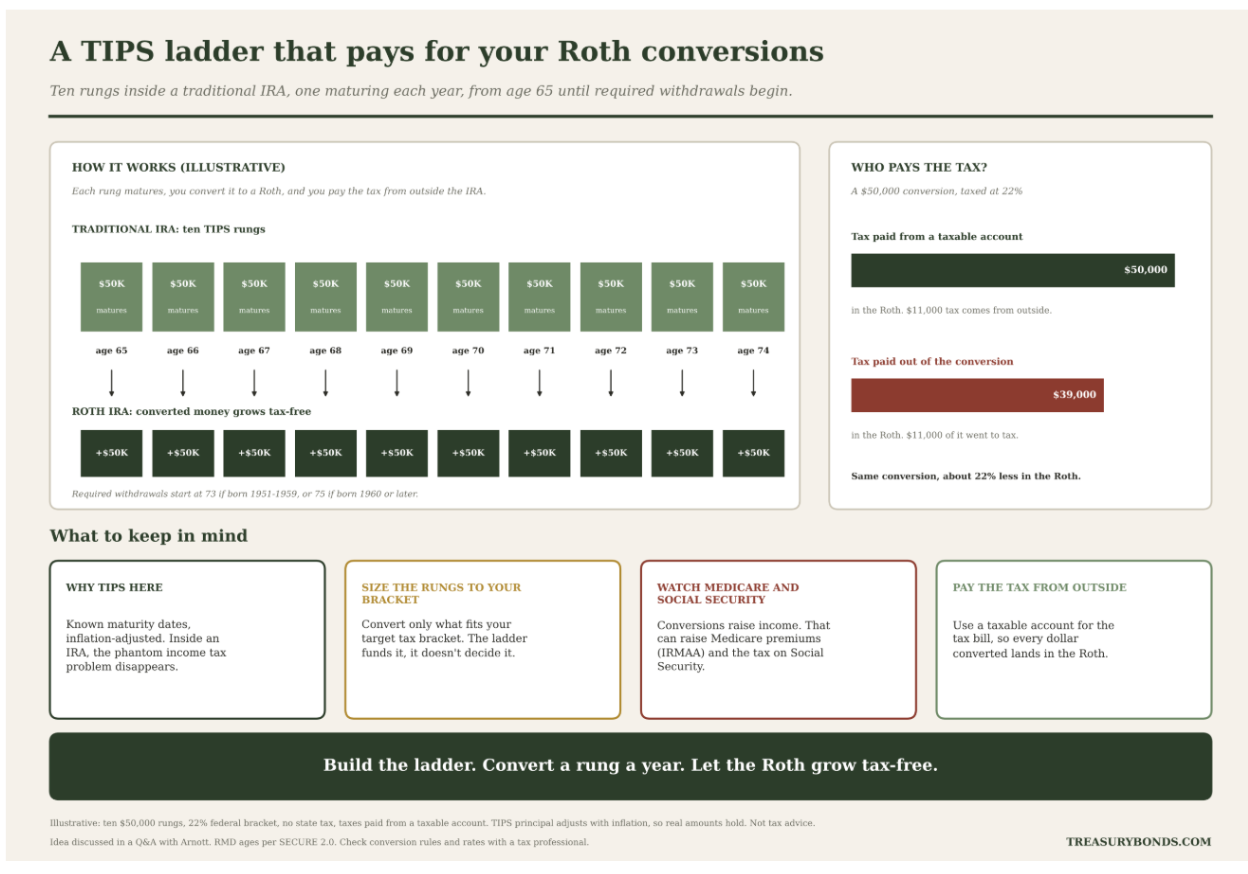
The ladder works like this:
- Inside the traditional IRA, buy TIPS that mature in a staggered way, one per year, from age 65 up to the year RMDs begin.
- As each rung matures, you take the proceeds and convert them to a Roth.
- Repeat every year until you reach the RMD age.
Why TIPS fit this job
Known dates. Each rung matures in a year you choose, so the money is there when you need it, without selling stocks in a down market.
Inflation protection. TIPS principal adjusts with CPI, so your conversion money keeps its purchasing power while it waits.
No phantom income problem. Outside an IRA, the inflation adjustment on TIPS is taxed each year even though you don’t receive it until maturity. Inside a traditional IRA, nothing is taxed until you convert, so that drawback goes away. I
What the ladder doesn’t decide for you
The ladder funds the conversions. It doesn’t decide how big they should be. A few things to weigh:
Your tax bracket. A common approach is to convert only as much as fits inside the bracket you’re comfortable with, not the whole rung. You could convert more or less than a rung pays.
Medicare premiums. Higher income from a conversion can push you into higher IRMAA surcharges, and Medicare looks back two years at your income.
Social Security taxation. More income can make more of your benefit taxable.
Future tax rates. Conversions are a bet that your tax rate later, or your heirs’ rate, will be at least as high as today’s. Nobody knows.
TIPS availability. There isn’t always a TIPS maturing in exactly the year you want, so ladders sometimes use nearby maturities or a TIPS fund to fill gaps.
What this means for fixed income investors
- Think of the ladder as a funding schedule. Each rung is a dated bucket of inflation-protected money, ready for a specific purpose.
- Use the tax-deferred account for TIPS. It solves the phantom income problem and is where the ladder sits naturally.
- Keep taxable cash available for the conversion tax bills. That’s what makes the strategy work at full strength.
- Hold to maturity. If you ladder to maturity, price swings in between don’t change the amount you’ll have on each date, apart from inflation.
- Check the yield at each rung. The five-year TIPS real yield is about 2.7%, but other maturities may differ, so look at the curve before you buy.
Bottom line
A TIPS ladder in a traditional IRA, converting one rung a year until RMDs start, is a clean way to turn a boring bond holding into a tax plan. Pay the tax from outside the IRA, size each conversion to your bracket, and keep an eye on Medicare and Social Security effects. It’s not for everyone, and the numbers depend on your situation, but as a use case, it’s a good one. As always, consult with a financial/tax professional that knows your individual situation.