
Treasuries posted strong gains on Thursday, extending the midweek rebound from the post-CPI lows. Yesterday’s September CPI report was followed this morning by a hot PPI report. Producer prices accelerated to 6.3% from a year ago, up from 5.6%, and core PPI rose to 5.0% from 4.8%.
Normally that’s a recipe for higher yields. Instead, Treasuries held onto gains all day, and yields ended at three-week lows.
The AI credit angle
So what was the market looking at? The poor performance of heavily indebted AI and data center names. CoreWeave (CRWV) opened at its lowest level since May 2025 before bouncing, along with other tech names that started the day deep in the red.
My read is that the bond market spent the day worrying about credit stress in the AI buildout, not about inflation. When investors get nervous about borrowers that have taken on a lot of debt, they tend to buy Treasuries.
Oil and the dollar
Crude oil kept climbing toward $100 a barrel and settled at its highest level in nearly a month. Normally that would pressure yields higher, but Treasuries ignored it. The U.S. Dollar Index fell 0.5% to 102.00, backing away from levels it last saw in early April.
The yield check
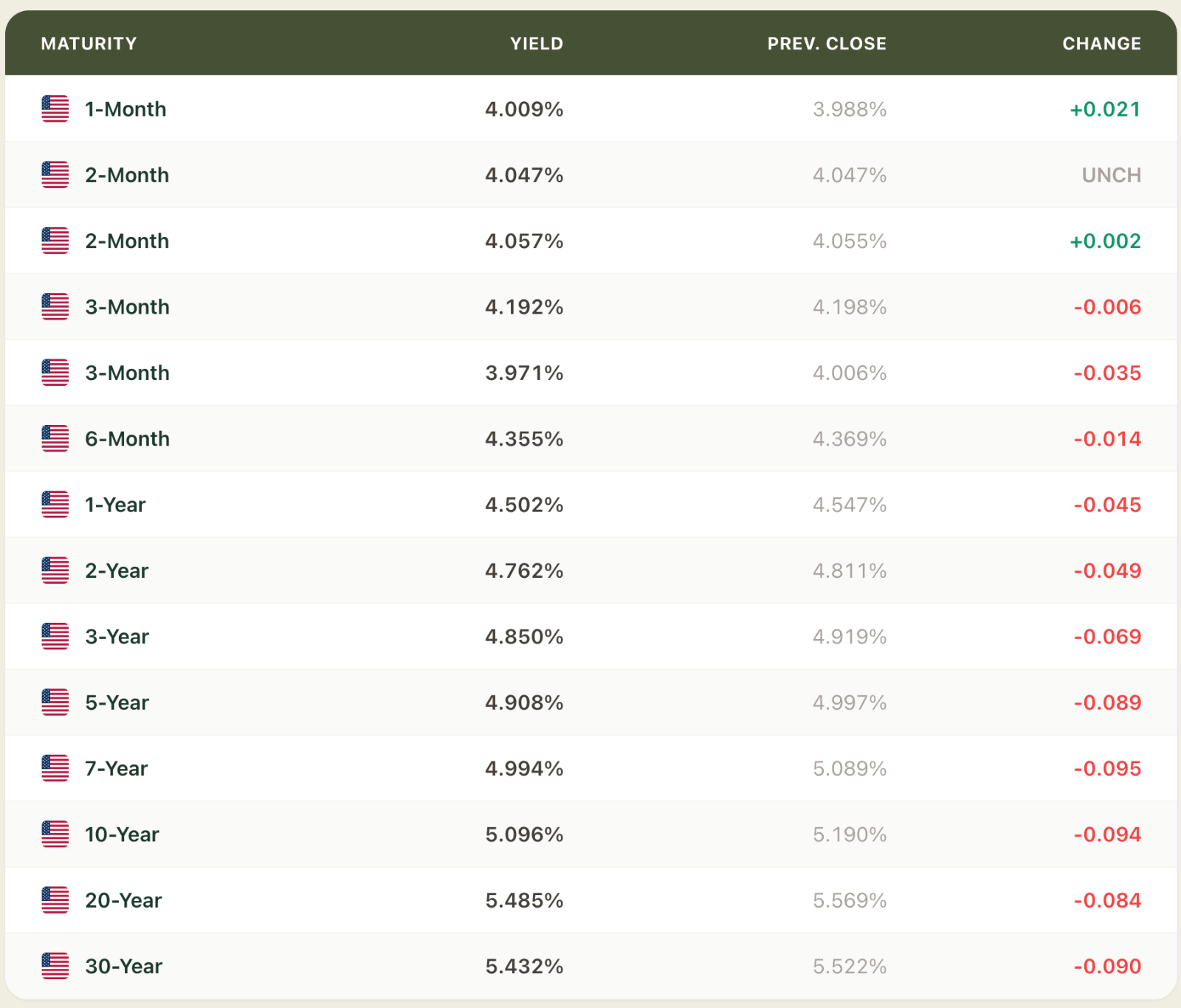
The long end rallied more than the short end, which is what you’d expect in a flight-to-quality day.
The Treasury buyback
The Treasury accepted $6 billion out of $40.8 billion offered in today’s buyback of longer-dated Treasuries. That’s about 15% of what dealers and investors were willing to sell, so there was a lot of supply on offer.
Around the world
Australia: September employment fell by 39.3K (expected a gain of 19.6K), and the unemployment rate stayed at 4.7%. After that weak report, there’s a growing belief the Reserve Bank of Australia will hold policy steady at its next meeting.
Eurozone: August industrial production fell 0.5% for the month (expected flat) and 1.1% from a year ago.
United Kingdom: August GDP rose 0.1% (expected a 0.1% drop) and is up 2.1% from a year ago. Industrial production rose 0.8% for the month and manufacturing production 1.2%. Chancellor Healey signaled he intends to follow the IMF’s guidance on reducing the deficit in the autumn budget.
France: September CPI was 3.1% from a year ago (expected 3.0%), up from 2.4% the month before. The EU-harmonized measure was 3.4%, as expected.
Germany: Chancellor Merz said negotiating the EU’s seven-year budget will be difficult, but he’s hopeful of an agreement before year-end.
Japan: August core machinery orders jumped 5.2% for the month (expected 2.2%), but industrial production fell 2.4% and capacity utilization fell 4.2%.
South Korea: September exports surged 83.7% from a year ago, and the trade surplus was $49.97 billion.
Switzerland: September producer prices fell 0.2% from a year ago.
What this could mean for fixed income investors
Yields are lower, but they’re still high. The 5-year at 4.90% and the 10-year at 5.09% are still attractive income by recent standards.
Don’t chase the rally. Treasuries rallied on a day with hot inflation data and oil near $100. That tells me flows and risk sentiment are driving the market more than the data, and that can reverse quickly.
AI credit stress is a corporate bond story. If you own corporate bonds or bond funds, check your exposure to heavily indebted AI and data center issuers.
Keep some inflation protection. A 6.3% PPI and oil near $100 are reasons TIPS still deserve a place.
The long end is the most volatile. The 30-year yield at 5.43% moved the most today, and it will move the most on the way back up as well.
Watch global data. Weak labor and industrial data in Australia and Europe, alongside hotter prices in France, show how mixed the global picture is.
On a day when everything inflationary pointed the wrong way, Treasuries rallied anyway. Let's see what tomorrow brings!