
If you told me you had money you couldn't afford to lose and a five-year window to use it, the first question I'd ask is not "what yields the most?" It's "what are you afraid of?" For most people right now, the answer is inflation. The September CPI report showed prices up 3.7% from a year ago, with fuel oil and gasoline doing most of the damage.
Here is the choice a lot of fixed income investors may be weighing: a five-year Treasury or five-year TIPS. They're both exempt from state income tax, but they work very differently.
What each one pays today
- Five-year Treasury: about 5.00%. You know exactly what you'll earn, and you get your principal back at maturity.
- Five-year TIPS: a real yield of about 2.7%, plus whatever inflation turns out to be. The principal adjusts with CPI, and the interest is paid on the adjusted principal. In plain language, TIPS pay you a fixed amount on top of inflation.
The number that decides it: break-even inflation
Subtract the TIPS real yield (about 2.7%) from the Treasury yield (5.00%) and you get roughly 2.3%. That's the market's guess at average inflation over the next five years.
- If inflation averages less than about 2.3%, the plain Treasury comes out ahead.
- If it averages more, TIPS win.
With inflation at 3.7% today, that's the bet. Nobody knows how it plays out.
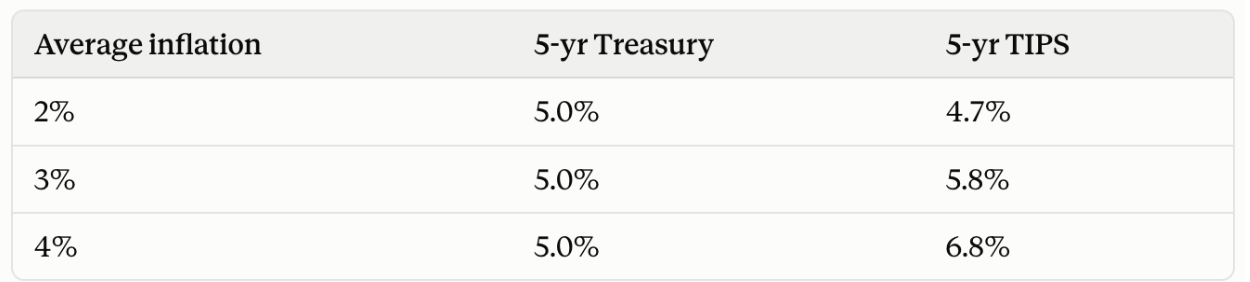
Here's roughly what you'd keep each year before taxes:
The benefits and weaknesses
Treasuries
- Benefit: They're simple. You can buy and sell them easily, and there's no cap on how much.
- Weakness: There's no built-in inflation protection. If inflation runs hot, your 5.00% shrinks in real terms.
TIPS
- Benefit: They protect you from inflation, they have a strong real yield right now, and there's no purchase limit.
- Weakness: There's something called phantom income. Each year, the inflation adjustment to your principal is taxed as income, even though you don't receive that money until the bond matures. That's why I'd lean toward holding TIPS in an IRA or other tax-deferred account. Also, if you sell before maturity, the price can move against you.
One more thing on taxes: both are taxed federally and exempt from state and local income tax. It's easy to forget until April.
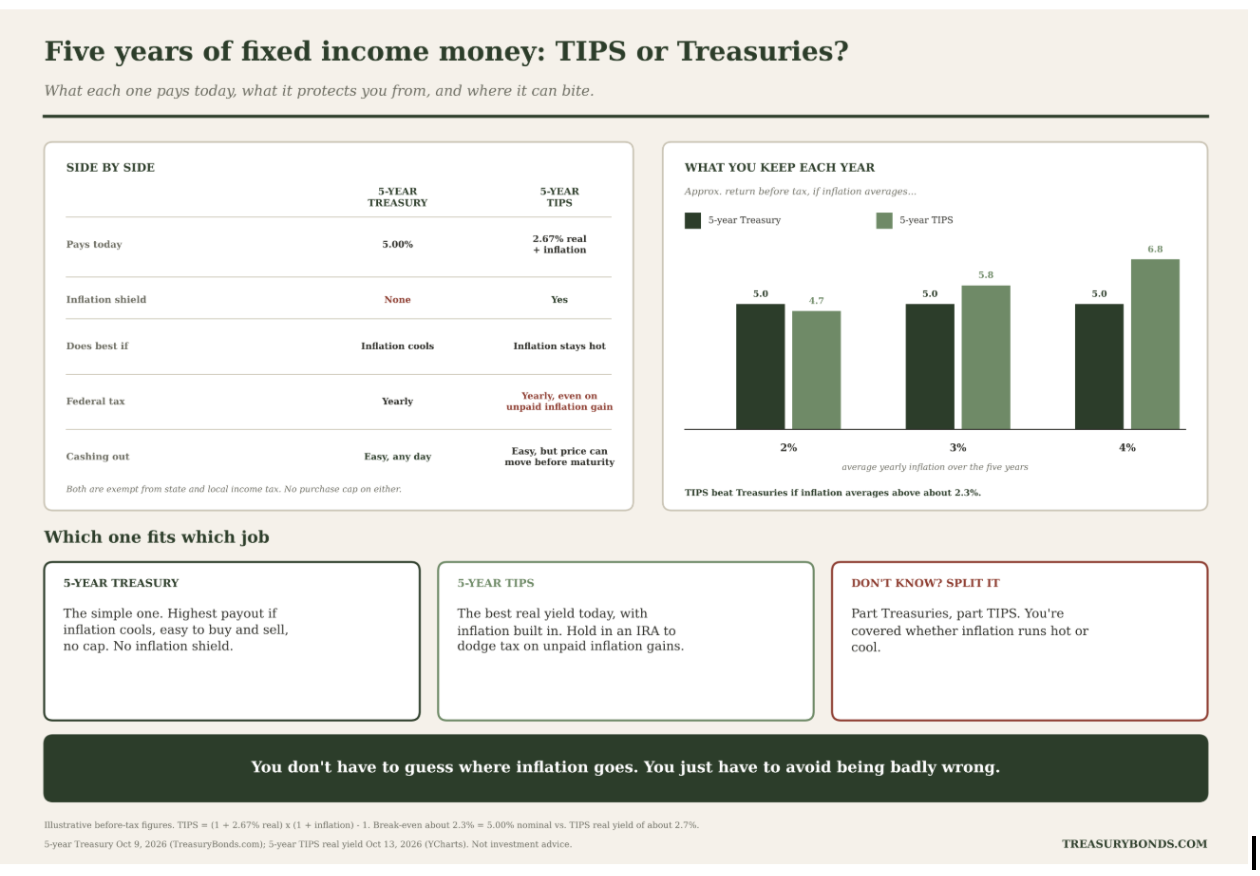
What this could mean for fixed income investors
- If you need simplicity and think inflation will cool, the five-year Treasury is hard to beat at 5.00%.
- If you're worried inflation stays high, TIPS are the stronger inflation shield, and the real yield is attractive. Put them in an IRA if you can.
- If you really don't know, split it. Part nominal Treasuries and part TIPS covers you whether inflation runs hot or cool. You don't need to guess right, you only need to avoid being badly wrong.
- Match the maturity to the need. If the money has a job in five years, such as a down payment or tuition, a five-year bond or a ladder ending in that year keeps you from selling early.
- Watch the tax account. The same TIPS can be a nuisance in a taxable account and a good fit in a tax-deferred one.
Bottom line
For a five-year window, my short answer is that TIPS look like the better value today for the inflation-protection job, and plain Treasuries look best if you think inflation fades. If I had to choose without knowing where inflation goes, I'd split between the two and hold the TIPS in a tax-deferred account.