If you truly want to heal a disease, you must not simply treat the symptoms-
You must identify and address the root cause of the health problem.
Japan is doing the opposite with the yen.
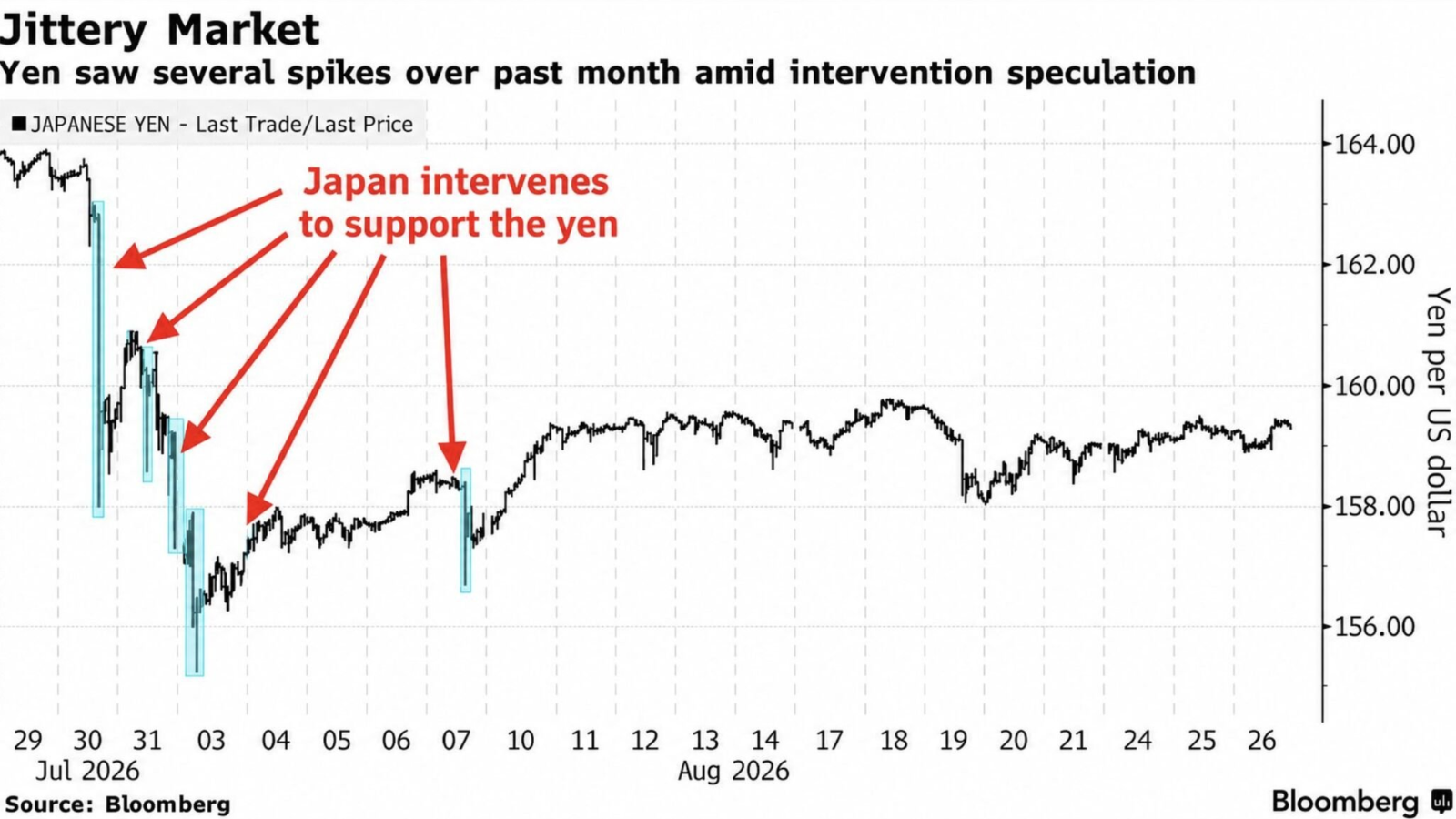
Spending ¥27 trillion (roughly $169 billion in USD) to purchase yen treats the symptom: a falling currency.
It certainly does not fix the underlying condition:
Japanese rates remain well below U.S. rates, making the yen an attractive currency to borrow and use to fund higher-yielding investments elsewhere.
Intervention can temporarily force traders out of those positions, but unless the BOJ raises rates or the Fed lowers them, capital eventually begins flowing out again.
This is why Japan has spent a record amount while the yen remains near 160 per dollar.
This is becoming a U.S. issue as well.
As of May, Japanese investors held $1.143 trillion in U.S. Treasuries, which is the most of any foreign territory.
For reference, that is 20% more than the United Kingdom and 73% more than China.
Japan’s $169 billion of intervention this year is equivalent to nearly 15% of that entire Treasury position.
The $1.143 trillion includes both official and private Japanese investors, so Tokyo cannot simply use all of it to defend the yen.
But that distinction actually reveals 2 separate risks for the United States.
The first is official selling.
Japan can obtain dollars for intervention by selling assets held in its foreign-exchange reserves, including Treasuries.
The Fed’s FIMA facility reduces this immediate risk by allowing Japan to borrow dollars against its Treasuries instead of selling them.
America’s support for the yen is partly an effort to protect its own bond market.
The second (and potentially larger risk) comes from actually treating the root problem.
If the BOJ raises rates enough to make Japanese bonds attractive again, Japanese banks, insurers and pension funds may begin bringing capital home.
Japan’s private investors would not need to dump Treasuries all at once to affect the market, they could simply stop buying as much.
The U.S. is running enormous deficits and needs a constant supply of buyers for new debt.
TD Economics estimates declining Japanese demand could eventually add 20–50 basis points to the 10-year Treasury yield.
Higher Treasury yields would flow through to mortgage rates, corporate borrowing costs, federal interest expense and stock valuations.
That leaves the United States facing an interesting paradox:
Helping Japan intervene protects the Treasury market today, but successfully fixing Japan’s interest-rate imbalance could weaken one of America’s largest sources of Treasury demand tomorrow.
Intervention does not cure the underlying condition.