
You can own an “inflation-protected” bond ETF and still lose money while prices are rising.
Understanding why starts with how Treasury Inflation-Protected Securities, or TIPS, actually work. TIPS are U.S. government bonds whose principal adjusts with changes in the Consumer Price Index.
Their coupon rate stays fixed, but it applies to the adjusted principal.
As that principal increases, the dollar amount of interest increases too.
Here’s a simplified example:
- You own $10,000 of TIPS with a 2% coupon.
- A 3% inflation adjustment increases principal to $10,300.
- Annual interest on that adjusted amount becomes $206, compared with $200 previously.
That adjustment helps preserve purchasing power. However, high inflation doesn’t automatically mean TIPS will outperform regular Treasuries.
Markets already price in expectations for future inflation.
Suppose a regular Treasury yields 5%, while a comparable TIPS bond yields 2% above inflation.
The roughly 3% difference is the breakeven inflation rate. Inflation averaging above that level generally favors TIPS held to maturity, before taxes and other market effects.
The key is how actual inflation compares with what investors already expected.
Then there’s duration risk.
TIPS prices generally fall when real yields rise, and longer-duration TIPS are more sensitive to those changes.
That price decline can overwhelm the inflation adjustment, leaving a TIPS ETF with a negative return even while inflation remains elevated.
Short-term TIPS ETFs reduce that sensitivity.
Two examples are:
• $VTIP: Vanguard Short-Term Inflation-Protected Securities ETF, which holds an A rating on TreasuryBonds.com.
• $STIP: iShares 0–5 Year TIPS Bond ETF, which holds an A+ rating on TreasuryBonds.com.
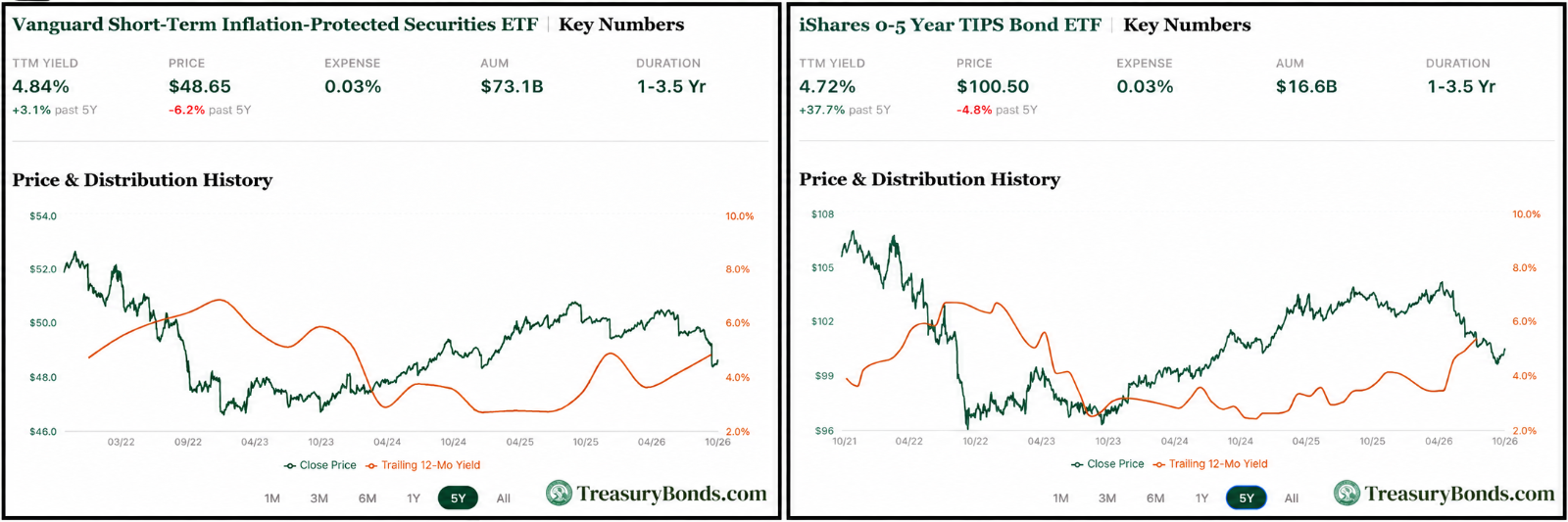
Both focus on shorter maturities.
They still fluctuate in value, but carry less interest-rate sensitivity than longer-duration alternatives.
They still fluctuate in value, but carry less interest-rate sensitivity than longer-duration alternatives.
It’s also important to understand the difference between owning an individual TIPS bond and owning a typical TIPS ETF.
An individual bond has a defined maturity date.
At maturity, Treasury pays the greater of its inflation-adjusted principal or its original face value. During deflation, the adjusted principal can decline.
That maturity floor also doesn’t necessarily protect the full purchase price if you bought the bond above face value. A typical TIPS ETF continually replaces its holdings. Its share price has no equivalent guaranteed maturity value.
For investors seeking to protect purchasing power, TIPS can serve a useful purpose... But choosing the right structure requires looking beyond the words “inflation-protected.”
Consider the inflation expectations already priced in, the fund’s duration, and when you’ll need the money.