A new Goldman Sachs Asset Management survey found that 36% of people earning more than $300,000 a year say they live paycheck to paycheck.
Fixed income can’t make anyone earn more, but it can give a big paycheck some structure, and structure is what’s missing.
What the survey found
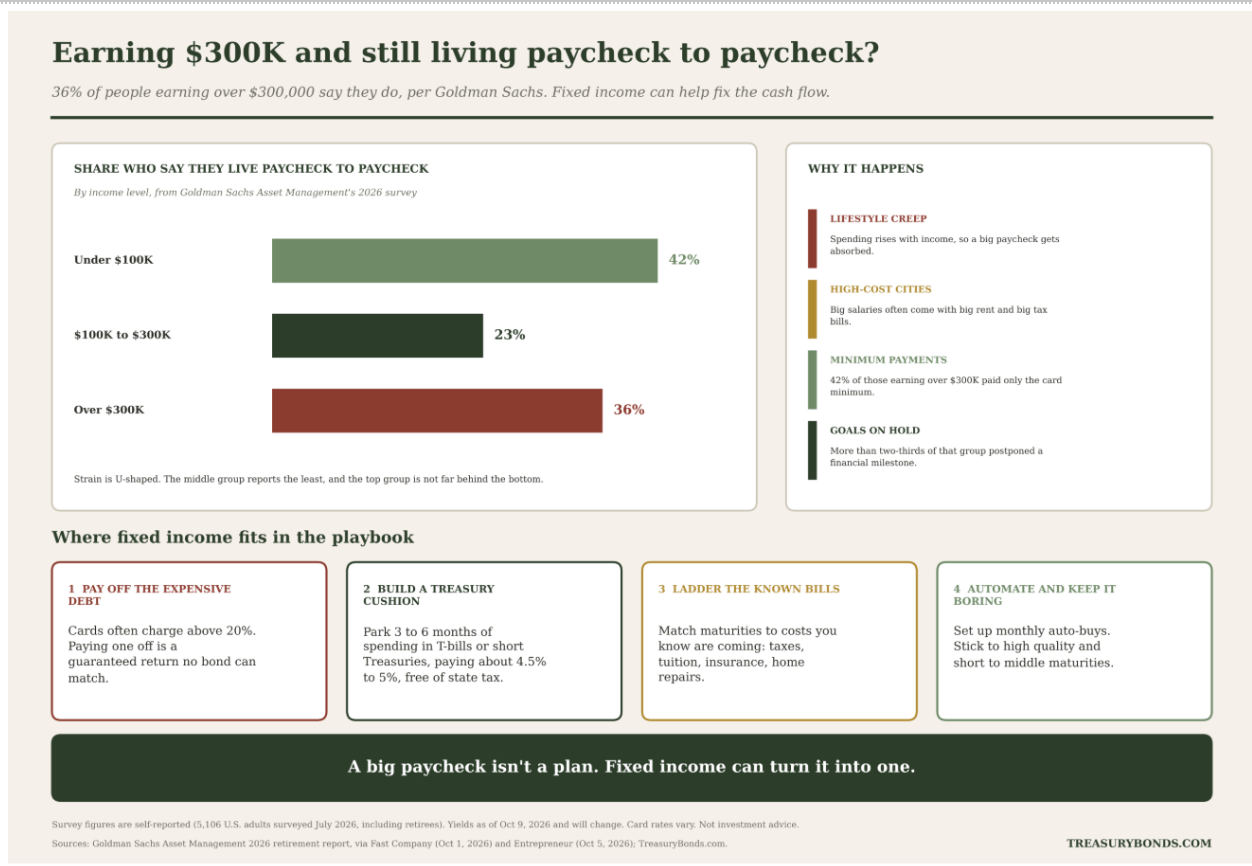
Goldman surveyed 5,106 U.S. adults in July 2026, including retirees and people still working. Among people earning over $300,000, 36% said they live paycheck to paycheck. Among those earning $100,000 to $300,000, it was 23%. Among those earning under $100,000, it was 42%.
The credit card numbers stand out. About 42% of those earning over $300,000 said they make only minimum payments, and more than two-thirds of that group postponed a financial goal. The likely reasons are lifestyle creep, where spending rises right along with income, and expensive cities with high rent and high taxes.
Why bonds belong in this conversation
If you’re earning $300,000 and feel broke, a bond isn’t going to fix your monthly budget. But a few simple fixed income tools can help put a floor under your finances. Here’s the order I’d think about.
1. Pay off the expensive debt first
If you’re carrying a credit card balance, nothing in the bond market beats paying it off. Cards often charge more than 20%. On a $20,000 balance at an assumed 22%, you’re paying about $4,400 a year in interest. That same $20,000 in a short-term Treasury earning about 4.5% brings in around $900. Paying off the card puts roughly $3,500 a year back in your pocket, guaranteed.
2. Build a cushion in Treasuries
Most people stuck in the paycheck cycle have no real buffer. A common target is three to six months of spending. Someone spending $15,000 a month would need $45,000 to $90,000. T-bills and short Treasuries are a good home for that money. The 1-year Treasury was around 4.5% on October 9, and interest on Treasuries is exempt from state and local income tax, which matters a lot for high earners in high-tax states. A $90,000 cushion at 4.5% earns about $4,050 a year.
3. Ladder your known expenses
Some bills aren’t surprises: property taxes, tuition, insurance premiums, estimated tax payments. Instead of letting that money sit in checking where it leaks away, buy T-bills or Treasuries that mature right before each bill comes due. Money that’s already committed to a bill is much harder to spend.
4. Automate it and keep it boring
The hardest part isn’t picking the bond, it’s actually setting money aside. Set up a monthly automatic purchase on payday. Stick to high credit quality and short to middle maturities. This isn’t the place to reach for yield. The point is stability.
5. For high earners, look at tax-aware options once the basics are in place
If you’re in a high federal bracket, municipal bonds may be worth a look. The formula is the muni yield divided by one minus your tax rate. As an example, a 3.5% muni at a 35% federal rate works out to about 5.4% taxable-equivalent.
What this could mean for fixed income investors
A bigger paycheck isn’t a plan. Structure matters more than income. Fixed income gives your cash a job.
The order matters. Debt, then cushion, then ladder, then longer-term income.
Safe and short comes first. With the 1-year near 4.5% and the 5-year near 5.0% on October 9, you can earn a decent yield without stretching.
Taxes are part of the yield. For high earners, what you keep after tax is what counts.
Don’t confuse a yield with a fix. If spending is the problem, bonds can help contain it, but they can’t solve it on their own.
Bottom line
Earning more doesn’t automatically mean you’re building wealth. If you’re making a lot and still feeling squeezed, the fix usually starts with cash flow. Pay off the expensive debt, build a Treasury cushion, ladder the bills you know are coming, and automate the whole thing. It isn’t exciting, but it works.