
The market is currently charging more to insure French government debt against default than it charges for Nvidia or Alphabet. France’s five-year credit default swap (CDS) was reported at about 81 basis points on October 2, and a chart making the rounds on X shows it at 81.2 against 40.9 for Alphabet and 26.6 for Nvidia. Oracle is still higher, at 171.2
What a CDS is
A credit default swap is insurance against a borrower failing to pay. The price is quoted in basis points per year. At 81 basis points, it costs about $81,000 a year to insure $10 million of French debt. At 26.6, it costs about $26,600 a year to insure $10 million of Nvidia’s.
Why France, and why now
The French story is a mix of numbers and politics:
Debt and deficit. Public debt is about 119% of GDP, and the 2026 deficit is expected near 5.4% of GDP, well above the EU’s 3% reference. Debt is projected to keep rising next year.
Politics. The government doesn’t have a secure majority in parliament, and the 2027 presidential election gives parties little incentive to back unpopular budget cuts. Analysts have pointed to the polls and to some candidates’ proposals as risks.
Ratings. Scope cut France to A+ last month, matching Fitch and S&P. DBRS rates it AA with a negative outlook. That’s still investment grade.
Yields. The French 10-year yield briefly touched about 4.99% on October 1, the highest since 2002. It was 4.81% on October 14. The gap over German Bunds was about 135.5 basis points on October 14, down from about 147 on October 2, but still far above the normal range of roughly 20 to 50.
Why comparing France to a tech company can mislead
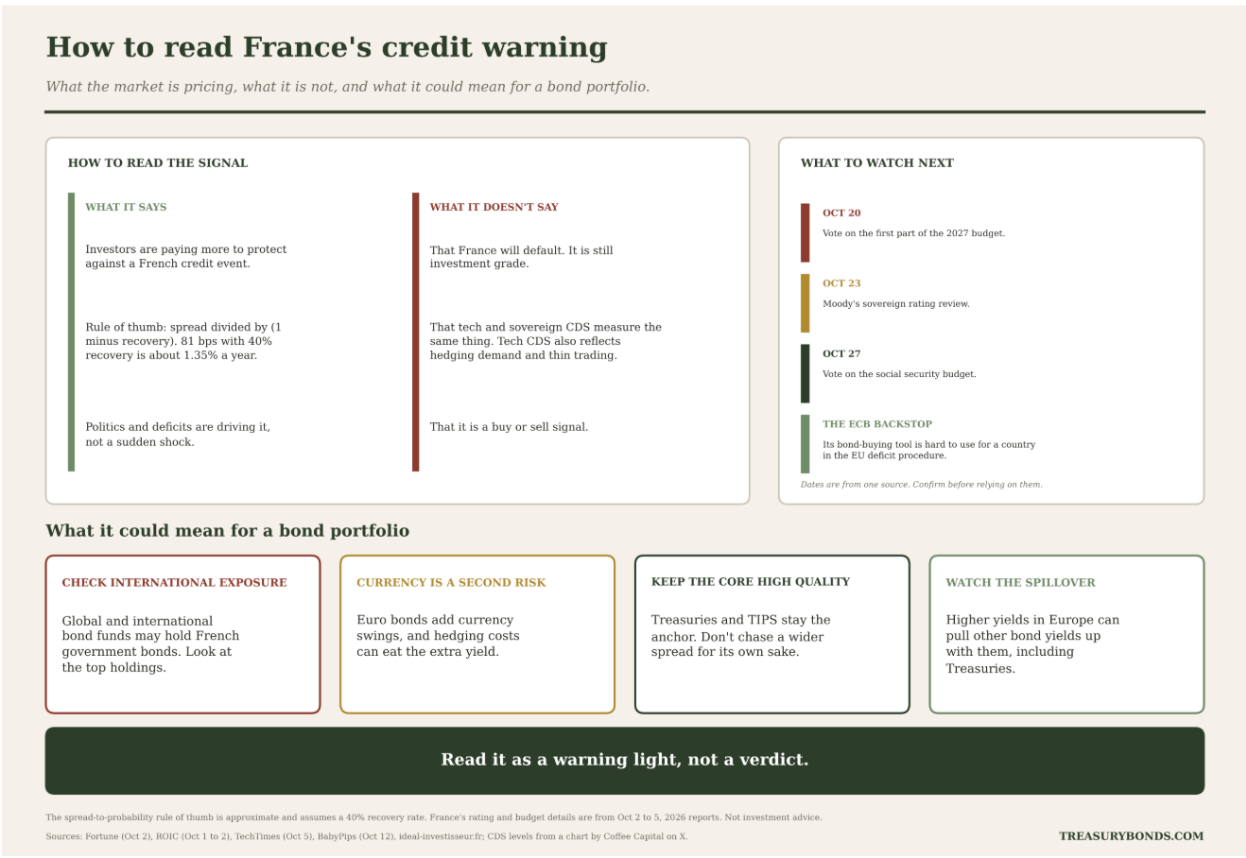
The headline is catchy, but tech CDS often reflects hedging demand, not just default fears. Investors buy Oracle protection, for instance, as a way to hedge AI-related exposure. Nvidia has very little debt, so its CDS can be thin and move on small trades. France, on the other hand, is a sovereign that issues its own debt, is backed by a central bank in a currency union, and has a huge bond market.
What this could mean for fixed income investors
Check your international exposure. Global and international bond funds may hold French government bonds. Look at the top holdings.
Currency is a second risk. Euro bonds add currency swings, and hedging costs can eat the extra yield.
Keep the core high quality. Treasuries and TIPS can stay the anchor. A wider spread isn’t a reason to buy by itself.
Watch the spillover. Higher yields in Europe can pull other bond yields up with them, including Treasuries. Italy, Belgium and Greece also saw spreads widen as French yields rose.
Know the calendar. A budget vote, a Moody’s review and the ECB’s limited ability to step in can all move this quickly.
Bottom line
France isn’t about to default. But the market is clearly charging more for French risk than it did a month ago, and it’s now above where Nvidia and Alphabet trade. For U.S. bond investors, it’s a reminder that fiscal and political risk can reprice quickly, even in big developed markets. Check what you own overseas, keep your core in high-quality bonds, and treat this as a warning light, not a verdict.