
Ask a room of investors what they’d do with $100,000 and someone will say real estate. It sounds solid. You can drive by it, you can touch it, and someone else’s rent pays the mortgage.
I’ve watched plenty of people learn what “someone else’s rent” really means.
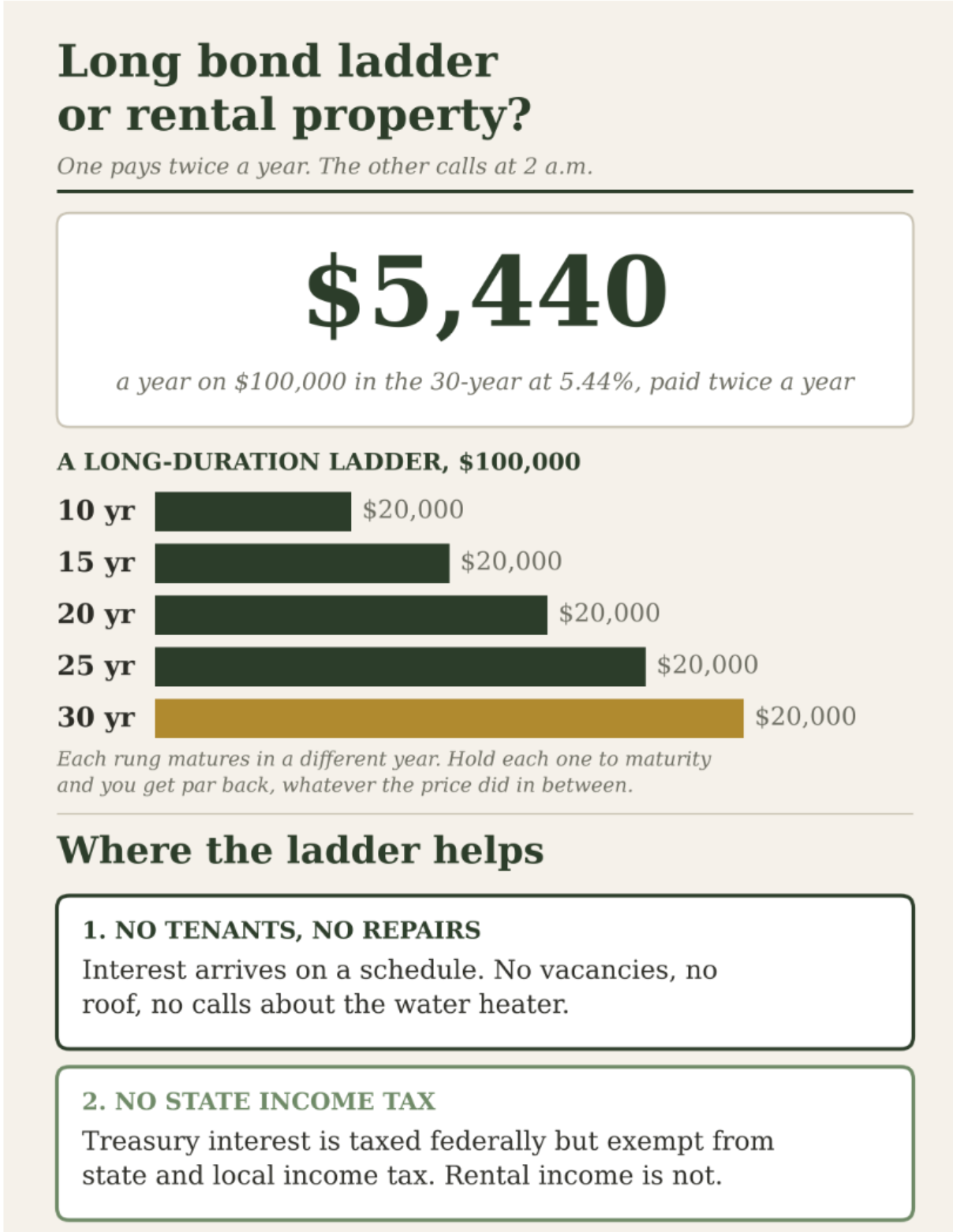
Here is the other side of that trade. The 30-year Treasury closed Friday at about 5.44%, and the 10-year at 5.10%. On $100,000 in the 30-year, that’s roughly $5,440 a year, paid twice a year by the U.S. government. There are no tenants, no vacancies, no roof, and no 2 a.m. call about the water heater.
What a long ladder actually is
A ladder just means you don’t put everything into one bond. You split the money across several long maturities, say 10, 15, 20, 25 and 30 years. Each rung matures in a different year, pays interest on a schedule, and gives you par back at the end.
That does two things. You aren’t betting everything on one year’s interest rate, and you always have a rung coming due to reinvest at whatever rates are then.
Where the ladder beats the building
Simplicity. Interest arrives on a schedule. There is no maintenance, no vacancy, and no property manager.
State taxes. Treasury interest is taxed federally but exempt from state and local income tax. Rental income gets no such break.
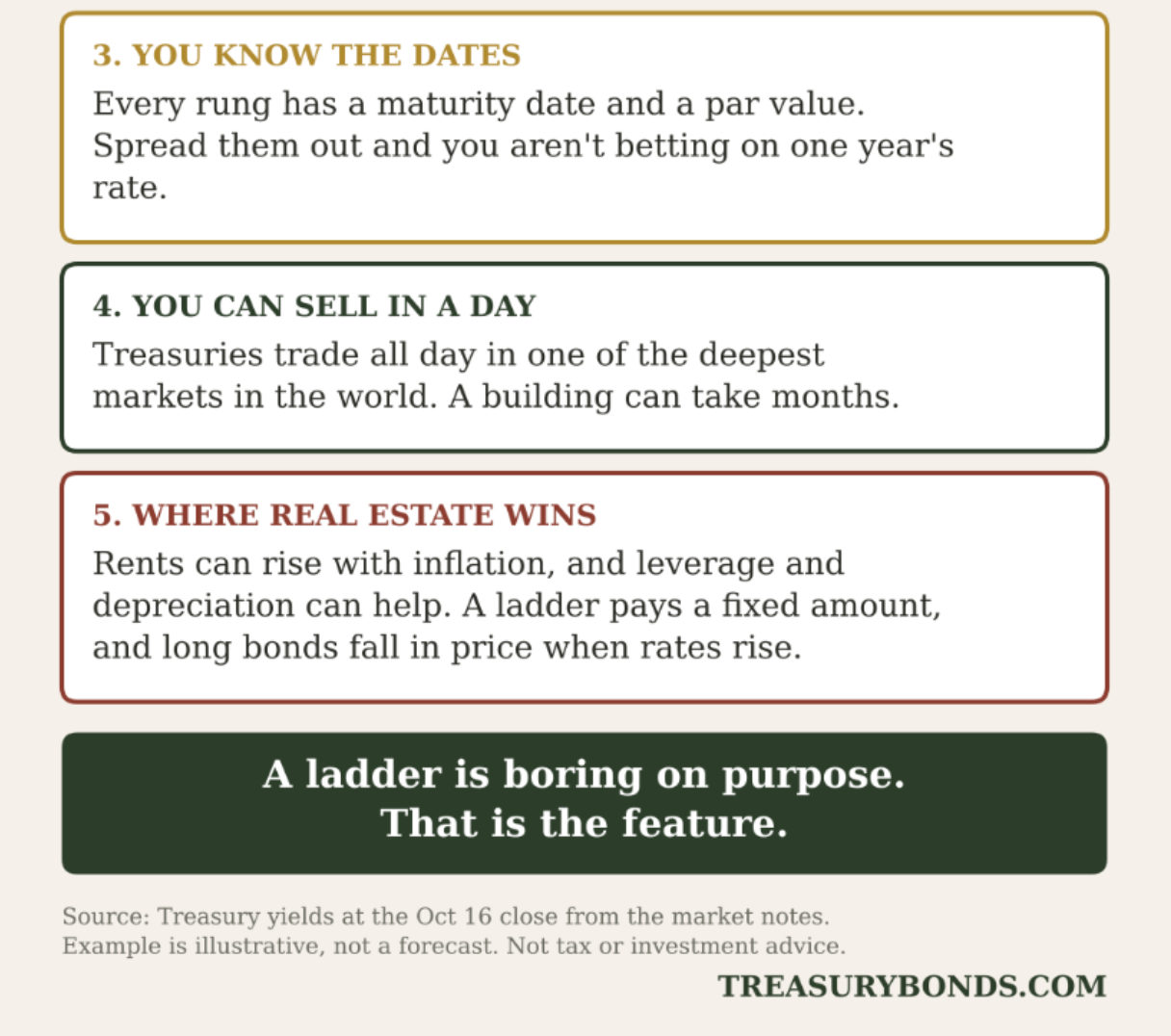
Known dates. Every rung has a maturity date and a par value.
Liquidity. Treasuries trade all day in one of the deepest markets in the world. Selling a building can take months.
Where real estate wins
I’m not going to pretend otherwise. Rents can rise with inflation, and a fixed bond payment doesn’t. Leverage and depreciation can help the math. And long bonds fall in price when rates rise, which is a real risk if you have to sell before maturity. A ladder you hold to maturity avoids that problem, but it doesn’t make it disappear.
What this could mean for fixed income investors
- Long Treasuries now pay a yield that makes the “boring” choice worth a second look.
- Spreading maturities across a ladder can reduce the risk of picking the wrong year.
- If you hold each rung to maturity, price swings in between matter less than the payment you were promised.
- If you already own property, you don’t have to choose. A ladder can be the part of your portfolio that doesn’t need a phone.
- Compare the after-tax, after-expense income from a property to the Treasury yield, not just the rent check.
Bottom line
A rental property is a business. A Treasury ladder is an income stream. If you want a job, buy the building. If you want a paycheck that shows up on schedule, build the ladder.