
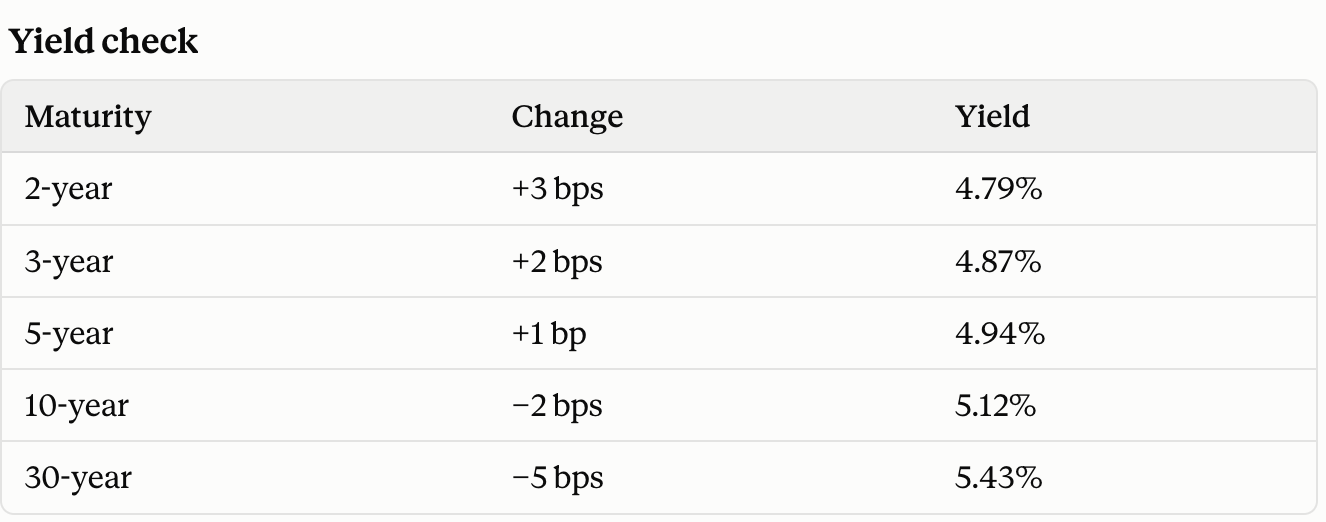
Tuesday’s bond market was a split decision. The long end held up and the short end gave ground. Yields on 10-year and 30-year Treasuries fell, while shorter maturities finished higher in yield. Oil drove most of it.
What happened
Oil jumped, then reversed. Overnight, WTI crude rose past its September high of $106.75, a level not seen since late April. That pressured shorter-dated Treasuries from the start of the day. But oil quickly backed off its high, and Treasuries set fresh session highs in the late morning.
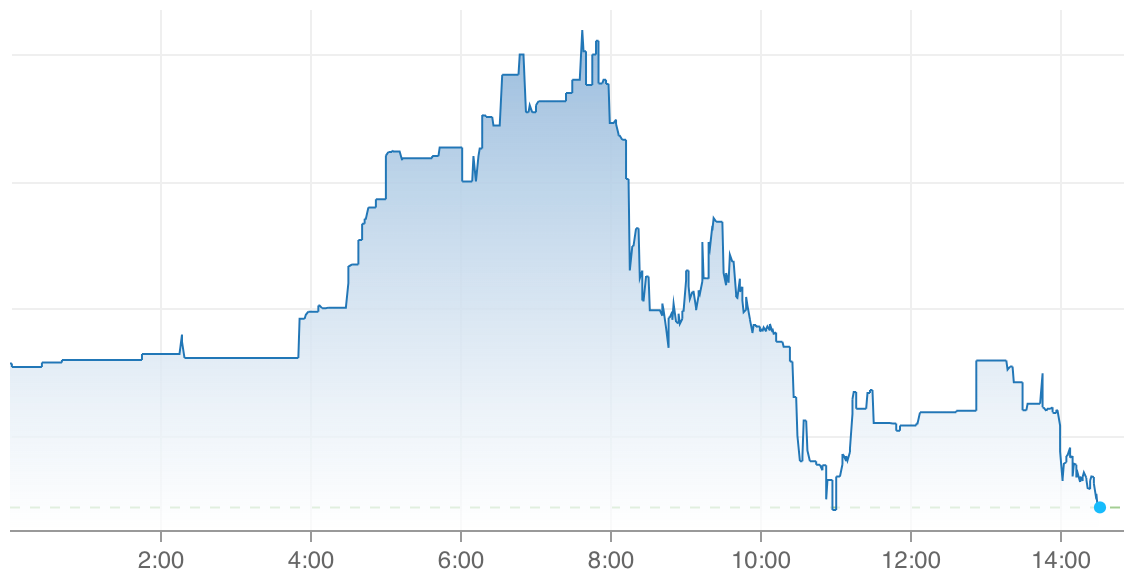
Then came a headline. Israel’s N1 News reported that mediators’ proposal in the U.S.-Iran conflict had been approved by the U.S. That report wasn’t confirmed by other news sources or U.S. officials, and was followed by another report saying an agreement isn’t close. Oil bounced briefly, Treasuries pulled back from their highs, and shorter maturities slipped into the red.
The afternoon was quiet. The trading range narrowed, so the long end kept its gains while the front end couldn’t avoid a lower finish. Crude ended at the bottom of a $9-a-barrel range, and the U.S. Dollar Index fell 0.3% to 101.70.
Housing is still weak
Two housing reports came in below expectations:
Housing starts fell 5.2% in September to a seasonally adjusted annual rate of 1.221 million, against 1.305 million expected. August was revised up to 1.288 million.
Building permits slipped 0.2% to 1.400 million, a bit above the 1.390 million expected. But the key takeaway is that single-unit permits didn’t grow in any region. Permits are a leading indicator, and the lack of growth reflects the strain higher financing costs put on builders and buyers.
Pending home sales fell 7.3% in September, against an expected gain of 0.1%, after rising 0.3% in August.
Other news
U.S. and Russia/Ukraine: Politico reports the U.S. will propose a trilateral summit with the leaders of Russia and Ukraine.
U.K.: Chancellor Healey ruled out a capital gains tax increase in the autumn budget. The jobs data was stronger than expected: unemployment fell to 4.7% (4.9% expected) and employment rose 102K (20K expected).
Europe: Germany’s Merz and France’s Macron called for an EU budget agreement before year-end. Germany’s September PPI rose 6.7% from a year earlier (6.3% expected), while October ZEW sentiment fell to 28.1 (30.2 expected).
China: The PBoC left its one-year Loan Prime Rate at 3.00% and the five-year at 3.50%, as expected.
What this could mean for fixed income investors
Oil is still the swing factor. Short-term yields reacted most to oil, so headlines from the Iran talks can move your front-end ladder rungs quickly.
The long end is holding. Even with oil topping $106, the 10-year and 30-year ended lower in yield, and the 30-year is still at 5.43%.
Housing weakness is a growth signal. Starts, permits and pending sales all point to a slowing market, which can support longer-term bonds if it continues.
Watch tomorrow’s auctions. There’s no top-tier data, but the Treasury sells 20-year bonds, on top of a 17-week bill sale. Auction demand is a good read on appetite for long maturities.
Don’t trade the headlines. One unconfirmed report moved oil and Treasuries within minutes, then another contradicted it. A ladder that doesn’t depend on headlines is the point.
Bottom line
Oil pushed short-term yields higher and the long end held on. Housing keeps showing the strain of high rates, and a single unconfirmed Iran report was enough to swing the market. Volatility remains the name of the game.