
Two bonds can both say “5%” and put very different amounts in your pocket.
A 5% yield that’s fully taxable and a 5% yield that’s tax-free are not the same investment.
The headline yield is what a bond pays before tax. Your after-tax return is what’s left once the government takes its share. For anyone in a higher bracket, that share can be large.
The formula is simple. To see what a tax-free yield is worth in taxable terms, divide it by one minus your tax rate.
A 5% tax-free yield equals 6.58% taxable at the 24% bracket.
At 32%, it equals 7.35%.
At 37%, it equals 7.94%.
The higher your tax bracket, the wider the gap.
The flip side
The same math works in reverse for taxable bonds. The 30-year Treasury closed Friday at about 5.44%. After federal tax, that’s roughly:
4.13% in the 24% bracket
3.70% in the 32% bracket
3.43% in the 37% bracket
Treasury interest is exempt from state and local income tax, which can add to what you keep, depending on where you live.
Why this trips people up
Headline yields are easy to compare. After-tax yields take a step more. So most people stop at the headline.
Brackets differ. A bond that’s attractive for someone at 37% may not be for someone at 12%.
Other taxes matter. State tax, the net investment income tax (NIIT) and the alternative minimum tax (AMT) can move the result in either direction.
Inflation sits on top of it all. After tax and inflation, what you really earn can look quite different.
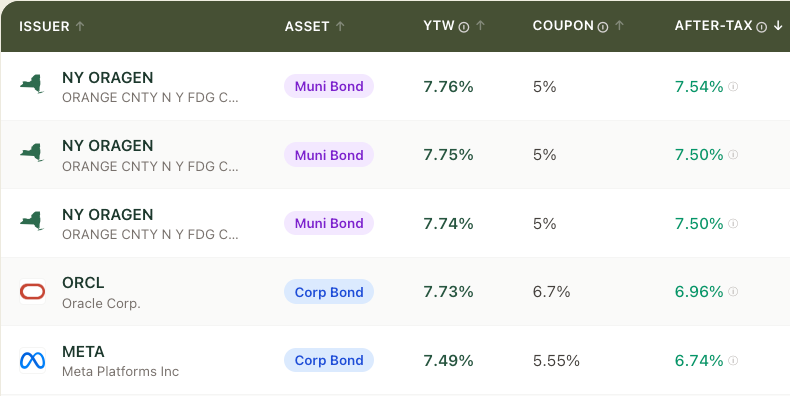
The playbook for fixed income investors
Compare on the same terms. Put taxable and tax-free yields on an after-tax basis before deciding which pays more.
Know your real bracket. The right comparison uses your marginal federal rate, and your state’s too.
Think about account type. Taxable interest often fits in an IRA, where it isn’t taxed until withdrawal. Tax-free bonds generally belong in a taxable account, since the tax break is wasted inside an IRA.
Use the state exemption. If you live in a state with income tax, Treasuries have an edge over bank CDs and corporate bonds of the same yield.
Check for side effects. Tax-exempt interest can still count toward some calculations, such as how much of your Social Security is taxed and Medicare premium surcharges.
Include it in every comparison, whether it’s Treasuries, CDs, annuities or muni bonds.
Be sure to check out our new asset allocation guide!