
Most people build a Treasury ladder by asking one question: where’s the highest yield?
Retirees should start with a different one: when do I need the money?
That’s especially true for anyone covering the years before Social Security starts.
If you stop working at 62 and plan to claim at 70, you need a way to pay the bills for eight years.
A ladder built around those years can do it, and it doesn’t care much where yields happen to be that week.
Look at your spending year by year.
Then buy a Treasury that matures right when each year’s money is due.
A bond coming due in 12 months covers next year’s bills.
One coming due in 24 months covers the year after.
That’s it. Instead of picking maturities to chase a higher rate, you pick them to match your life.
Why the gap years matter
Claiming Social Security early costs you for life.
For someone with a full retirement age of 67, claiming at 62 cuts the benefit by 30%, according to the Social Security Administration.
Waiting past 67 raises it by up to about 8% a year until 70.
By my math that makes a benefit at 70 roughly 70% to 80% larger than at 62, though the exact figure depends on your birth year and record.
A ladder is a way to pay for the wait.
The Treasuries carry you through the gap, and you collect a bigger check that adjusts for inflation for the rest of your life.
A simple example
Say you plan to stop working at 64, claim Social Security at 67, and need $60,000 a year from savings in between. Three rungs:
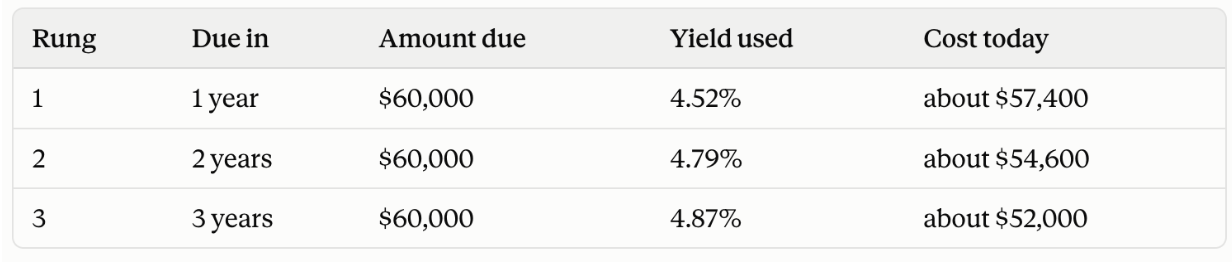
The whole bridge costs roughly $164,000 today and delivers $180,000, with about $16,000 coming from interest.
For a longer gap, like retiring at 62 and claiming at 70, the same approach with eight rungs would cost around $311,000 today for $48,000 a year, using estimated yields for the in-between years.
How to build yours
List your spending year by year for the gap. Include taxes, health insurance and big one-time costs.
Subtract any income coming in, such as a pension or part-time work.
Buy a maturity for each year, using T-bills or notes that come due when the money is needed. Buying at auction or on the secondary market both work.
Add a cushion for inflation. Your costs will probably rise, so build in a few percent a year, or fill later rungs with TIPS.
Reinvest nothing you need. When a rung matures, it goes to the bills, not back into the ladder.
Bottom line
Don’t ask what the best yield is. Ask what you’ll spend, and when. A ladder that matches your bills turns the years before Social Security from an unknown into a plan, and it lets you wait for a bigger check without watching the market.