
Most investors who own cash and short-term bills feel good about their income today.
The checks are bigger than they’ve been in years.
I can’t tell you rates are about to fall. In September the Fed raised its target to 3.75%-4.00%, and Chair Warsh said inflation “is too high and has been for too long.”
Most Fed officials expect at least one more hike this year, and markets have priced in a good chance of one in December.
September CPI came in at 3.7%.
So rates may keep rising for a while, and anyone who tells you otherwise is guessing.
The case for locking in income doesn’t need them to fall.
Reinvestment risk
If you hold T-bills or a savings account, your income resets every few months.
When rates fall, your income falls with them, and you can’t do anything about it.
It has happened before, and quickly:
Short-term Treasury yields were around 5% in 2007 and near zero by the end of 2008.
They were around 2% in 2019 and near zero again in March 2020.
The 10-year yield hit a record low around 0.5% in the summer of 2020.
A person living on bill income in those years watched it disappear.
Someone who had locked in a long Treasury kept getting the same check.

Today, the curve pays you to lock
Here’s what makes the case stronger now.
Monday’s yields were about 4.36% on a 6-month bill, 4.52% on a 1-year, 4.94% on a 5-year, 5.12% on a 10-year and 5.47% on a 30-year.
Longer maturities pay more than shorter ones.
Here’s what that means on $100,000, as an illustration and not a forecast:
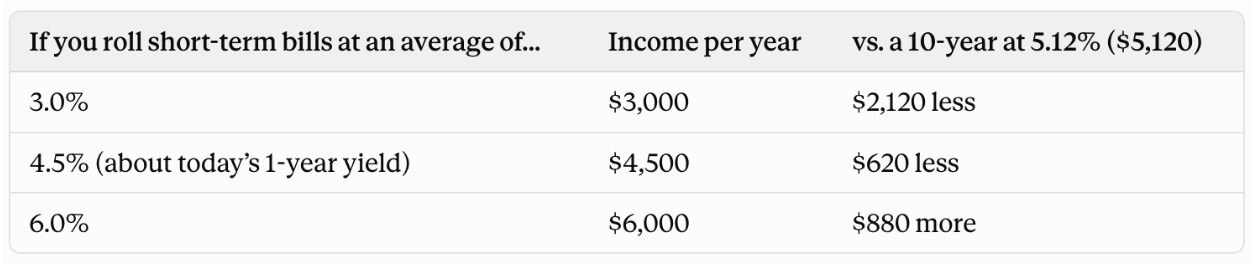
Locking in wins unless short rates average above roughly 5.1% over the next decade.
Short-term yields are 4.4% to 4.5% today, so they’d have to rise a good deal and stay up.
The risk of locking in
Locking in has a cost.
If rates keep rising, you’ll own a bond that pays less than new ones, and its price will be below what you paid if you have to sell.
If you hold it to maturity, you still get all your interest and your face value back.
But you’ll have given up the chance to earn more.
How to do it without betting on one date
Stage your purchases. Instead of buying everything at once, buy a third now, a third in a month or two, and a third after. That’s useful when the Fed is still hiking.
Build a ladder. Spread maturities across years, so you lock in some income at today’s yields and keep some money coming due that can be reinvested if rates rise.
Keep a short-term layer. Hold enough T-bills for what you’ll need in the next few years, so you never have to sell a long bond early.
Match to your needs. Lock in the amount of income you’d be uncomfortable losing, not your whole portfolio.
Bottom line
Yields are above 5% on long Treasuries, the curve pays you to extend, and short-term income can disappear fast. Lock in what you need, stage your purchases, and let the rest float.
This is not personal financial advice, We would recommend anyone considering this consult with their financial advisor first to make sure this plan fits into one’s financial goals, retirement plans.