
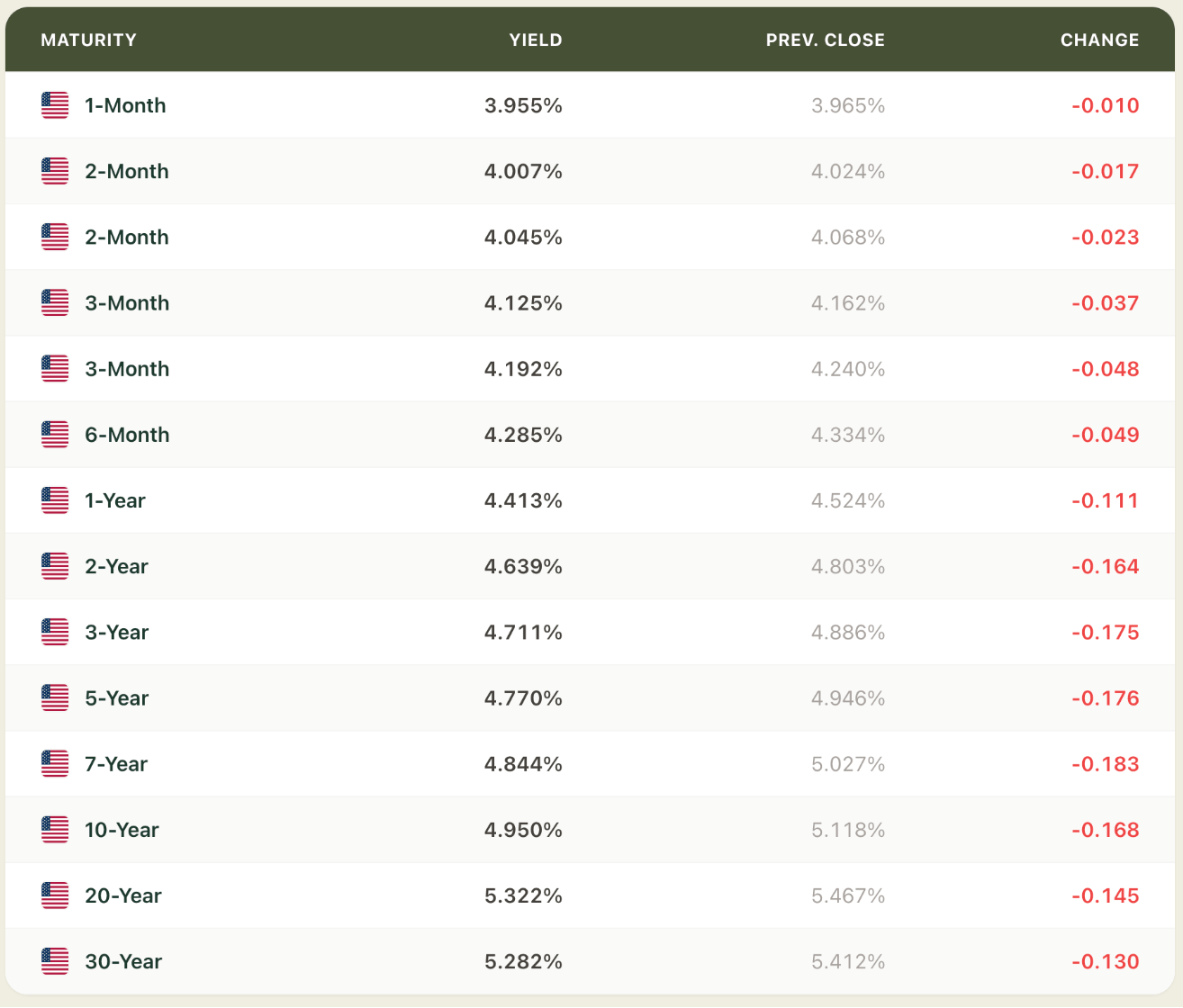
One day after bonds sold off into the close on Iran headlines, Treasuries did the opposite on Thursday. Yields fell sharply across the curve, reversing most of the surge from late September and early October.
About half of the gains came at the open, after French debt weakened overnight and money moved into safer German Bunds and U.S. Treasuries. Buying continued through the session.
Why Bonds Rallied
A flight to safety out of France. Continued weakness in French government debt sent buyers toward Bunds and Treasuries.
Geopolitical worries. President Trump said there are no current negotiations with Iran, which kept the conflict front and center.
Stress in AI infrastructure names. Persistent weakness in heavily indebted AI infrastructure companies added to worries about credit.
Short covering. Traders who had bet against bonds had to buy them back, which fed the daylong rally
Technical picture
The 10-year and 30-year both fell back below their 50-day moving averages (4.977% and 5.386%) and reached one-month lows. The 5-year stopped just above its own 50-day average of 4.753%, but still closed at its lowest level in six weeks.
Other Factors
Oil rose toward $100 a barrel, which would normally push yields up on inflation worries. This time, bonds ignored it. The rally masked oil’s climb, which means the market cared more about safety and positioning than inflation on this day.
The dollar index slipped 0.2% to 101.61.
Today's Economic Data
Jobless claims fell by 6,000 to 194,000 for the week ending October 17, below the 200,000 consensus. Continuing claims rose by 25,000 to 1.728 million. Layoffs remain low, which fits a solid demand environment.
The Conference Board’s Leading Economic Index was unchanged in September, versus a consensus decline of 0.1%.
Natural gas inventories rose by 77 bcf.

Global Picture
Bank of Korea held at 3.00%, as expected.
Bank Indonesia kept its main rate at 5.75% when markets expected a 25-bp hike, though it raised its deposit facility rate by 25 bps to 5.00%.
Swiss National Bank left its rate at 0% and kept open the option to intervene in currency markets.
New Zealand’s Q3 CPI was 3.7% year over year, slightly below expectations.
Hong Kong’s CPI was 1.9% year over year, and unemployment rose to 3.9%.
China’s FDI was down 4.3% in September.
Japan’s investors were net sellers of foreign bonds (-JPY161.6 billion), much less than the prior week.
U.K. factory orders (CBI) were weaker than expected at -32. European car registrations rose in September.
What this could mean for fixed income investors
The window for 5% on the 10-year may be narrowing. The 10-year closed at 4.95%. If you’ve been waiting for 5%, one day’s rally can take it away.
Short and intermediate Treasuries still pay around 4.6% to 4.8%, with the 2-year at 4.64% and the 5-year at 4.77%.
The rally could be fragile. It was driven partly by short covering and fear, and oil near $100 is still a risk.
Moving averages matter for traders. Yields back below their 50-day averages suggest momentum has shifted, at least for now.
Watch next week. The Fed meets October 27 to 28, so the move comes just before an important decision.
Buying in steps works in a market like this, when one day can reverse the previous one.
Bottom line
Bonds rallied hard on safe-haven buying, short covering and worries about AI infrastructure credit, even as oil pushed toward $100. The move pulled yields back to one-month lows, but nothing about the underlying inflation and geopolitical risks has gone away.