
Municipal bonds are a different type of investment, because the money you lend usually turns into something you can drive past: a school, a road, a water plant or a hospital wing.
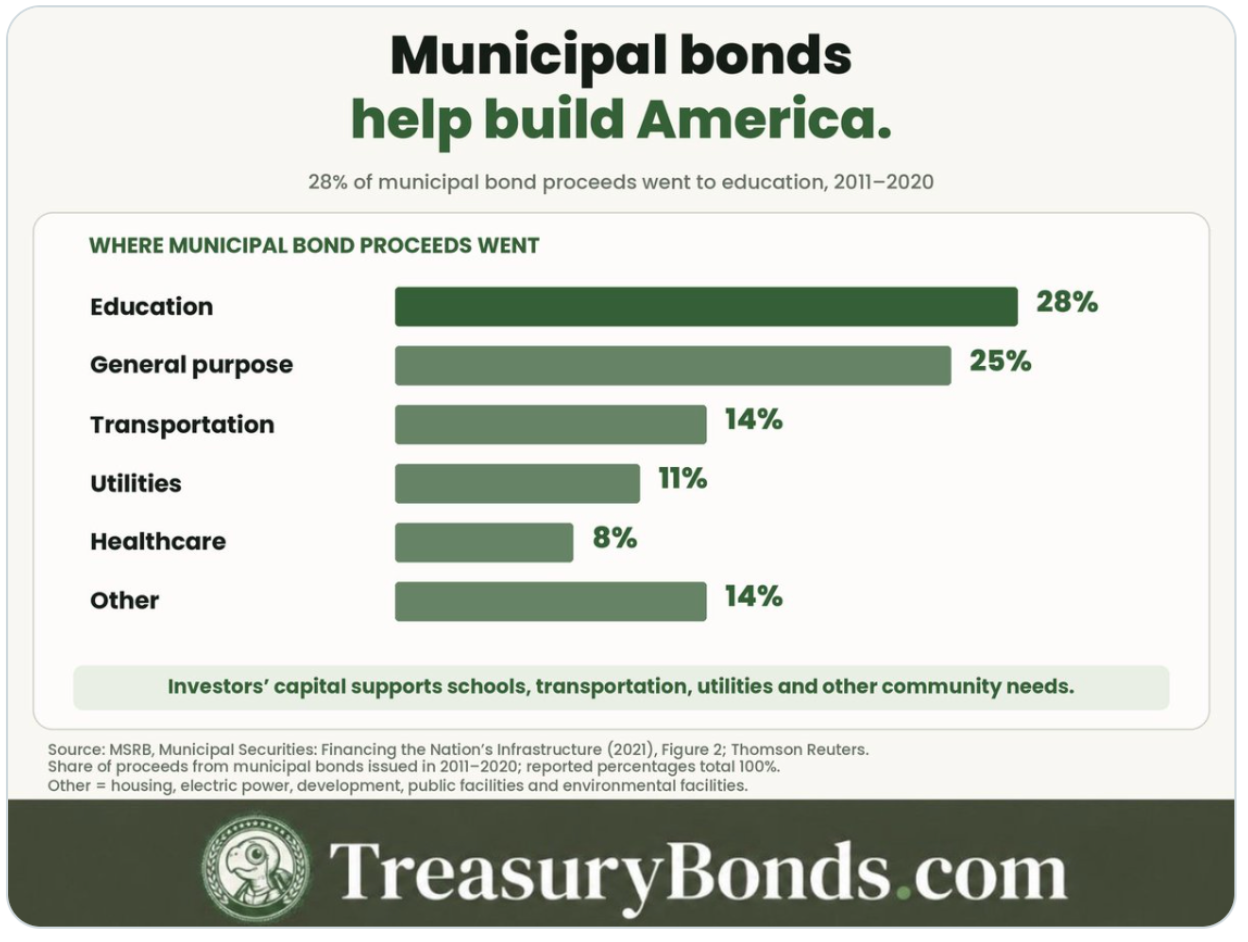 Where muni bond money went
Based on MSRB data, here is where municipal bond proceeds went from 2011 to 2020:
- Education: 28%. The largest single use.
- General purpose: 25%. Broad government financing that can cover many needs.
- Transportation: 14%. Roads, bridges, airports and transit.
- Utilities: 11%. Water and sewer systems.
- Healthcare: 8%. Hospitals and related facilities.
- Everything else: 14%. Housing, electric power, development, public facilities and environmental projects.
Why the purpose matters to investors
Knowing where the money goes is a good first step in understanding what a muni really owns.
That’s because the purpose often decides how the bond is repaid:
General obligation (GO) bonds are backed by the issuer’s taxing power. A school district or city promises to use tax revenue to pay you.
Revenue bonds are backed by income from a specific project, such as water bills, tolls or hospital revenue. If the project underperforms, repayment is at risk.
A water utility bond and a hospital bond can both be “munis,” but they can carry very different risks.

The tax angle
The main reason many investors buy munis is that interest is generally exempt from federal income tax, and often from state tax if you buy bonds from your own state.
That changes how you compare yields.
To compare a muni with a taxable bond, use the tax-equivalent yield: the muni yield divided by (1 minus your tax rate).
For illustration only, using a made-up 3.5% muni yield:
- At a 24% federal bracket, it equals about 4.6% taxable.
- At a 32% bracket, about 5.15%.
- At a 37% bracket, about 5.56%.
What fixed income investors need to know
Munis can make sense mainly for taxable accounts and higher tax brackets.
They add diversification away from Treasuries, with different risks, including credit risk.
Purpose and repayment source help you understand the risk, not just the yield.
For retirement accounts like IRAs, the tax exemption has no value, so taxable bonds usually make more sense there.
A mix is common: Treasuries for safety and liquidity, munis for tax-efficient income.
Bottom line
Municipal bonds fund things communities use every day. What matters is who is paying you back, how, and what the after-tax yield looks like compared with your alternatives.