
After Thursday’s big rally, Friday was a pullback. Yields rose about 4 basis points across most of the curve, helped along by oil climbing past $103 a barrel. But even with the losses, Treasuries finished the week ahead for the third week in a row.
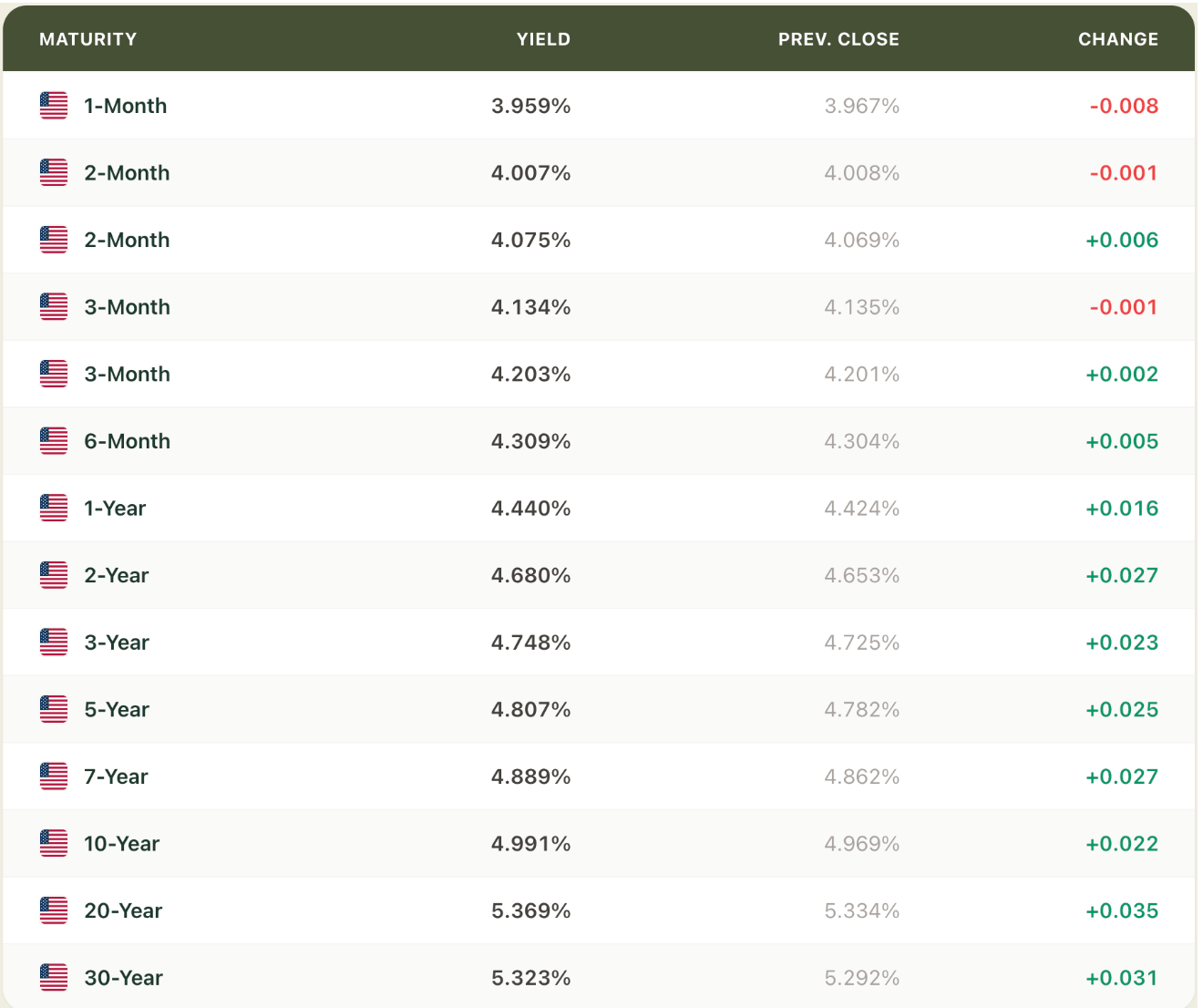
The 10-year yield ended just above its 50-day moving average (4.984%). That’s the level it fell below on Thursday, so Friday’s move took back a technical line.
How the day played out
Treasuries opened lower, tried to bounce in the first hour, then ran into resistance when the long bond briefly turned positive.
After that, prices slipped to fresh lows, with oil’s persistent climb adding pressure. The dollar index rose 0.2% to 101.81, ending little changed for the week.
What’s driving things
Oil past $103. A steady rise in oil keeps inflation worries alive.
AI trade worries. Global concerns about AI spending persisted. One example: SK Hynix canceled the planned U.S. IPO of its Solidigm unit.
France. French debt rebounded ahead of tonight’s Moody’s review of the country’s credit rating. S&P and Fitch have already cut their views of France in recent weeks, so a downgrade from Moody’s is likely.
The data
Consumer sentiment: The University of Michigan’s final October reading rose to 48.0 from the preliminary 46.3 (consensus was 46.3). That’s still well below 53.6 a year ago, and consumers remain worried that higher prices are eroding their purchasing power.
Flash PMIs: The S&P Global manufacturing PMI rose to 56.0 from 55.9, and services came in at 57.9, down from 58.8. Readings above 50 signal expansion, and these are strong.
That strength is worth noting, because it cuts against the story that the economy is rapidly slowing. This week’s bond rally may have been more about fear and positioning than a clear sign of weak growth.
Around the world
Philippines: The central bank raised its policy rate by 50 bps to 5.50%, more than expected, and lifted its 2027 inflation forecast to 6.0% from 5.4%.
Japan: September core CPI was 2.1%, in line with expectations. The Economy Minister said conditions for declaring the end of deflation haven’t been met. October manufacturing PMI was 53.3, below the 54.5 expected.
Europe: Eurozone composite PMI fell to 51.9 from 53.1. Germany held up better (52.8). France’s composite dropped to 48.4, which signals contraction.
U.K.: PMIs beat expectations (composite 53.1), but September retail sales fell 0.4% and GfK consumer confidence plunged to -24 versus -14 expected.
Australia: Composite PMI fell to 47.7 from 51.3, with services at 47.8, a contraction.
India: Composite PMI rose to 56.7.
Next week is Packed
FOMC statement on Wednesday. A rate hike is not widely expected.
Advance Q3 GDP on Thursday. The consensus is 3.0%, up from 2.2%.
Three Treasury note auctions.
Other risks: oil, the Iran conflict, France’s credit rating and the AI trade.
What this could mean for fixed income investors
A third straight weekly gain shows the trend in yields has been lower, but the 10-year is back at 4.99%, close to the 5% level that investors have been watching.
One day doesn’t change the story. Thursday’s big drop was partly reversed, which is a reminder that these moves can be fast in both directions.
Auctions will matter. Demand at three note auctions will show whether buyers are willing to step in near 5%.
Strong PMIs and a possible 3.0% GDP could be a reason for yields to rise if the data surprises on the upside.
Oil above $103 is a risk for inflation and for yields.
Buying in steps helps when the direction depends on a week full of data.
Treasuries near 4.7% to 5.3% across the curve still offer solid income.
Bottom line
Treasuries gave back part of Thursday’s gains, but a third weekly advance leaves yields lower than where the week began. Next week’s Fed statement, GDP and auctions will decide whether the rally has legs or whether oil and strong data push yields back up.