
Here’s one of the first surprises new bond investors run into.
You see a bond quoted at 98.5, you think you’re paying $985 for a $1,000 bond, and then the confirmation shows a different number.
It’s accrued interest, and once you understand it, bond quotes get a lot easier to read.
Clean vs. dirty
A $1,000 face-value bond pays a 6% coupon, semiannually.
That works out to $60 a year, or $30 every six months.
Quoted (clean) price: 98.5% of $1,000 = $985
Accrued interest: Suppose 90 days of the 180-day coupon period have passed. That’s $30 × 90 ÷ 180 = $15
Settlement (dirty) price: $985 + $15 = $1,000
So the quote says $985, but the amount you pay is $1,000.

Why you pay accrued interest
The seller has owned the bond for half of this coupon period, so they’ve earned half of the $30 coupon, which is $15.
But the coupon is paid in full to whoever holds the bond on the payment date. That’s you.
So you pay the seller the $15 up front, and on the next payment date you collect the full $30. Net, you earn only the portion of the coupon for the time you actually held the bond.
You get your $15 back.
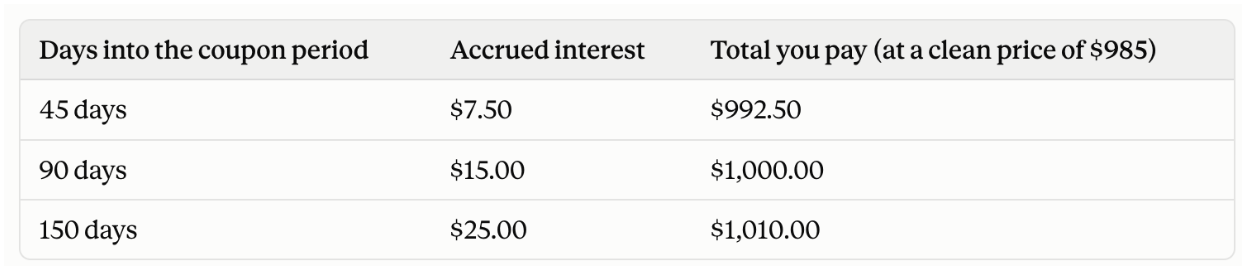
The same bond at different times
The accrued amount changes with the calendar:
Why quotes use the clean price
If bonds were quoted with accrued interest included, the price would jump around every day as interest builds up, then drop sharply when the coupon is paid.
Quoting the clean price keeps the number tied to what changes the bond’s value, such as interest rates and credit, so you can compare prices across days.
The accrued interest is then added at settlement.
What it means for fixed income investors
Look at the total, not just the quote. On a trade confirmation, check the principal and the accrued interest separately.
A “discount” may not be one. A bond quoted at 98.5 looks cheaper than par, but with accrued interest included you may pay exactly $1,000 or more.
Don’t assume the accrued interest is lost. You get it back in the next coupon.
Buying right before a coupon date means a large accrued interest payment and a large coupon in return. It’s neutral in value, but it affects your cash outlay.
Different bonds use different day-count conventions. Corporate and municipal bonds commonly use 30/360. Treasury notes and bonds count actual days. The numbers will differ slightly.
Taxes can be affected. The accrued interest you pay can generally be subtracted from the interest you report on that first coupon.
Costs are separate. Commissions, markups and bid-ask spreads come on top of the price.
Bottom line
The quoted price is the clean price. What you actually pay is the clean price plus accrued interest, called the dirty price. Accrued interest isn’t a fee, it’s your money coming back, and knowing the difference makes bond quotes far easier to read.