
Most people shop for bonds by looking at the coupon. A better first question is how much the price will move if rates change.
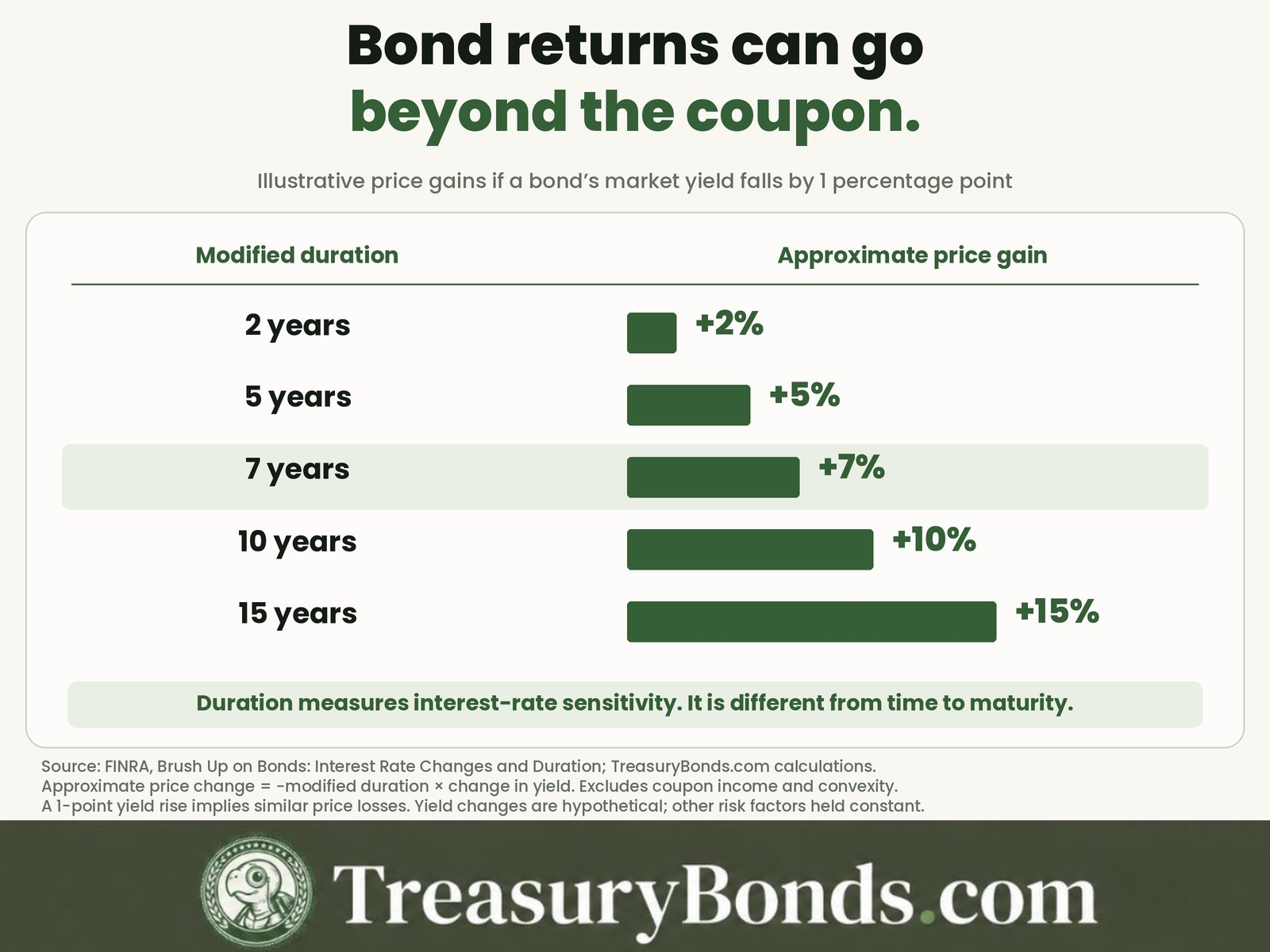
A bond with 15 years of modified duration gains roughly 15% if its yield falls by one percentage point. It loses roughly 15% if the yield rises by one point. That’s why duration deserves as much attention as the coupon.
In this illustration, a one-point yield drop lifts prices by about 2% at a duration of 2 years, 7% at 7 years, and 10% at 10 years.
What duration actually measures
Duration measures interest-rate sensitivity. The rule of thumb is simple: the approximate price change equals the modified duration times the change in yield, with the sign flipped.
Here’s how it looks for a one-point drop in yield:
- 2 years of duration: price up about 2%
- 5 years: about 5%
- 7 years: about 7%
- 10 years: about 10%
- 15 years: about 15%
It works the same way in reverse. A one-point rise in yields implies similar price losses.
Duration is not time to maturity
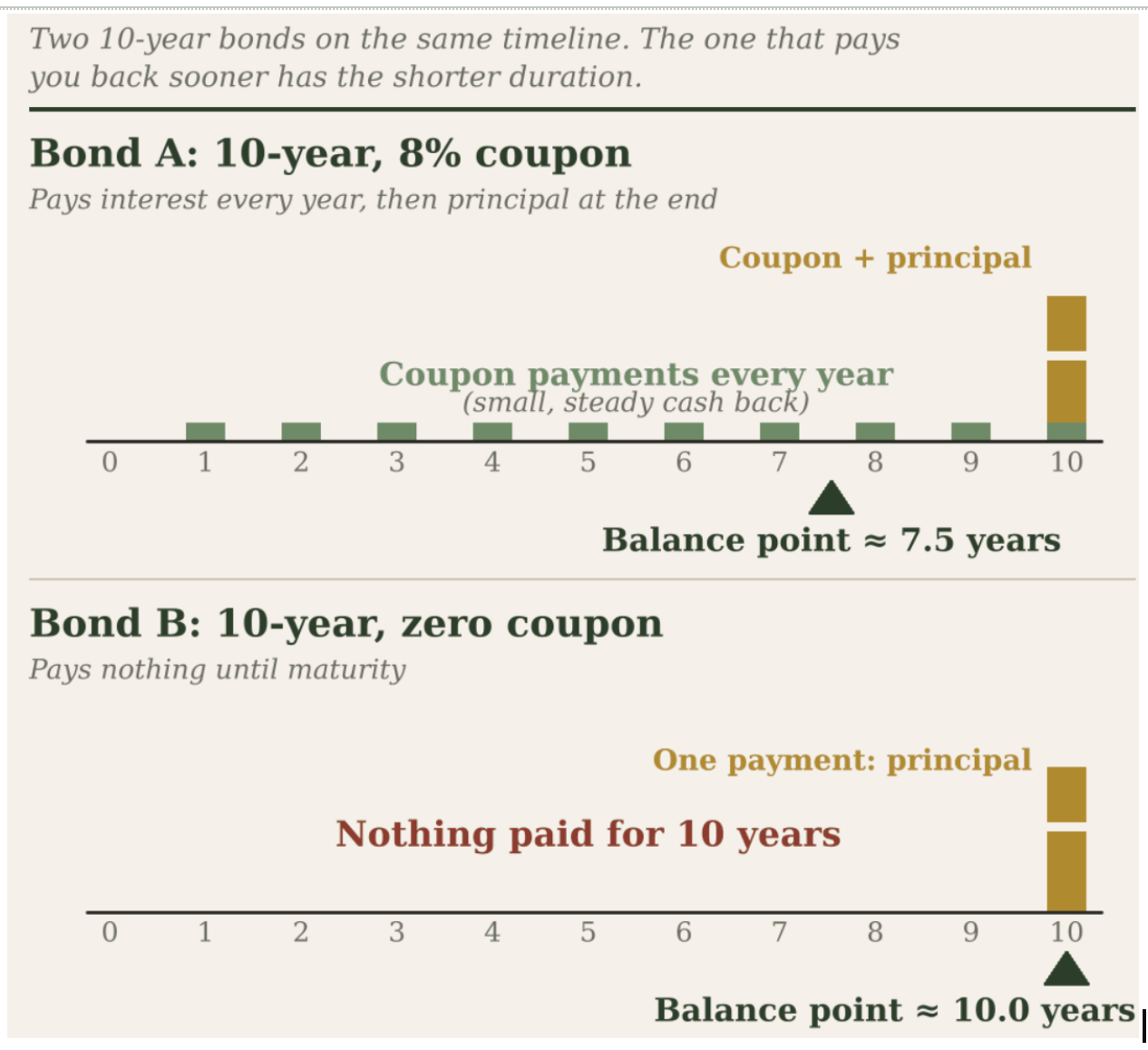
This is the part that trips people up. Maturity is the date a bond repays its principal. Duration is how sensitive its price is to rates. They’re related, but they’re different numbers.
A higher coupon returns more of your money sooner, so the duration comes in shorter than a similar bond with a lower coupon. A zero-coupon bond pays nothing until the end, so its duration is close to its maturity.
Coupons are only part of the return
Think of a $1,000 bond with 7 years of duration. If its yield falls one point, the price rises about 7%, or roughly $70. If its yield rises one point, the price falls about $70. The coupon is the same either way. Only the price changes.
Now put the coupon back in. Say you buy a bond yielding 5% with a duration of 7 years and hold it for a year:
Yields fall one point: about 5% from interest plus about 7% from the price gain, so roughly 12%.
Yields rise one point: about 5% from interest minus about 7% from the price loss, so roughly negative 2%.
Same bond, same coupon, a 14-point swing in the outcome. The difference comes almost entirely from duration.
What it looks like in today’s market
Yields on Monday were about 4.71% on the 2-year, 4.98% on the 10-year and 5.29% on the 30-year. Using the standard formula for a bond priced at par, my rough estimates of modified duration at those yields are:
2-year note: about 1.9 years
10-year note: about 7.8 years
30-year bond: about 14.9 years
That means a new 30-year Treasury today has about the same duration as the top row of the chart. A one-point rise in yields would cost a 2-year note roughly 2%, and a new 30-year bond nearly 15%. Both are Treasuries with essentially no credit risk. The difference is purely interest-rate risk.
Know your duration before you buy.