
Illinois residents should look at what they keep after taxes, and that’s where this bond gets interesting.
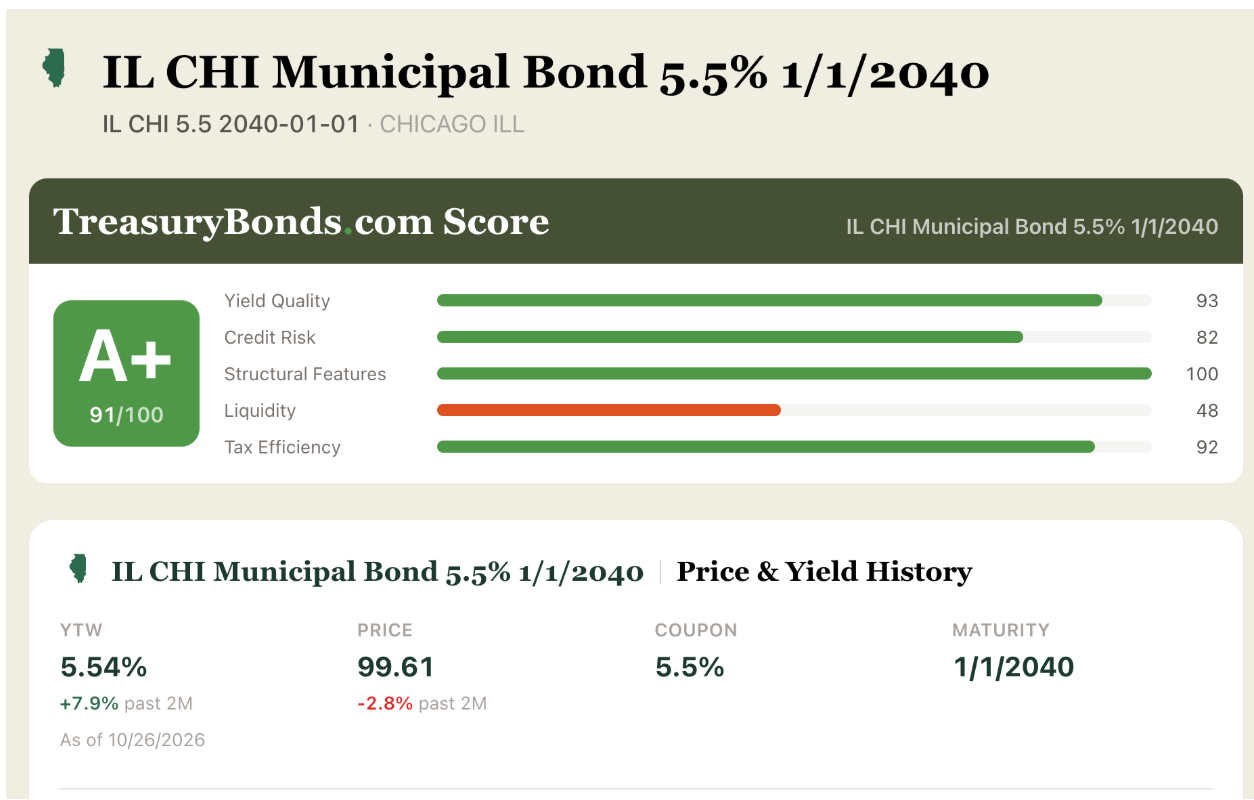
The IL CHI 5.5% Muni Bond due January 1, 2040 is quoted at 99.61 with a yield to worst of 5.54%, as of October 26.
That’s 0.44 percentage points above the 5.10% maturity-matched Treasury. Its TreasuryBonds.com Score is A+ (91/100).
The tax benefit is the main attraction
Municipal bond interest is generally exempt from federal income tax.
NerdWallet notes that Illinois allows a subtraction for income from tax-exempt bonds issued by the state or local Illinois governments, and the state income tax is a flat 4.95%.
Chicago is an Illinois local government, so interest from this bond should avoid both.
That matters because the bond’s score for Tax Efficiency is 92, among its best.
What the yield is worth after taxes
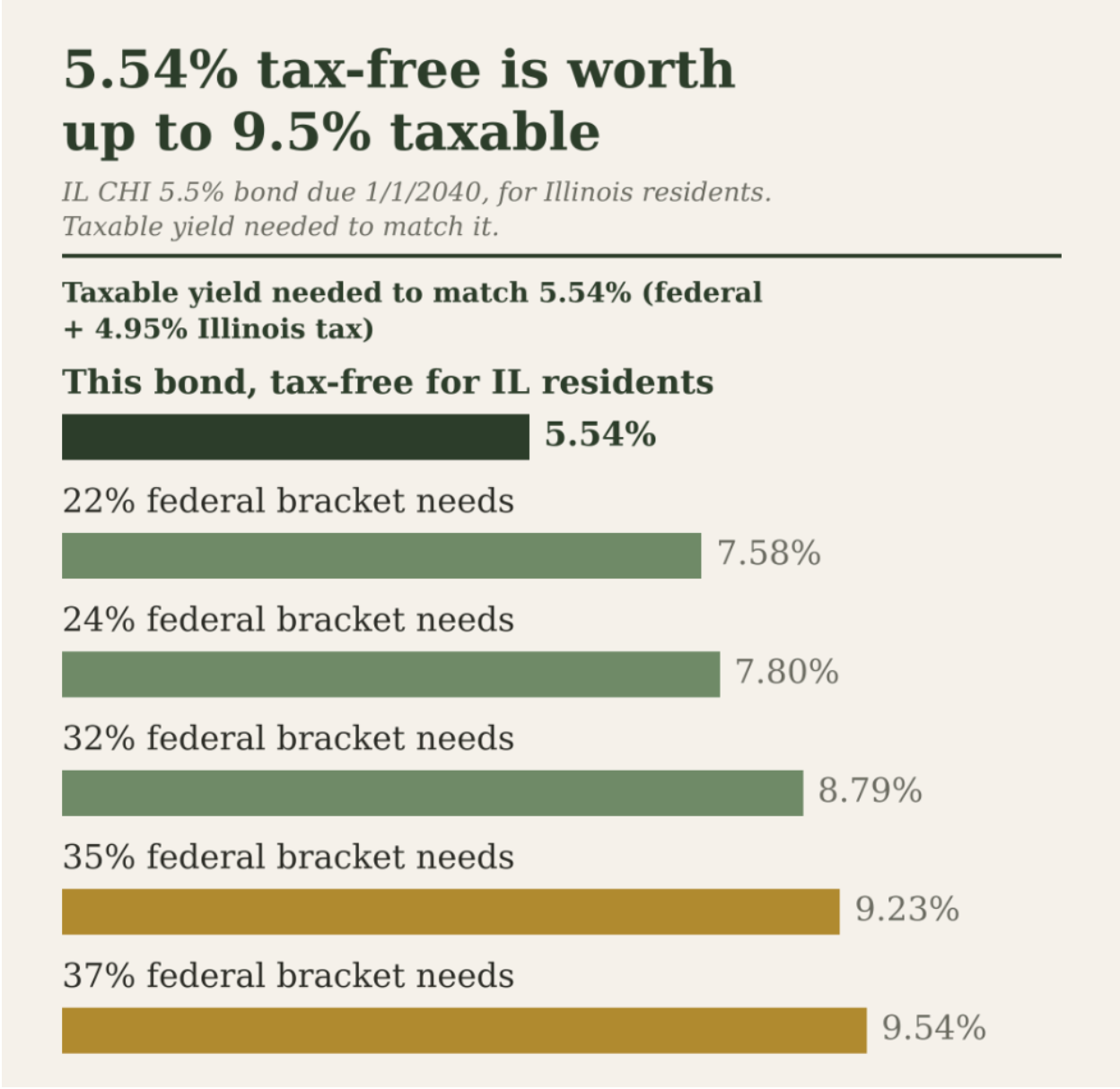
Here’s what a taxable bond would have to pay to match 5.54% tax-free.
These are our estimates, adding the 4.95% Illinois rate to the federal bracket (and ignoring the extra 3.8% investment income tax some high earners pay.
22% federal bracket: about 7.58%
24%: about 7.80%
32%: about 8.79%
35%: about 9.22%
37%: about 9.54%
Compare that with the 5.10% Treasury. Treasury interest is exempt from state tax but not federal tax, so for someone in the 24% bracket it works out to roughly 3.9% after federal tax, against 5.54% tax-free here.
The higher your bracket, the bigger the gap.
Other points in its favor
At 99.61 with a 5.5% coupon, you’re not paying a big premium, and you collect the coupon until 2040.
Yield Quality is 93 and Structural Features is a perfect 100.
Thirteen years is long enough to lock in today’s yield but shorter than a 30-year bond. By my rough estimate, with no call, duration is around 9 years, so a one-point rise in yields could cost roughly 9% in price.
The risks
Chicago’s credit has weakened.
On February 25, Fitch and KBRA cut the city’s general obligation rating from A-minus to BBB-plus, both with negative outlooks.
KBRA cited a deteriorating fund balance and rising fixed costs.
Fitch cited consecutive operating deficits since 2023 and reliance on one-time fixes.
Pensions are a big problem. One report puts Chicago’s combined pension funded ratio at 28.1%, with a net unfunded liability of about $36.4 billion.
Bottom line
For an Illinois resident in a taxable account, a 5.54% tax-free yield that’s the equivalent of roughly 7.6% to 9.5% before tax is a strong income. It’s also paying above Treasuries, which tells you the market sees real risk in Chicago. If you’re comfortable with that credit and can hold to 2040, the tax math is attractive.