
A 5.69% yield sounds great when similar duration Treasuries are paying 4.79%. That’s a gap of 0.90 percentage points, and it’s the kind of number that makes people click “buy.”
Take the Charter Communications bond (CHTR 2.25%, due 1/15/2029) as an example.
At first glance it looks like a decent income. Look under the hood, and the TreasuryBonds.com Score tells a different story: a C grade, 47 out of 100.
What the yield is telling you
The bond’s yield to worst is 5.69% against 4.79% for the matching Treasury, so you’re getting an extra 0.90% for taking Charter’s credit risk.
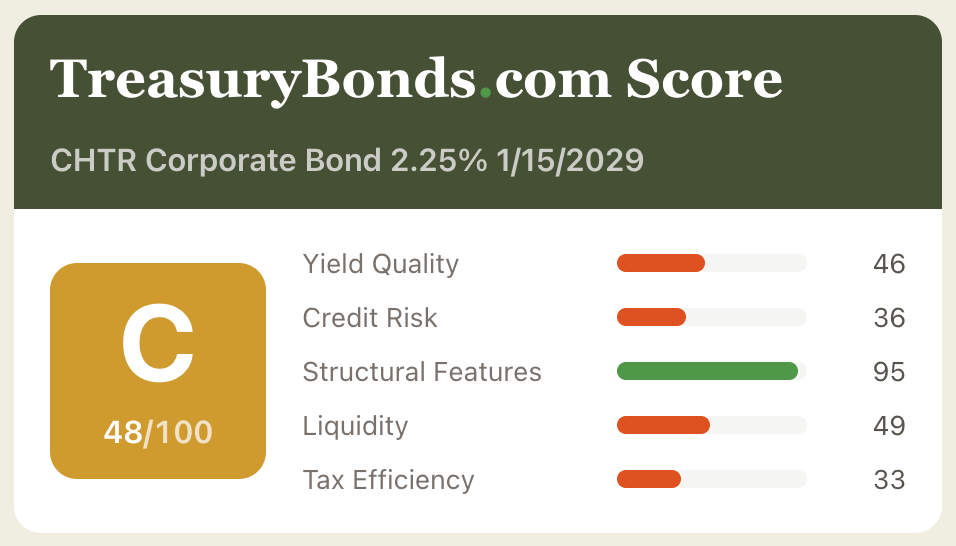
What the score breaks down
Yield Quality: 44. The yield is okay, not great.
Credit Risk: 36. This is the weakest of the main risk measures. You’re being paid a modest spread for a real credit risk.
Structural Features: 95. The bright spot. The way the bond is built scores very well.
Liquidity: 49. Middle of the road. It may not be easy to sell at a fair price when you want to.
Tax Efficiency: 33. Low. More on that below.
What it means for fixed income investors
Don’t buy a yield, buy a bond. Look at credit risk, liquidity, structure and taxes along with the yield.
Compare the spread to the risk. A 0.90% pickup over Treasuries may be fine for some investors and thin for others.
Check the last trade date. If it hasn’t traded in weeks, treat the price as a guess.
Know where your return comes from. A discount bond with a low coupon earns most of its return at maturity, which affects taxes and cash flow.
Look at siblings. Check other bonds from the same issuer, and compare maturities, yields and scores.
A grade is a starting point. A C doesn’t mean “never buy,” but it should make you ask harder questions before you do.
Bottom line
The CHTR 2.25% 2029 bond has a weak credit score, middling liquidity, a low tax score and a price that may be out of date.
That doesn’t make it a terrible bond, but it does make it a bond that deserves homework.