
Friday had a split personality. Tech stocks got hit hard all day on worries about how much AI companies are spending and what that spending will earn. Treasuries, by comparison, barely flinched. They opened with gains, drifted in a sideways range, and finished within striking distance of where they started.
The result was the fourth straight weekly gain for the Treasury complex, with yields now down about 40 basis points from their October highs.
Where yields ended the week
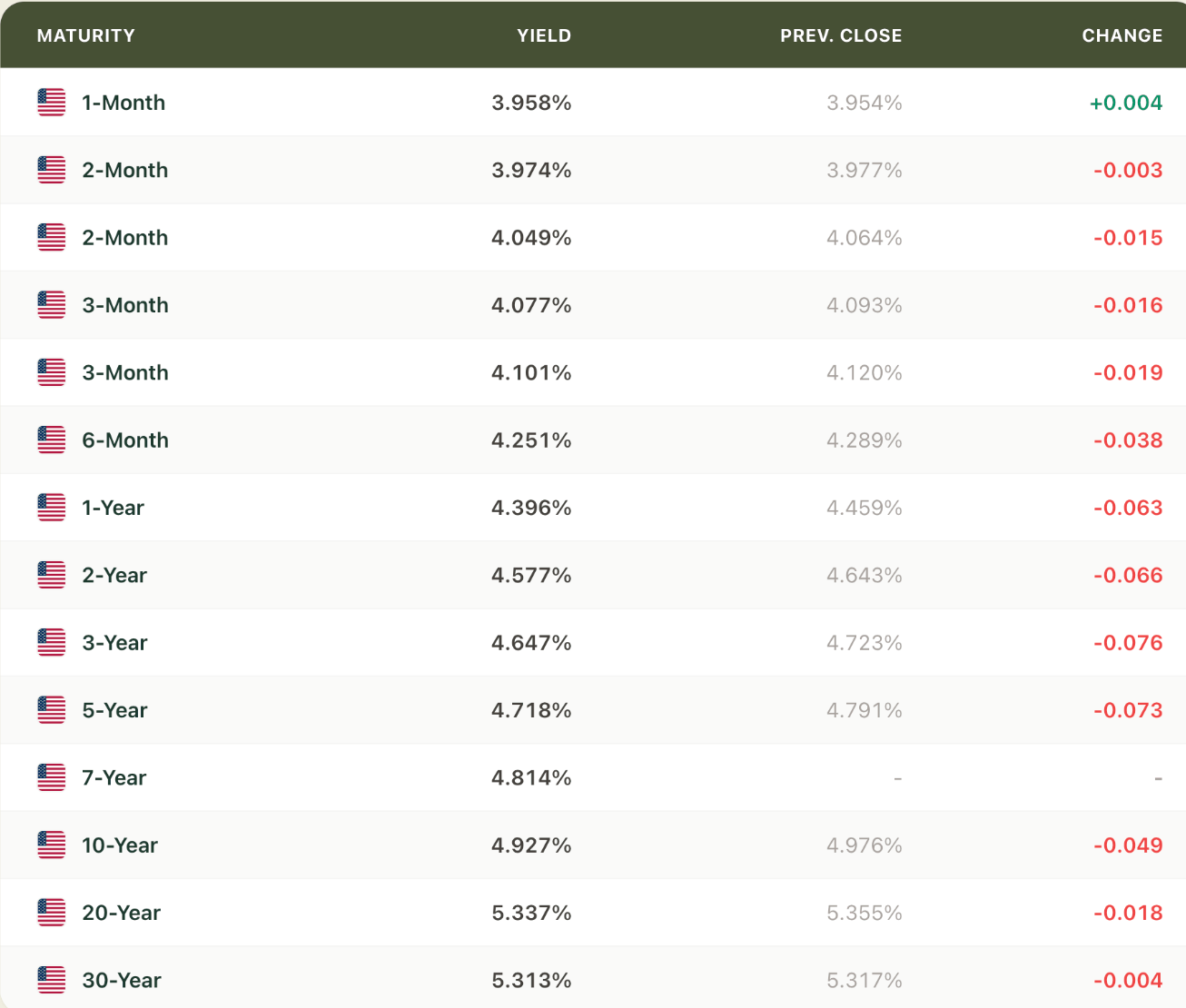
Shorter maturities led the rally, so the curve steepened a bit. Yields touched levels last seen in mid-to-late September early in the session.
What kept a lid on the rally
Oil. Crude settled just above $104 a barrel, adding almost $1 for the week. That’s a reminder that inflation pressure hasn’t gone away, and it kept Treasuries from running further. The U.S. Dollar Index slipped 0.2% to 101.89, though it’s up 0.1% for the week. Add some talk about possible military action against Iran after the midterm elections, and you can see why the bond market wasn’t willing to push too hard.
The Fed and the data
St. Louis Fed President Musalem, a non-voter this year, spoke in favor of additional rate hikes at a measured pace. T
On the data side, the third-quarter Employment Cost Index rose 0.8%, right in line with expectations and down from 0.9% in the second quarter.
Wages and salaries rose 0.7% and benefits 0.9%.
The Chicago PMI slipped to 55.3 in October from 58.8 in September.
Around the world
Japan: The Bank of Japan held its policy rate at 1.25% as expected. It said its price target has been reached and that annual ETF sales will rise to 860 billion yen from 330 billion in January. Tokyo core CPI was 2.6% year over year, as expected.
Eurozone: Third-quarter GDP grew 0.4% (expected 0.2%). Inflation readings were hot in several countries. Italy’s October CPI came in at 5.4% year over year (expected 4.6%), France at 3.4% (expected 3.2%) and Spain at 4.9%. France’s GDP shrank 0.1% in the quarter, and Italy’s was flat.
Germany: Third-quarter GDP rose 0.2% (expected 0.1%), and unemployment held at 6.4%.
South Korea’s September industrial production rebounded 9.0% month over month, and Australia’s third-quarter producer prices rose 3.6% year over year.
The week ahead
All eyes will be on Friday’s jobs report, but there’s plenty before it.
Monday: Final October manufacturing PMI (prior 56.0), September job openings (consensus 7.1 million), construction spending, and ISM Manufacturing (consensus 54.7; prior 54.5). At 3:00 p.m. ET, Treasury releases its quarterly refunding financing estimates.
Tuesday: September factory orders (consensus 1.2%; prior 0.1%) and business inventories.
Wednesday: ADP employment (consensus 75,000; prior 90,000), the September trade balance (consensus -$108.4 billion), ISM Services (consensus 54.8; prior 54.9), and the Treasury’s quarterly refunding announcement at 8:30 a.m. ET.
Thursday: Third-quarter productivity (consensus 3.1%) and unit labor costs (consensus 1.4%), plus weekly jobless claims (consensus 197,000; prior 194,000).
Friday: October nonfarm payrolls (consensus 65,000; prior 29,000), unemployment rate (consensus 4.2%), average hourly earnings (consensus 0.3%; prior 0.1%), and preliminary November University of Michigan sentiment (consensus 47.2; prior 48.0).
Bottom line
Stocks wobbled, bonds held steady, and yields ended the week lower. But the next five days could change the tone. Treasury’s refunding plans, a stack of data, and Friday’s jobs report will all test whether the October bond rally has legs.