
On October 30, S&P revised its outlook on Meta to negative from stable and affirmed the AA- rating. This is technically not a downgrade, but warning a downgrade could follow.
What S&P is worried about
The concern is leverage.
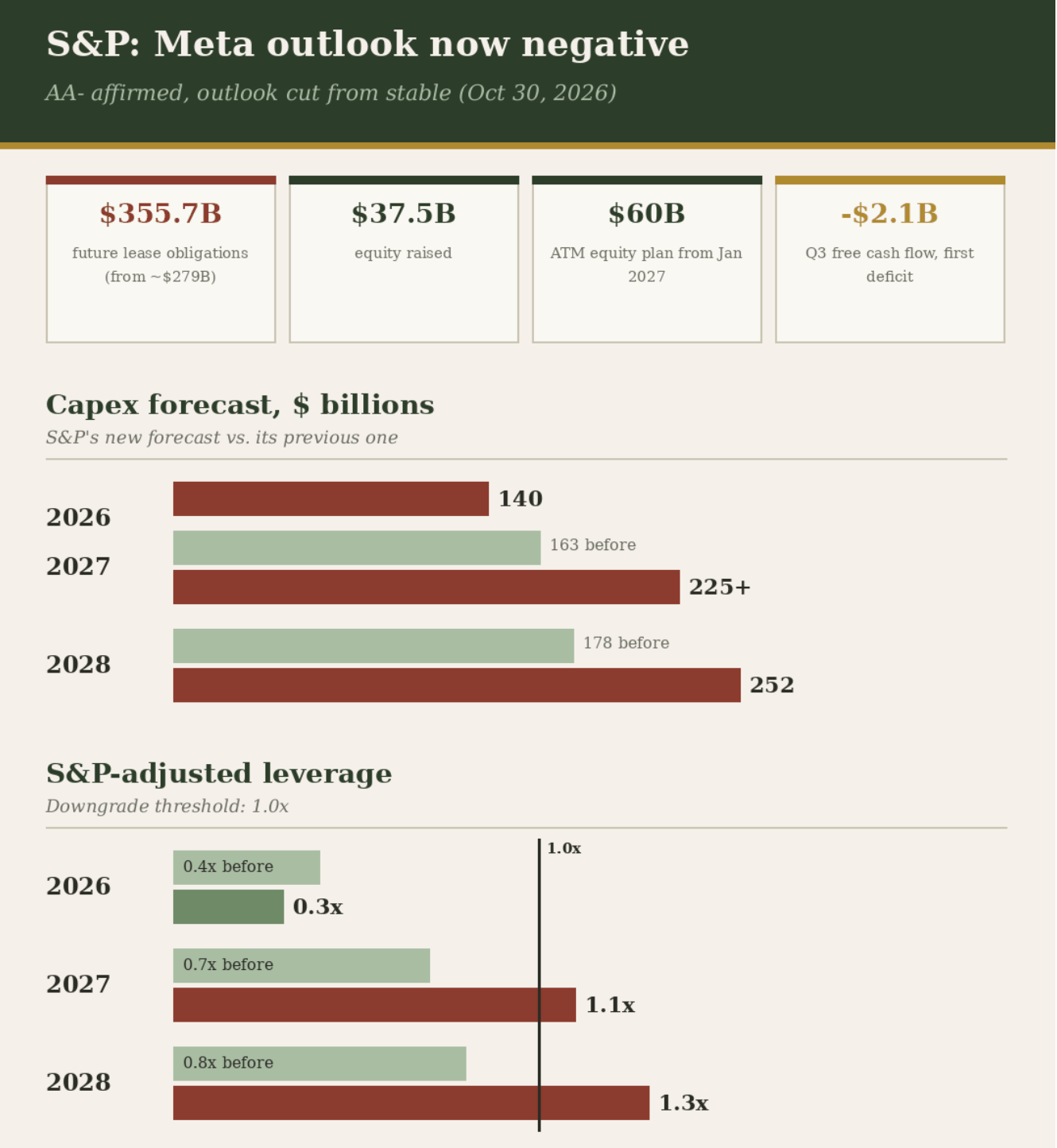
S&P says Meta’s adjusted leverage could rise above its 1.0x downgrade threshold as early as 2027, up from about 0.1x in 2025.
S&P forecasts 1.1x in 2027 and 1.3x in 2028, versus its earlier forecast of 0.7x and 0.8x.
Future lease obligations jumped to $355.7 billion as of September 30, from about $279 billion in the second quarter, and S&P counts them in its leverage math.
The spending forecast
S&P forecasts Meta’s capex at $140 billion this year. Management’s guidance is $135 billion to $145 billion.
S&P sees it accelerating to over $225 billion in 2027 (previously $163 billion) and $252 billion in 2028 (previously $178 billion), flattening out after that.
The core business is strong
Third-quarter revenue rose 26.1%, with advertising up 25.9%, and Meta has 3.64 billion engaged users.
But costs rose faster, partly because of a $9.89 billion charge tied to resolving litigation with a number of state attorneys general, which knocked about 2,000 basis points off reported operating margins.
Capex, including principal payments on finance leases, hit $34.9 billion, and free cash flow turned negative (-$2.1 billion) for the first time.
The monetization question
S&P says Meta’s ability to monetize its AI investments looks more limited than its peers.
Meta is counting on better advertising tools and new agentic apps like Muse, but it’s unclear when those will earn more than they cost.
Several peers are already earning revenue by leasing data center capacity to outside customers, including frontier model labs and enterprise customers.
The equity cushion
There’s good news too. S&P’s forecast doesn’t include the ATM, and if it did, leverage would be 0.7x in 2027 and 1.1x in 2028. S&P still expects debt to cover the 2028 gap.
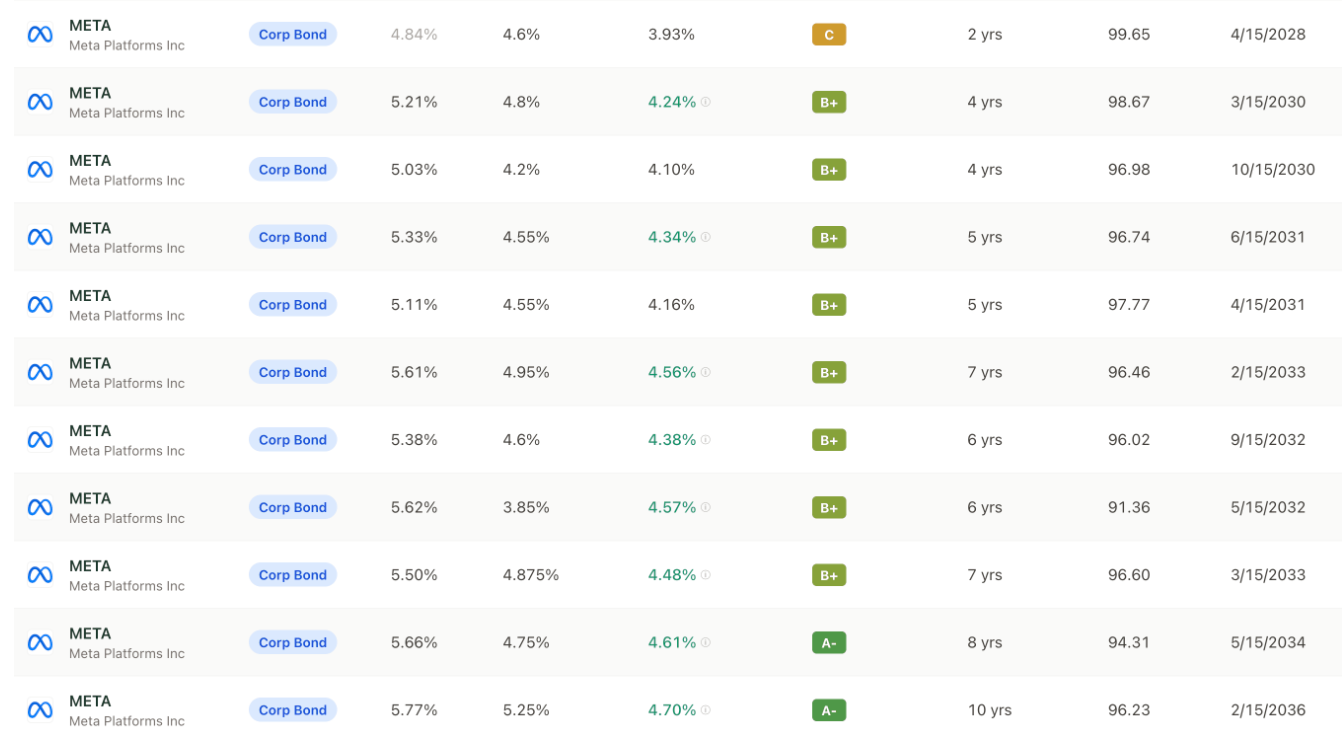
We've been adjusting our ratings as well as you can see here on our Meta bonds page.
Bottom line
Meta isn’t in trouble. Meta recently raised $37.5 billion by selling $25.0 billion of Class A common stock and $12.5 billion of mandatory convertible preferred stock. It also plans up to $60 billion of Class C stock through an at-the-market program beginning in January 2027. S&P calls the raise credit positive because Meta can cover the 2027 cash deficit with equity instead of debt. But S&P is saying that when capex heads toward $250 billion a year and free cash flow stays negative through 2028, even a AA- balance sheet gets tested.
For bond investors, the message is to watch what these companies owe, including leases, and how soon the AI spending pays off.