Ask a retiree what they like least about owning a rental, and you’ll rarely hear “the returns.” You’ll hear about the late-night call about a burst pipe, the tenant who’s three months behind, or the roof that needs replacing.
For years, the monthly rent check made it worth it. But at 65 or 70, a lot of owners are asking whether they still want the job that comes with it.
What the rental really pays
Gross rent isn’t what you keep. Property taxes, insurance, repairs, vacancies and management all come out first.
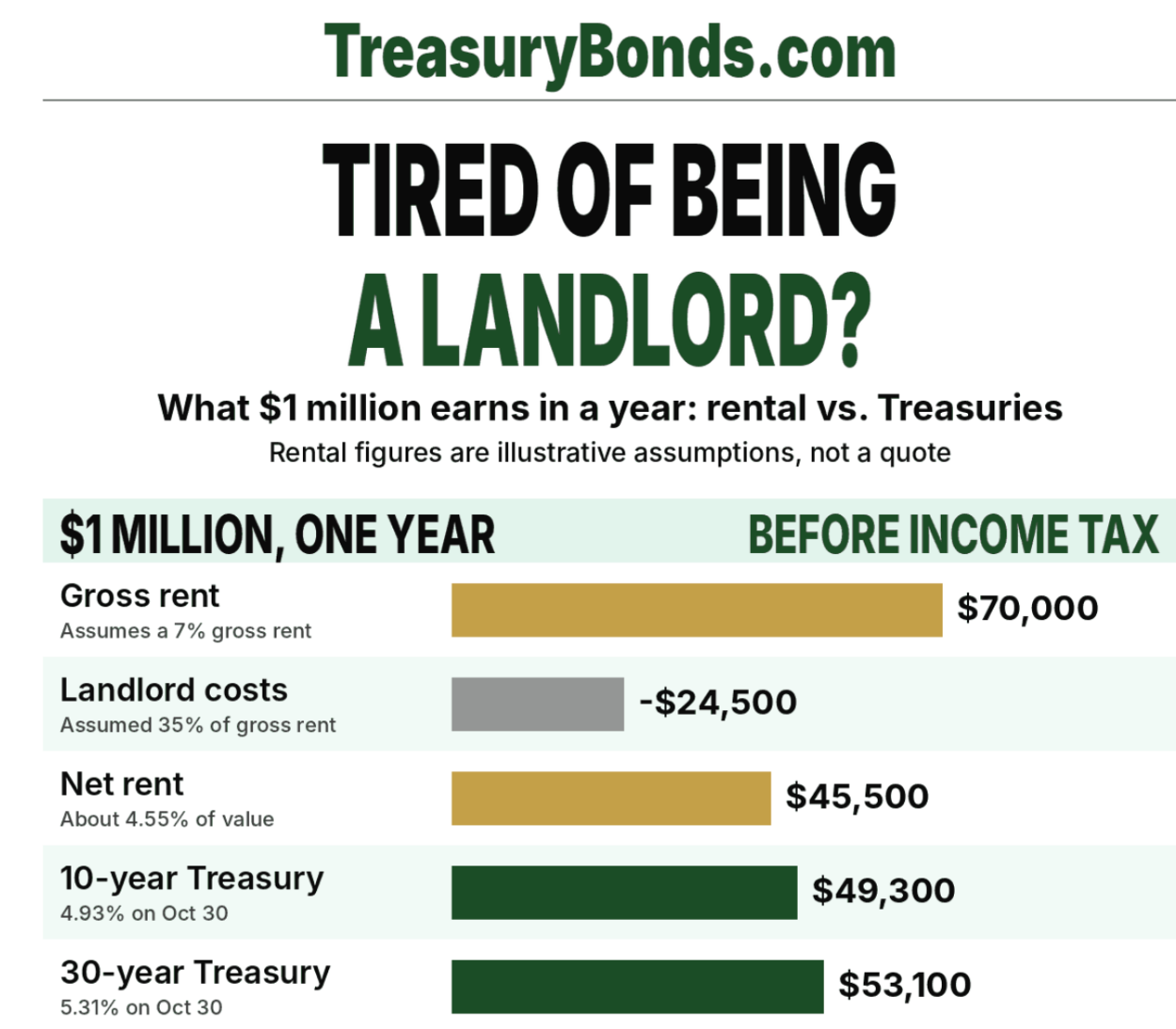
Take a $1 million property that brings in 7% gross rent, or $70,000 a year. If costs run about 35% of that rent (an assumption, and yours will differ), you’re left with about $45,500, or 4.55% of the property’s value, before income tax.
What Treasuries pay
On Friday, October 30, the 10-year Treasury yielded about 4.93% and the 30-year about 5.31%.
On $1 million, that’s roughly $49,300 and $53,100 a year. No tenants, no repairs, no vacancies. The interest is paid by the U.S. government, and it’s exempt from state and local income tax, which matters if you live somewhere with a high state tax.
What you give up
Rental property has real advantages. Rents can rise over time, depreciation can lower your taxable income, and the building may appreciate.
A Treasury’s interest is fixed. If you sell before maturity, the price can be higher or lower than what you paid, and inflation can erode what a fixed payment buys.
A rental can pay well, but it also pays you in phone calls. For a retiree who wants steady income without being on call, Treasuries are a simple, government-backed alternative that may pay as much or more after costs.
The trade-off is giving up rent growth and potential appreciation, and the tax bill from selling needs planning.