
Here’s a question I’ve been asking lately: when the 10-year Treasury touches 5% and the 30-year sits above it, who is actually buying all this debt?
It matters because the answer decides what the government pays to borrow, and a lot of what you pay for a mortgage, a car loan or a business loan follows from it.
Plenty of Overseas Buyers
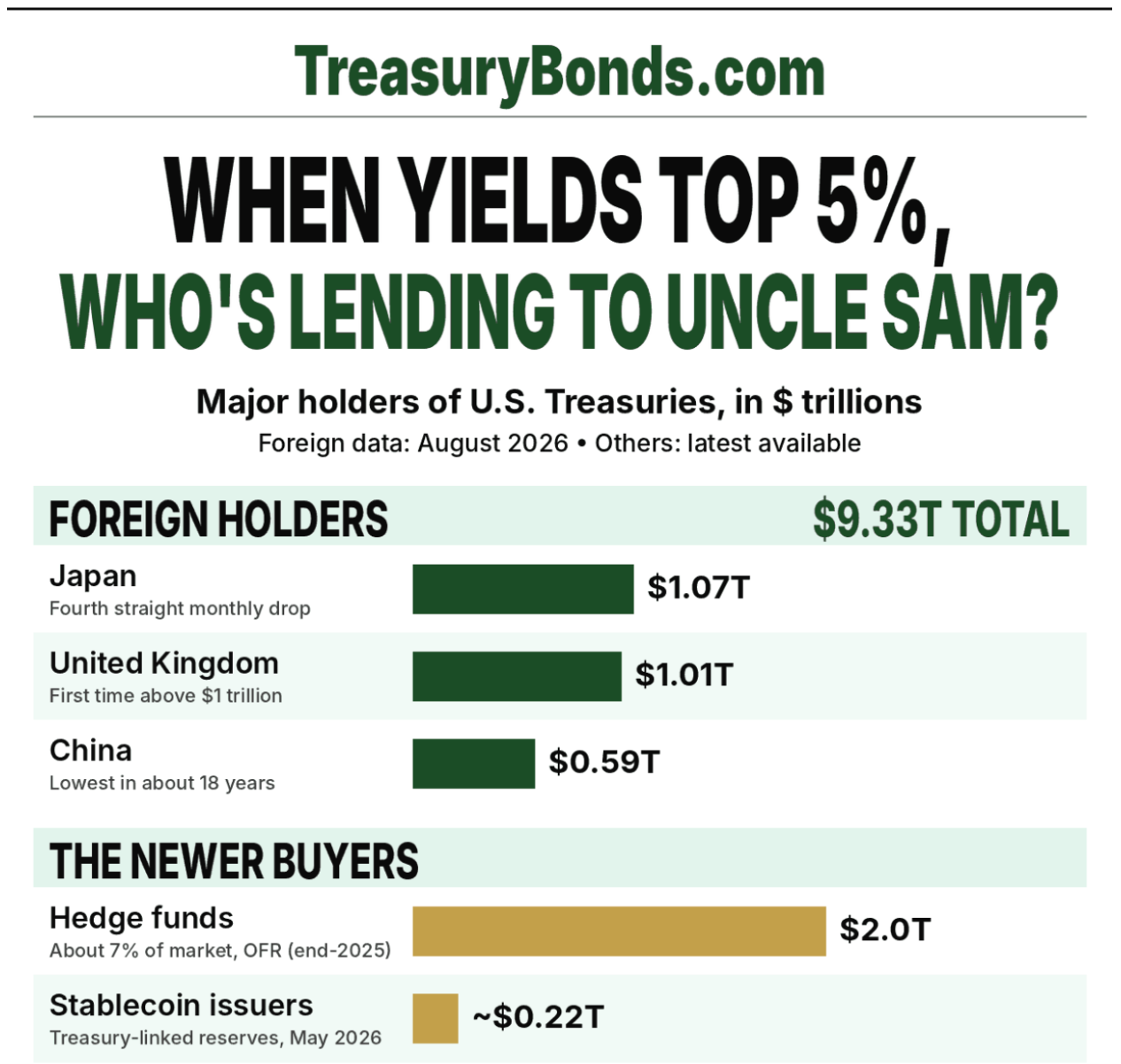
Foreign investors still hold a huge amount, about $9.33 trillion of Treasuries as of August, according to the Treasury’s latest international capital data. But the big names aren’t moving in step.
Japan is still the largest holder at about $1.07 trillion, but its holdings fell for a fourth straight month and hit their lowest level since December 2024.
The U.K. topped $1 trillion for the first time, at about $1.01 trillion.
China fell to about $591 billion, its lowest in roughly 18 years, and its third straight monthly decline.
Total foreign holdings rose by about $83 billion in August, with net purchases of about $109 billion, which snapped two months of declines.
But that data came before September, when inflation worries and talk of Fed rate hikes triggered a sell-off. The 10-year topped 5% for the first time since 2007.
The Newer Buyers
Hedge funds now hold a record share of the roughly $30 trillion Treasury market, about 7% at the end of 2025 according to the Office of Financial Research, or about $2 trillion in cash Treasuries, nearly triple five years earlier.
Much of it is the basis trade: buying Treasuries, selling matching futures and borrowing heavily to profit from a tiny price gap.
Morgan Stanley estimates those leveraged positions shrank about a fifth this year to roughly $1.2 trillion, but they’re still often levered 20 times or more.
Then there are stablecoin issuers. Reserves tied to Treasuries total roughly $220 billion as of May, with Tether and Circle the biggest.
That’s a small slice of the market, but it’s growing.
Why it Matters
Who buys decides how stable the market is. Long-term holders like pensions tend to hold through volatility.
Leveraged hedge funds can become forced sellers if volatility triggers margin calls, which can push prices down and force others out. Defenders say active funds add liquidity and can calm swings, so the risk isn’t a certainty.
When price-sensitive buyers set the yield, the government pays more to borrow, and it’s a reason to watch this week’s refunding, when Treasury releases its financing estimates and announcement.