
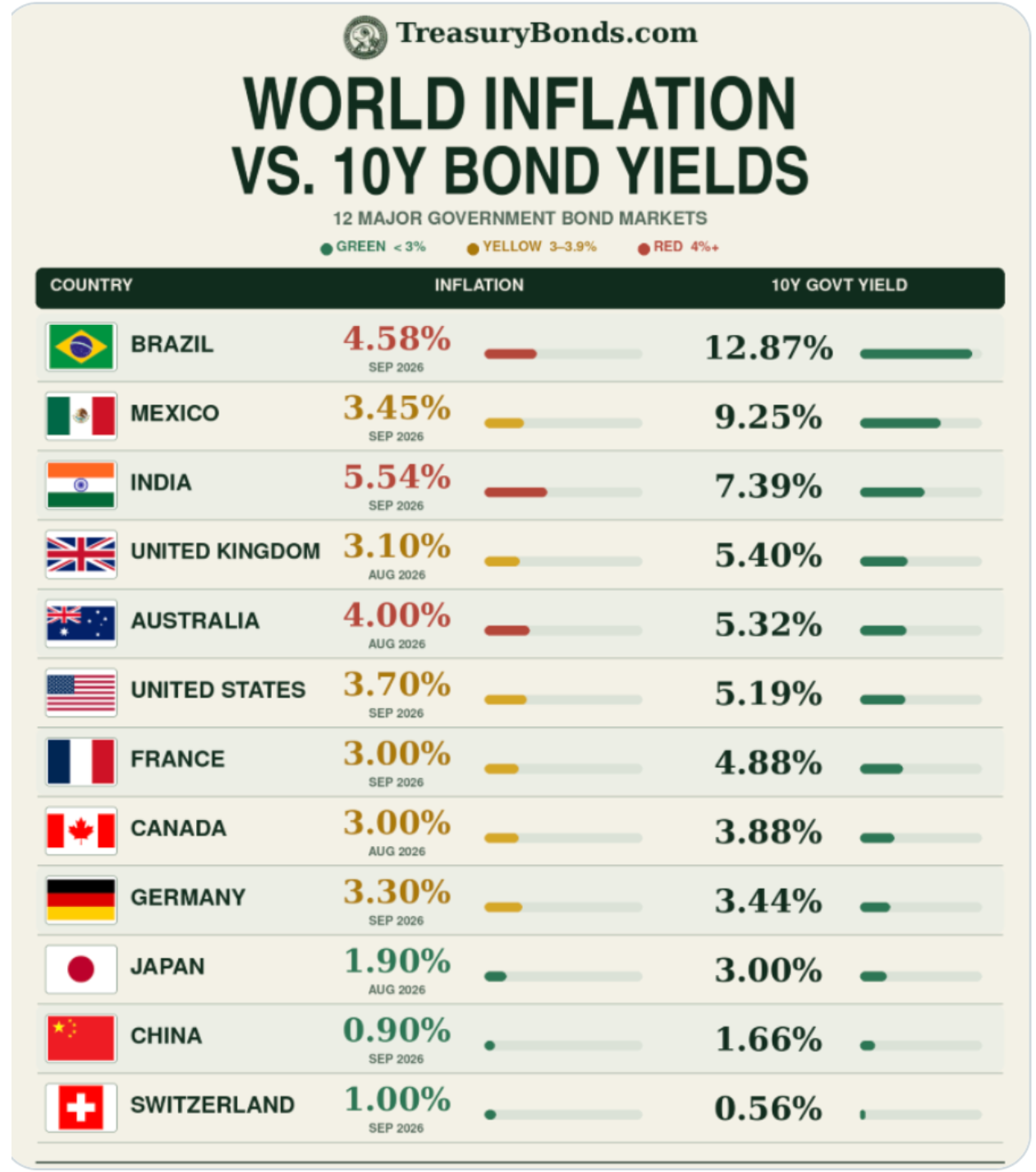
When people talk about bond yields, they usually talk about the U.S. We put together a chart lining up inflation against 10-year government bond yields in 12 major markets.
The simple math: yield minus inflation
The quick way to compare is to subtract inflation from the 10-year yield. It shows how much a country is paying you above the current rate of price increases.
Where the U.S. sits
The U.S. lands in the middle of the pack overall, sixth of the twelve by this measure. Among the developed markets, it’s third behind the UK and France. That’s notable. The U.S. 10-year pays about 1.5 points over inflation, while Germany pays almost nothing over inflation and Switzerland pays less than inflation.
The extremes
Brazil and Mexico pay by far the most, but those yields come with risks that U.S. Treasuries don’t have, including currency swings and higher default and political risk.
At the other end, Switzerland’s 10-year yield is less than its inflation rate. Investors there are effectively paying for safety. Germany is close to flat on the same math.
A few surprises
Australia has the highest inflation among the developed markets, at 4.00%, and Japan, long the world’s low-yield example, now has a 3.00% 10-year yield with 1.90% inflation. These are big changes from what many investors are used to.
Bottom line
A 10-year yield being set against inflation does show the U.S. not in as rough a shape as some other (albeit still-developing) countries, but regardless, inflation is a global concern at the moment.