
When people think about the risks of owning bonds, municipal bonds usually don’t top the list.
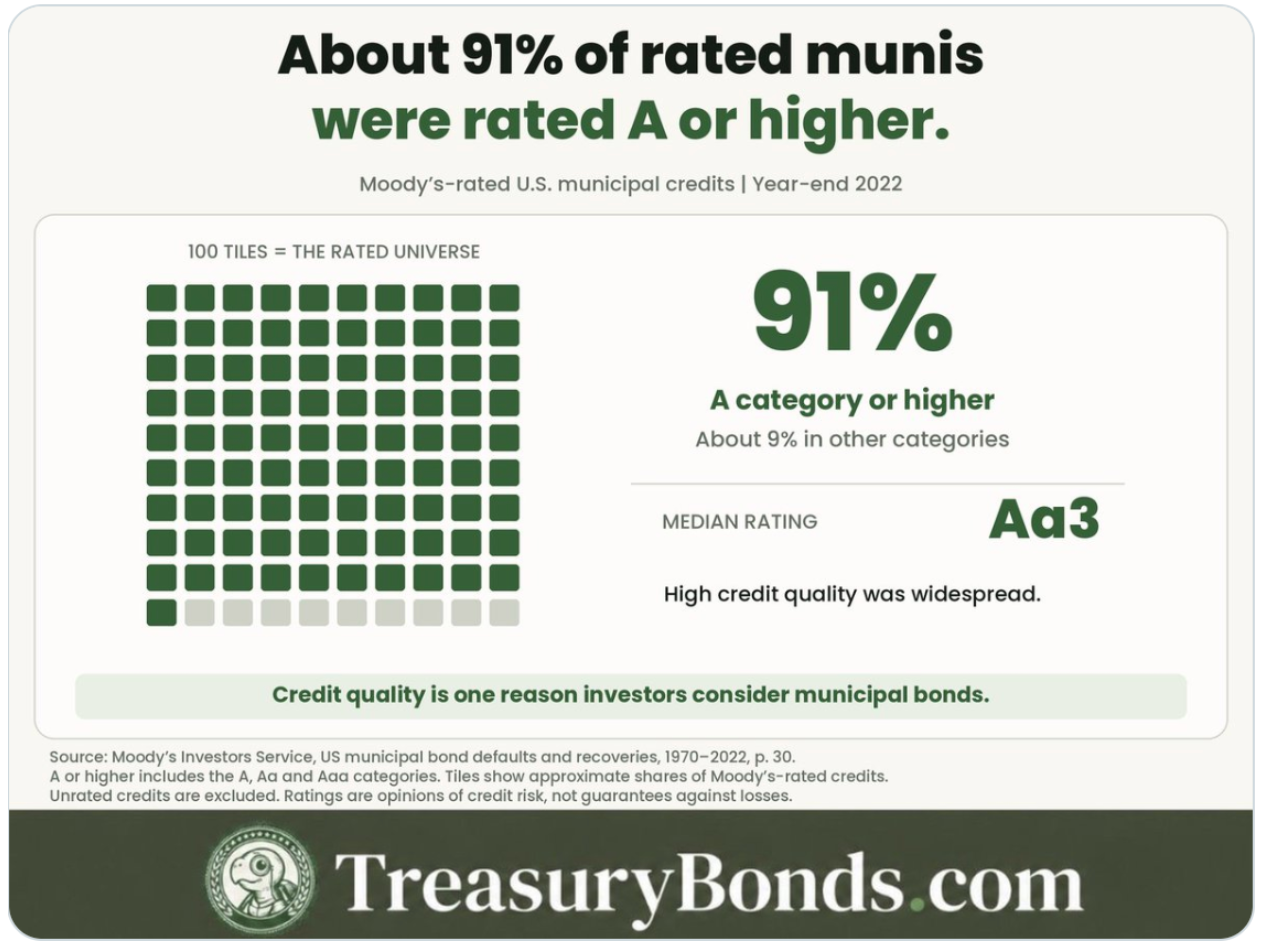
A chart we shared recently helps explain why: according to Moody’s, about 91% of the U.S. municipal credits it rated were in the A category or higher at year-end 2022, and the median rating was Aa3. Only about 9% fell into other categories.
What the numbers say
On Moody’s scale, the top categories run Aaa, then Aa, then A, with each broken into 1, 2 and 3 steps. “A or higher” includes all of those, so a muni rated A3 and one rated Aaa both count. A median of Aa3 means the typical rated issuer sits in the second-highest category, near the lower end of it. Put together, high credit quality was widespread across the rated muni market, which is one reason munis earn a place in many portfolios for investors who want income with a strong credit profile.
The risk
Even a muni with a pristine rating can lose value. Munis have interest-rate risk like any bond: when yields rise, prices fall, and longer maturities fall further, as I wrote about with long Treasuries. Some also have call features that let the issuer pay them back early, and many trade less actively than Treasuries, so selling before maturity can cost you.
Some quick notes on munis:
- Munis are often tax-exempt, so compare them with taxable bonds on a tax-equivalent basis.
- A high rating doesn’t protect against interest-rate swings or an early call.
- Spreading across issuers limits the damage from any single problem.
Bottom line
The credit quality of the rated muni market has been strong, and a 91% share rated A or higher is a good reason munis are popular with income investors. Each individual bond requires its own due diligence. Be sure to check out our Municipal Bond Ratings for our latest opinion.