
You can own an inflation-protected bond ETF and still see your fund drop in value. Why? It comes down to how Treasury Inflation-Protected Securities, or TIPS, actually work.
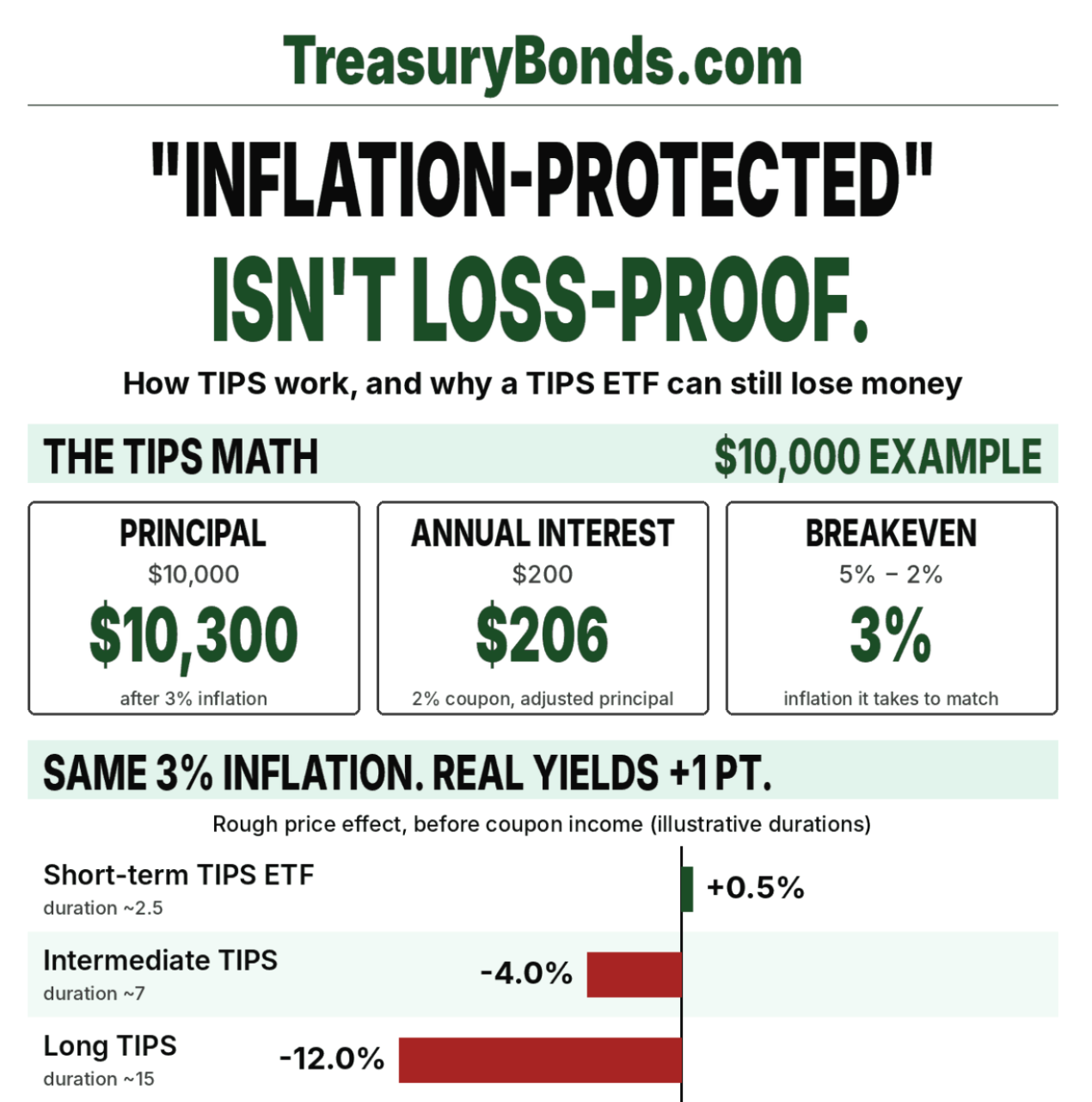
How TIPS work
TIPS are U.S. government bonds whose principal adjusts with the Consumer Price Index.
The coupon rate stays fixed, but it’s applied to the adjusted principal. As the principal rises, the dollar amount of interest rises with it.
Take $10,000 of TIPS with a 2% coupon. If inflation adjusts the principal up by 3%, it becomes $10,300. Annual interest on that amount is $206, up from $200.
That’s how the bond helps preserve your purchasing power.
High inflation doesn’t automatically mean TIPS win
Say a regular Treasury yields 5% and a comparable TIPS yields 2% above inflation.
The roughly 3% gap is the breakeven inflation rate.
If inflation averages more than that, TIPS held to maturity generally come out ahead, before taxes and other market effects. If it averages less, the regular Treasury wins.
Then there’s duration
TIPS prices generally fall when real yields rise, and longer-duration TIPS are more sensitive.
That price drop can easily overwhelm the inflation adjustment.
As a rough, simplified example, with 3% inflation and real yields up one point, a fund with a duration around 2.5 might gain about half a percent, an intermediate fund with a duration near 7 might lose about 4%, and a long one near 15 might lose around 12%, before coupon income.
Same inflation, different results.
An individual bond isn’t the same as an ETF
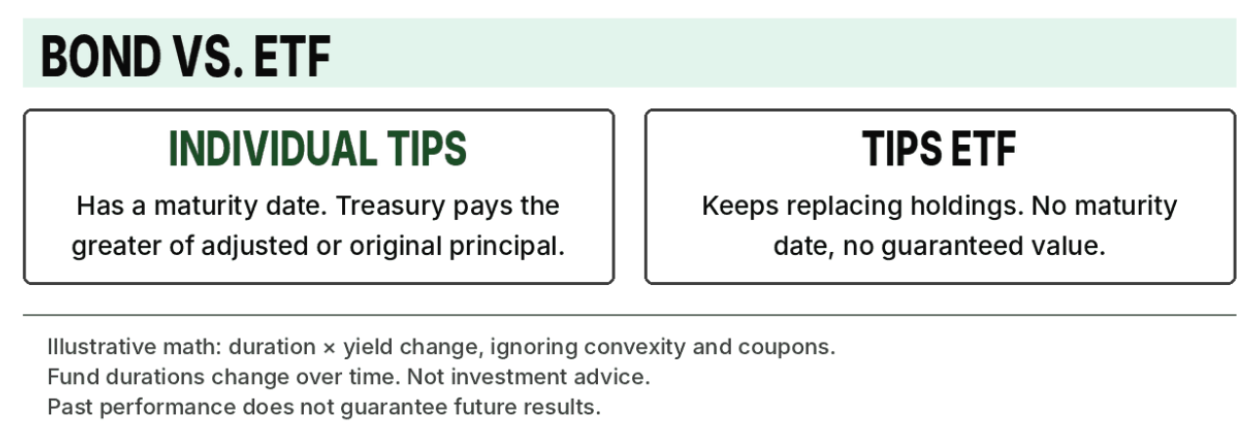
An individual TIPS has a maturity date. At maturity, Treasury pays the greater of the inflation-adjusted principal or the original face value. That floor doesn’t necessarily protect your full purchase price if you paid more than face value.
A typical TIPS ETF keeps replacing its holdings. Its share price has no guaranteed maturity value to fall back on.
Bottom line
TIPS can help protect purchasing power, but the words “inflation-protected” only tell part of the story. The inflation already priced in, the fund’s duration and when you’ll need the money all matter just as much.