
Bond math can get complicated fast, with duration, convexity, and yield curves. Here’s the simple version.
The numbers
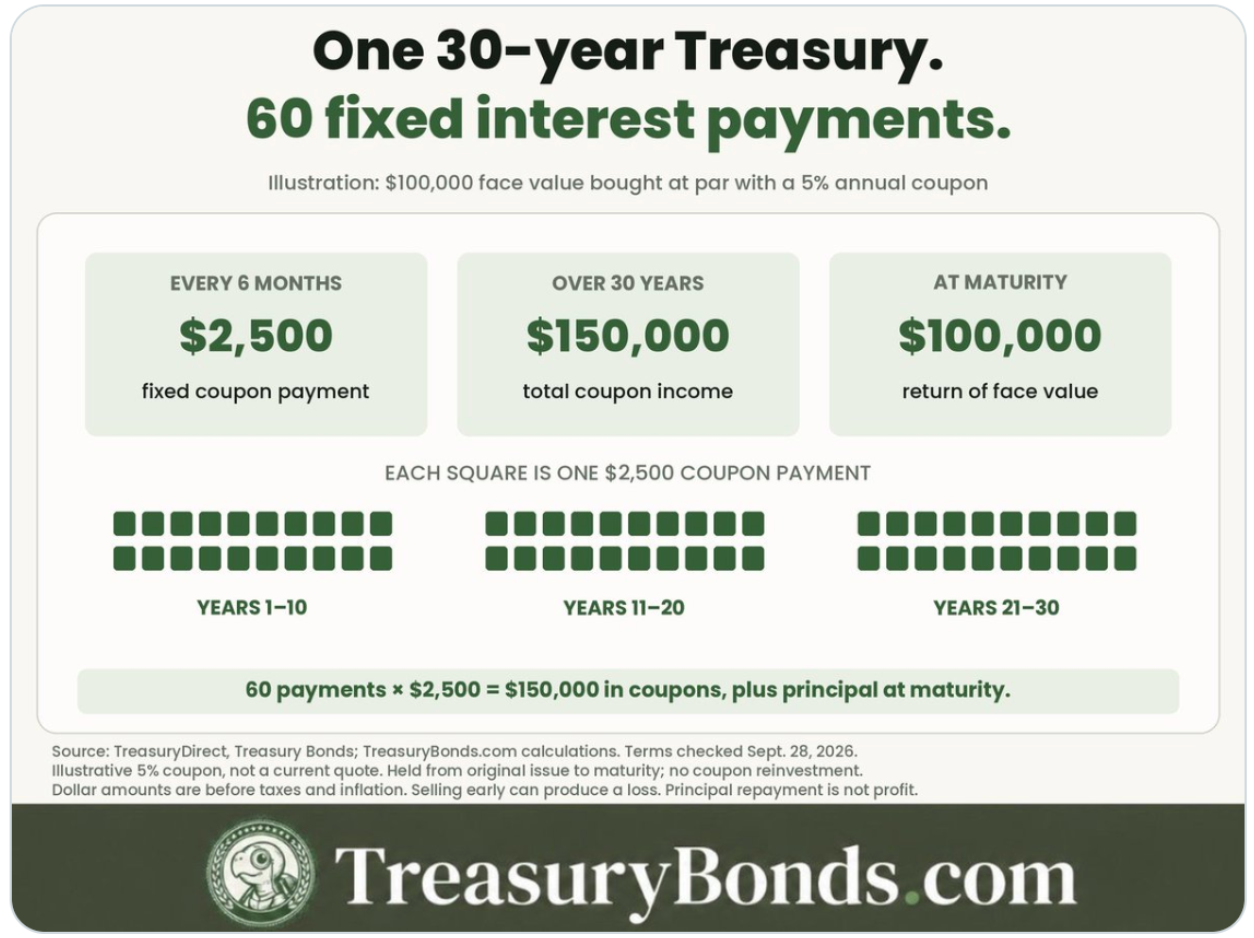
Take a 30-year Treasury bought at par with a 5% coupon and $100,000 of face value.
$2,500 arrives every six months. (5,000 a year in total).
60 payments arrive over 30 years, because two a year for 30 years is 60.
$150,000 in total coupon income is 60 times $2,500.
$100,000 of face value is repaid at maturity.
So the bond hands back $250,000 in total cash on a $100,000 purchase: $150,000 of income plus the original $100,000. And the payment amount and the payment dates are set on day one.
Why the simplicity appeals
Most investments come with a question mark attached to the income. With a Treasury held to maturity, the schedule is known in advance: the amount, the dates and the repayment. That’s three decades of income you can plan around, which is why people building a retirement paycheck like to start there.
What the round numbers don’t show
The example is before taxes and inflation, and over 30 years, inflation matters a lot. As an illustration, if prices rise 3% a year, $5,000 of annual interest has the buying power of about $2,060 in today’s dollars by year 30, and the $100,000 of principal is worth roughly $41,200 in today’s dollars. The dollar amounts stay the same, but what they buy shrinks.
The example also assumes you spend the coupons rather than reinvest them. If you reinvested every payment at the same 5% (a hypothetical, and rates won’t stay put), the total would grow to roughly $440,000 by maturity.
And selling early can produce a loss. If yields rose from 5% to 6%, that same bond would be worth about $86,200 on the market, a drop of roughly 14%. Hold it to maturity and the drop never has to be realized.
Bottom line
One 30-year Treasury, 60 fixed payments, $2,500 each, $150,000 in coupons and $100,000 back at the end. It’s about as simple as investing gets, and that simplicity is the appeal. Just remember what the round numbers leave out: taxes, inflation and what happens if you sell early.