
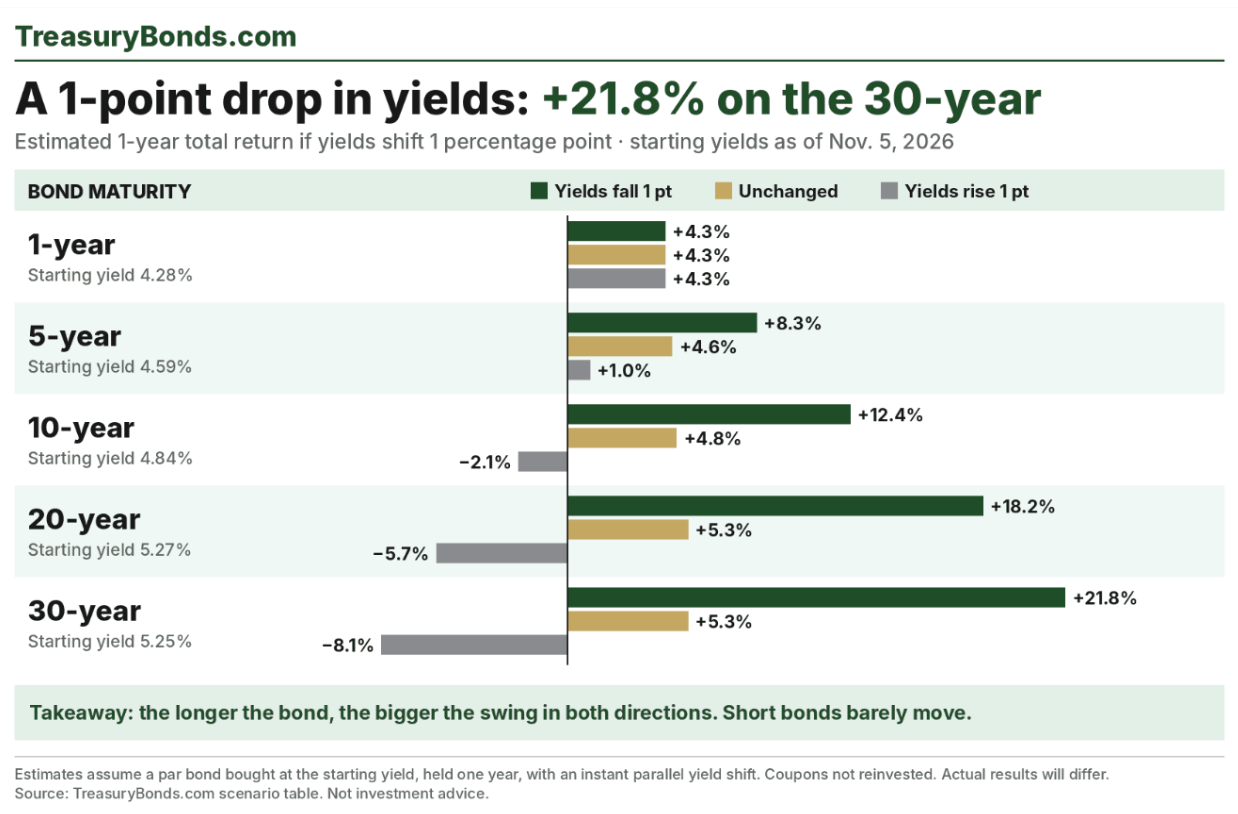
Most people look at a Treasury yield and think that’s what they’ll earn. Over a year, that’s only true if yields don’t move. If yields fall 1 percentage point, a 30-year Treasury could return about 21.8%. If they rise 1 point, the same bond could lose about 8.1%.
What the scenarios show
The estimates use yields from Nov. 5, 2026 and assume a one-time, parallel move across the curve:
Why longer bonds swing more
When yields rise, existing bonds get repriced lower. The longer the bond, the further away its principal is and the more a small change in yield moves the price.
The 30-year’s price falls roughly 13 to 14 percentage points for each point yields move, while the 1-year barely moves.
The trade-off is lopsided in one spot
Look at the 30-year: +21.8% on the upside versus −8.1% on the downside.
Because of convexity, the gain from a drop in yields is larger than the loss from an equal rise.
But yields have been going up lately, with five straight weekly gains in Treasuries and the 30-year around 5.25%.
Bottom line
With 30-year Treasuries yielding over 5%, the income alone is attractive. But the price risk is real, and it grows with maturity.