
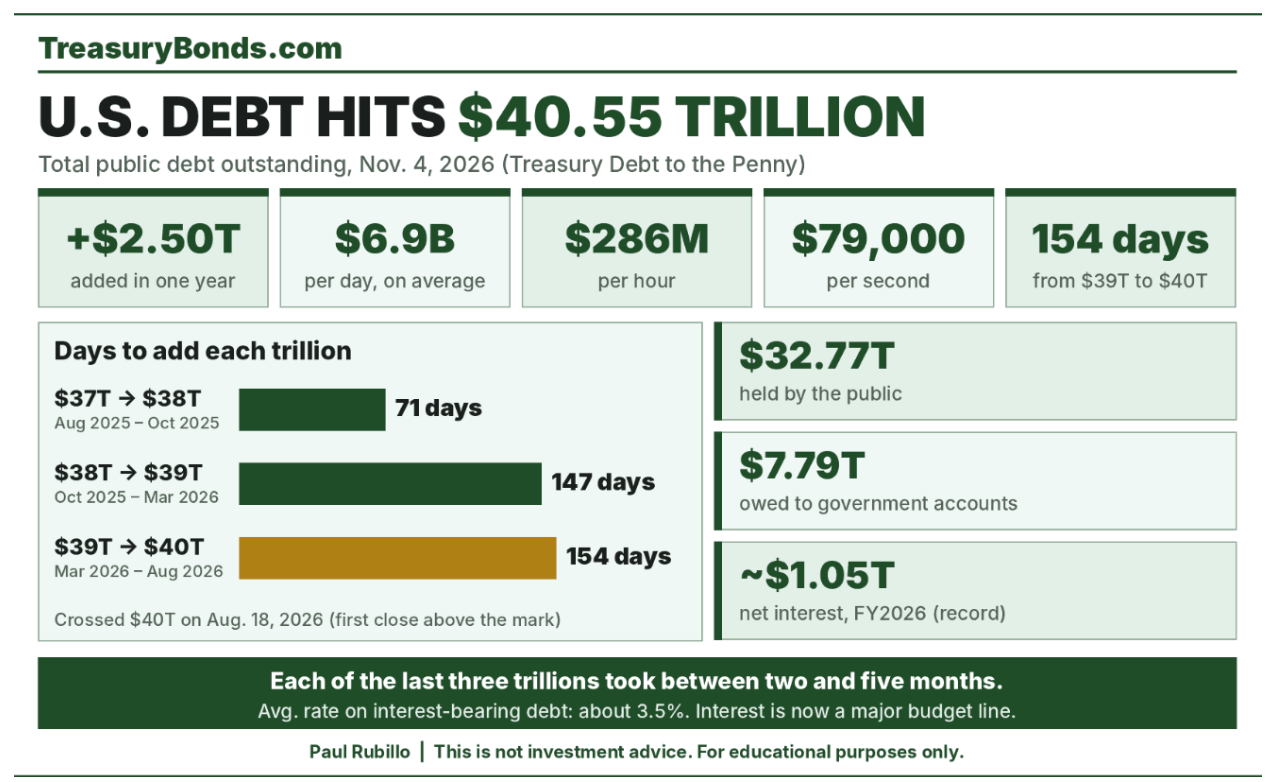
$40.55 trillion is the latest total public debt total, as of November 4, and it’s up roughly $2.5 trillion in a year.
Spread that over 365 days and you get about $6.9 billion a day, $286 million an hour, and $79,000 every second.
The debt first closed above $40 trillion on August 18, 154 days after it crossed $39 trillion on March 17.
Where the debt sits
About $32.77 trillion is held by the public. The other $7.79 trillion is owed to government accounts, such as trust funds.
The interest bill
Net interest cost came in near $1.05 trillion for fiscal 2026, a record. That was about 14 cents of every federal dollar spent, by one estimate.
The average rate on interest-bearing debt was about 3.5%, which means every refinancing at today’s higher yields adds to that bill over time.
What it means for fixed income investors
More debt generally means more Treasury issuance, and the market has to absorb it.
Supply can put upward pressure on yields, especially at longer maturities. The 10-year is at 4.86% and the 30-year at 5.26%.
Higher yields mean better income for new buyers, but they also push down the price of bonds you already own.
Ladders and shorter maturities can help manage that price risk.
Bottom line
The pace at which debt has been coming has many citizens wondering when the fiscal responsibility is going to kick in, if ever. For bond investors, the supply of Treasuries and what it means for yields is worth watching.