
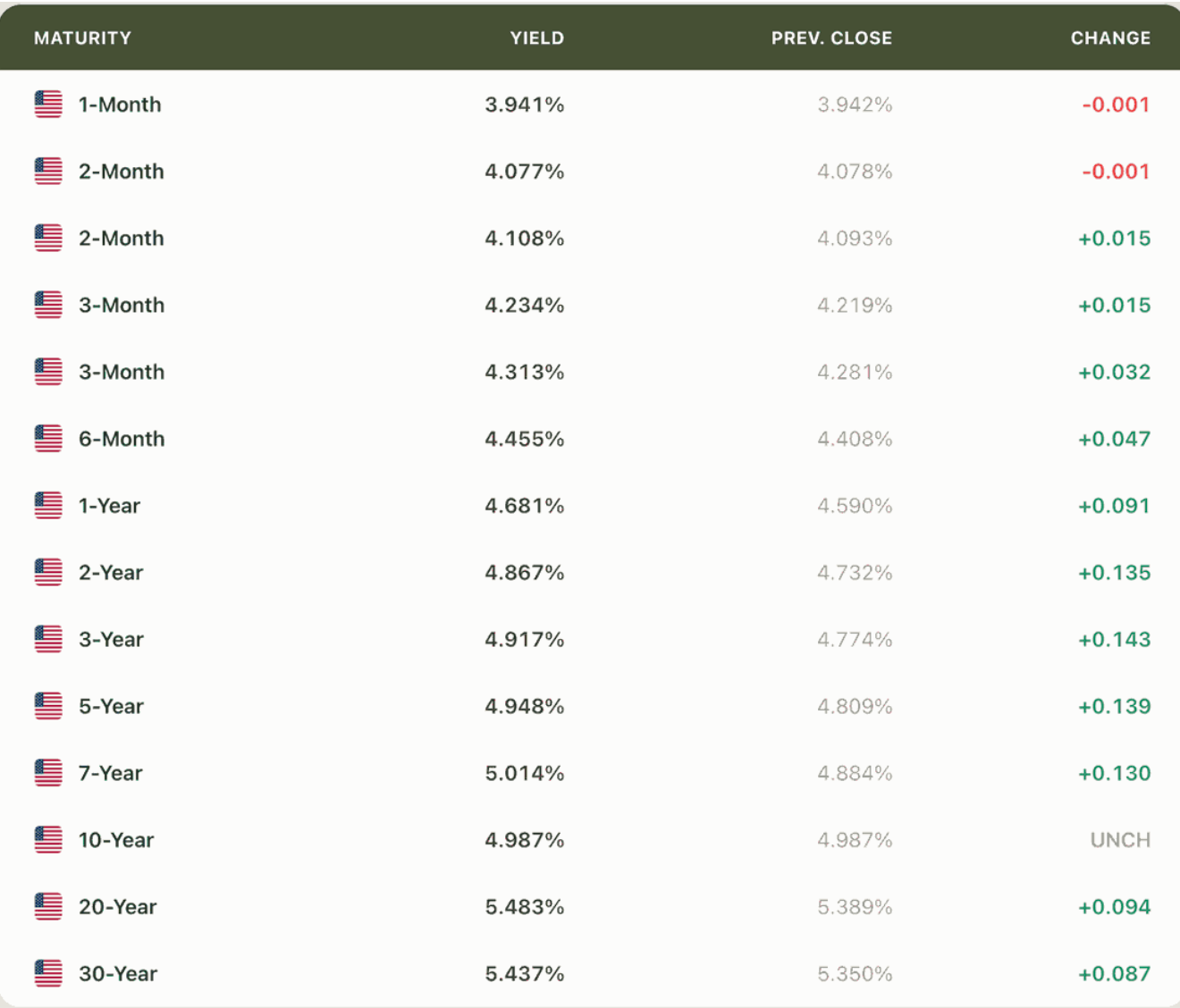
Treasuries returned from a midweek closure with heavy selling on Thursday. The 10-year note and the 30-year bond pushed above their 50-day moving averages, to yields last seen about three weeks ago.
The day opened lower, led by the belly of the curve, then tried a brief rebound that failed well before the market got back to Tuesday’s closing levels.
By the early afternoon, 5-year and longer yields were at three-week highs and the 2-year hit a four-week high.
Odds of a 50-basis-point hike in December climbed above 15%, roughly double where they stood Tuesday.
The 30-Year Auction
The Treasury sold $25 billion of 30-year bonds at a high yield of 5.441%, versus a 12-auction average of 5.005%.
Bid-to-cover came in at 2.36, below the 2.43 average. Indirect bidders took 68.1% (average 68.3%) and direct bidders 20.5% (average 21.3%).
Demand was a bit softer than usual, though not alarmingly so.
Other Pressure Points
Crude oil climbed back above its 200-day moving average (87.73), with WTI up 2.8% to $88.79 a barrel, adding to the inflation worry.
The U.S. Dollar Index rose 0.3% to 103.18, its highest level since early April.
Gold fell 2.8% to $3,886.30 an ounce.
On the fiscal side, the Treasury reported a $404.0 billion deficit for October, well above the $300 billion consensus and the $284 billion deficit a year ago.
The Data
Initial jobless claims rose 9,000 to 200,000 (consensus 195,000), still a low level consistent with a solid demand environment. Continuing claims fell 20,000 to 1.697 million.
Existing home sales dropped 5.5% in October to a 3.75 million annual rate, the lowest since August 2010, down 8.8% from a year ago.
Rising mortgage rates are curtailing buyer demand. Weekly crude inventories rose 4.657 million barrels.
Bottom Line
The sell-off looks like more of the same: inflation worry, rate hike pricing and heavy supply. Yields on the 10-year and 30-year are above their 50-day averages, and the 2-year is at a four-week high. The deficit and a soft-ish long-bond auction add to supply concerns, while the weak housing data shows the economic cost of higher rates. All eyes now turn to Friday’s PPI.