
Data center developers have raised at least $1.8 trillion since 2020, according to BloombergNEF, and a large amount of it has to be refinanced in the years ahead.
The 10-year Treasury is now back above 5%, and that changes the math for every company with a loan coming due.
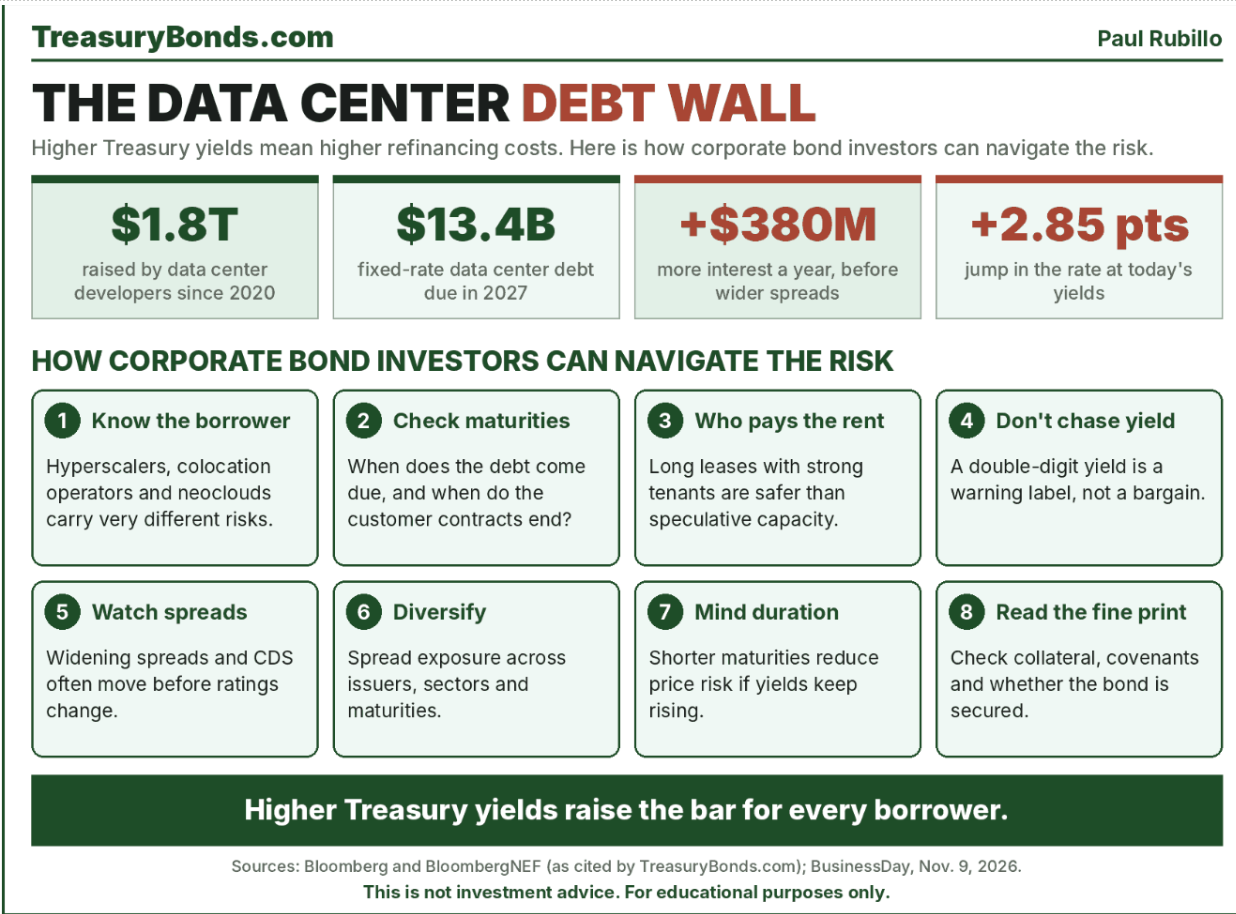
The numbers behind the headline
The chart shows capital raised by data center developers climbing sharply in 2025 and 1H 2026, with colocation providers, hyperscalers and neoclouds all in the mix.
At least $380 million more in annual interest. Refinancing that $13.4 billion at October Treasury yields would cost developers about 2.85 percentage points more, even if credit spreads stay flat.
Why higher Treasury yields matter
Every corporate bond is priced off the Treasury yield plus a spread for credit risk. When the 10-year Treasury moves from around 2% to 5%, that rise gets added to every borrower’s cost before any change in credit quality.
Much of the debt coming due was issued when rates were far lower.
Refinancing means the same borrower pays far more for the same loan, and that cuts into the cash available to cover interest and depreciation.
Where the stress is showing up
Recent reports describe banks and private credit lenders pulling back on new data center financing, with credit committees stalling some deals.
Bloomberg Law’s Distress Watch reported in October that data center debt was still selling off in the secondary market, and that five-year credit default swaps on hyperscaler debt were near their widest levels of the year.
What it means for corporate bond investors
When the debt comes due matters, as does whether customer contracts last longer than the loan.
Don’t chase yield. A double-digit yield is very risky.
Watch spreads and credit default swaps. They often move before rating agencies do.
Diversify. Don’t let one issuer or one theme drive your income.
Mind duration. Shorter maturities reduce price risk if yields keep rising.