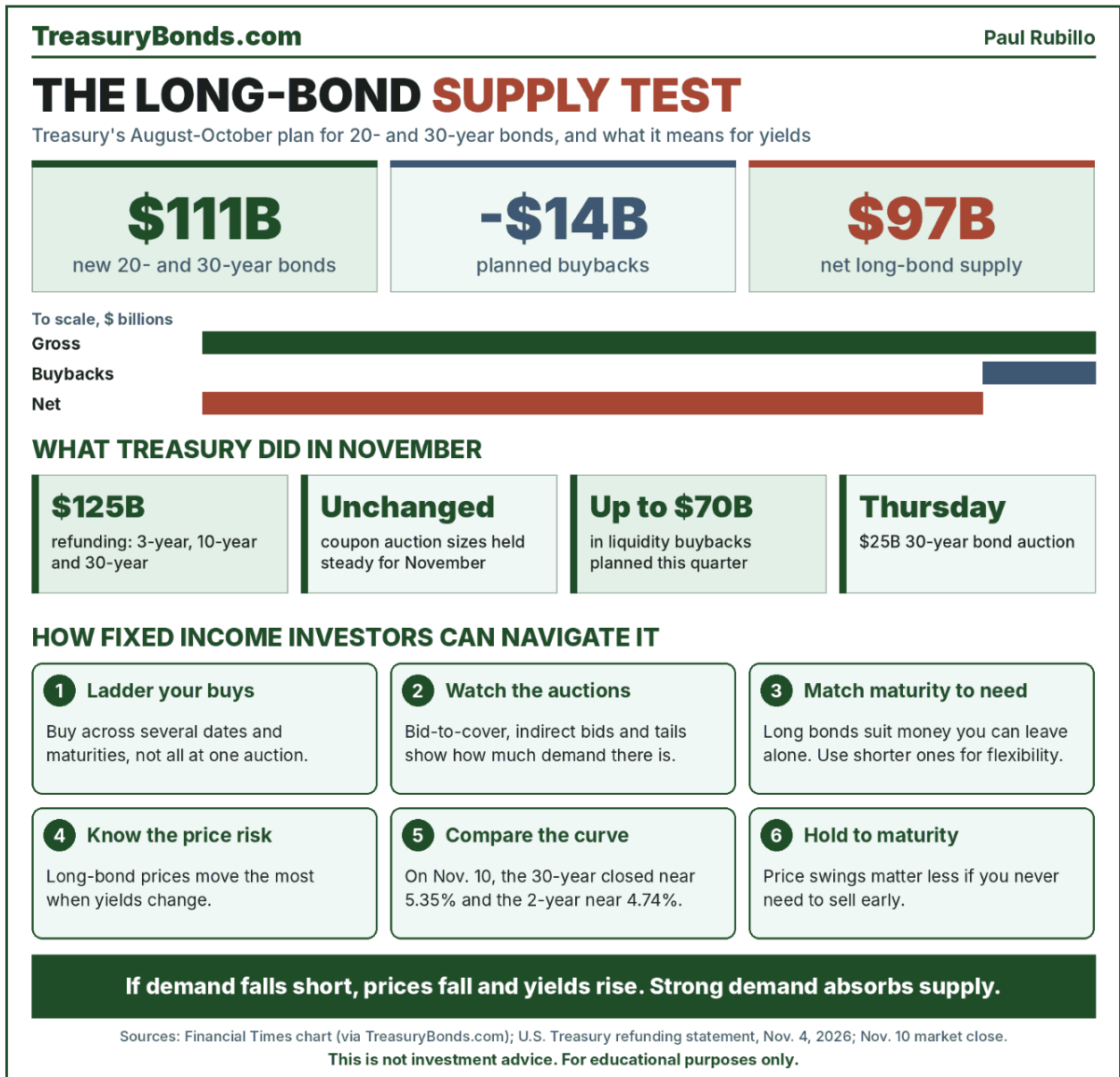
Over the August-October quarter, the U.S. Treasury’s plan called for $97 billion in net issuance of 20- and 30-year bonds.
The supply math
$111 billion in new bonds. That’s roughly the amount of 20- and 30-year bonds the Treasury planned to sell between August and October.
$14 billion in planned buybacks. The Treasury offset a small part of the supply by buying back older bonds.
$97 billion net. That’s what the market had to absorb after the buybacks.
Why supply and demand drive yields
If investor demand falls short at today’s yields, bond prices have to fall and yields have to rise to attract buyers.
If demand is strong, the market can absorb the supply without much pressure on yields.
The most recent 3-year and 10-year auctions were both met with weak demand, and the 10-year priced at a 5.020% high yield, against a 4.425% average of the last 12 auctions.
What the Treasury did in November
On Nov. 4, the Treasury announced a $125 billion refunding: $58 billion in 3-year notes, $42 billion in 10-year notes and $25 billion in 30-year bonds.
Coupon auction sizes stayed unchanged for November, and the Treasury said it anticipates maintaining them “for the next several quarters.”
The Treasury also plans up to $70 billion in off-the-run buybacks for liquidity support this quarter, up from $38 billion.
The final auction of the week is the $25 billion 30-year bond today.
What this means for fixed income investors
When there’s a lot to sell, buyers can demand more yield.
Buying across several auctions and maturities means you don’t rely on one day’s demand.
Bid-to-cover, indirect bids and tails show how much demand there really is.
Long bonds make sense for money you can leave alone. Shorter maturities keep more flexibility.
Hold to maturity if you can. Price swings matter less if you never need to sell early.