
Just as bond investors were starting to think the worst was behind them, the 10-year Treasury yield jumped about 30 basis points in a week to 5.16%.
That is its biggest weekly rise since April 2025.
What surprised some was that Treasuries kept selling off even as Nvidia rattled stocks, which is the opposite of what many investors expect from bonds.
What drove the move
October CPI rose 0.4% versus 0.3% expected, and core rose 0.3% versus 0.2%, the third straight month at that pace. Producer prices also came in strong on Friday.
Futures priced a 91% chance of a quarter-point December hike on Nov. 10. A week earlier, they priced 77% for a quarter-point and 23% for no change.
Fed Governor Christopher Waller said a 50-basis-point hike “should be considered” in December if October core CPI came in around 0.3% or higher. It did. He also said a quarter-point alone would put the Fed’s credibility at risk.
On Nov. 10, the 2-year yield rose 17 basis points to 4.73%. That was the largest one-day rise since April 9, 2025.
Why bonds and stocks fell together
In a normal growth scare, investors buy Treasuries and yields fall. That is what happened on Nov. 5, when an AI-driven stock selloff pushed the 10-year to 4.84%.
Last week the fear was inflation, not growth.
When inflation is the problem, bonds lose their cushioning role because the Fed may have to raise rates and hold them there.
When investors fear weaker growth, they can buy bonds in anticipation of rate cuts. Last week, sticky inflation made cuts harder to price in.
Supply is part of the issue
Treasury has said it will keep coupon auction sizes unchanged for at least the next several quarters.
But the deficit is large, about $1.99 trillion in fiscal 2026, and dealers expect heavy bill issuance.
Reuters reported that some dealers think the Treasury will cut 20- and 30-year auction sizes at some point in 2027.
This is a global story
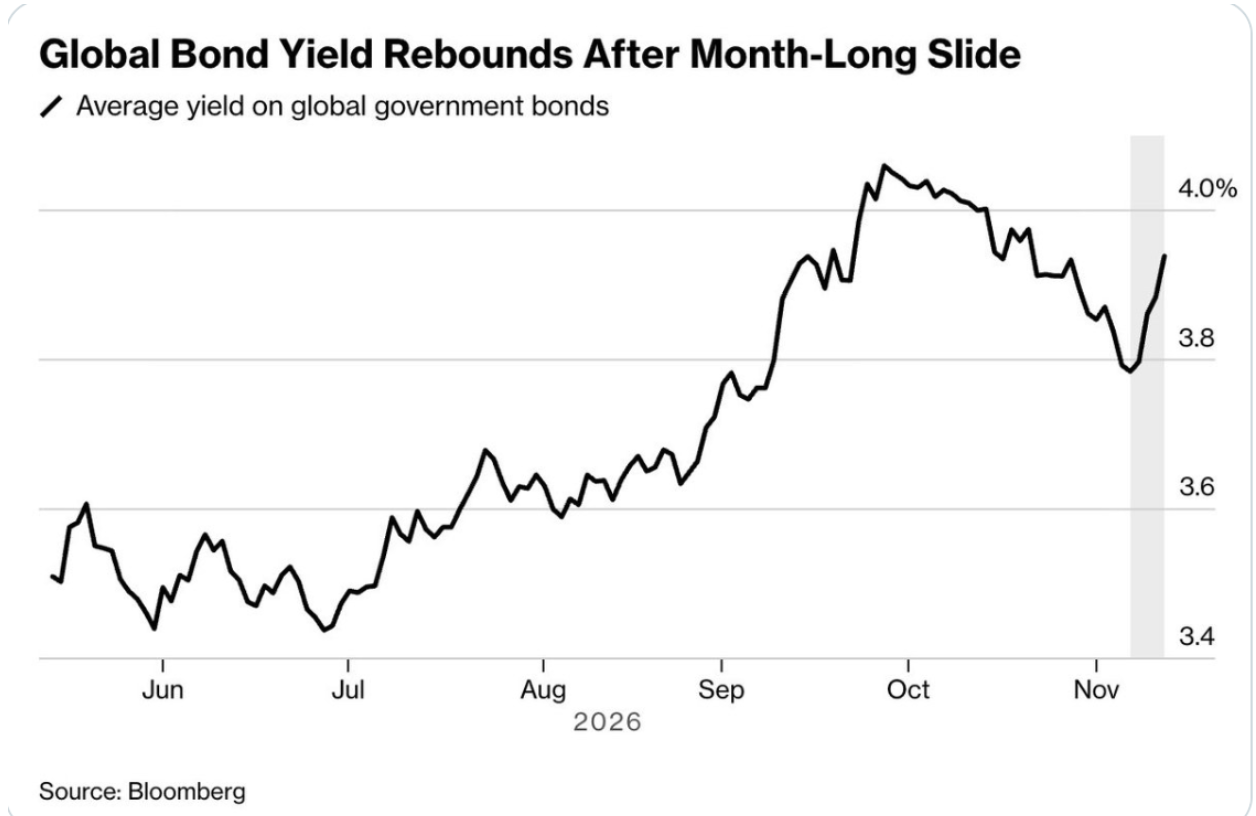
Bloomberg’s chart of average global government bond yields shows the same pattern.
They rose to roughly 4.0% in late September, slid to about 3.8% in early November, and have rebounded to about 3.9%.
Bottom line
Last week reminded investors that bonds don’t always hedge stocks. When inflation is the main fear, Treasuries can sell off along with equities. The path of yields now depends on inflation data, the Fed and how much supply the market has to absorb.