
When people ask me about bonds, the first question is usually about yield. The second should be about timing and payout schedules.
Here’s how the main types work.
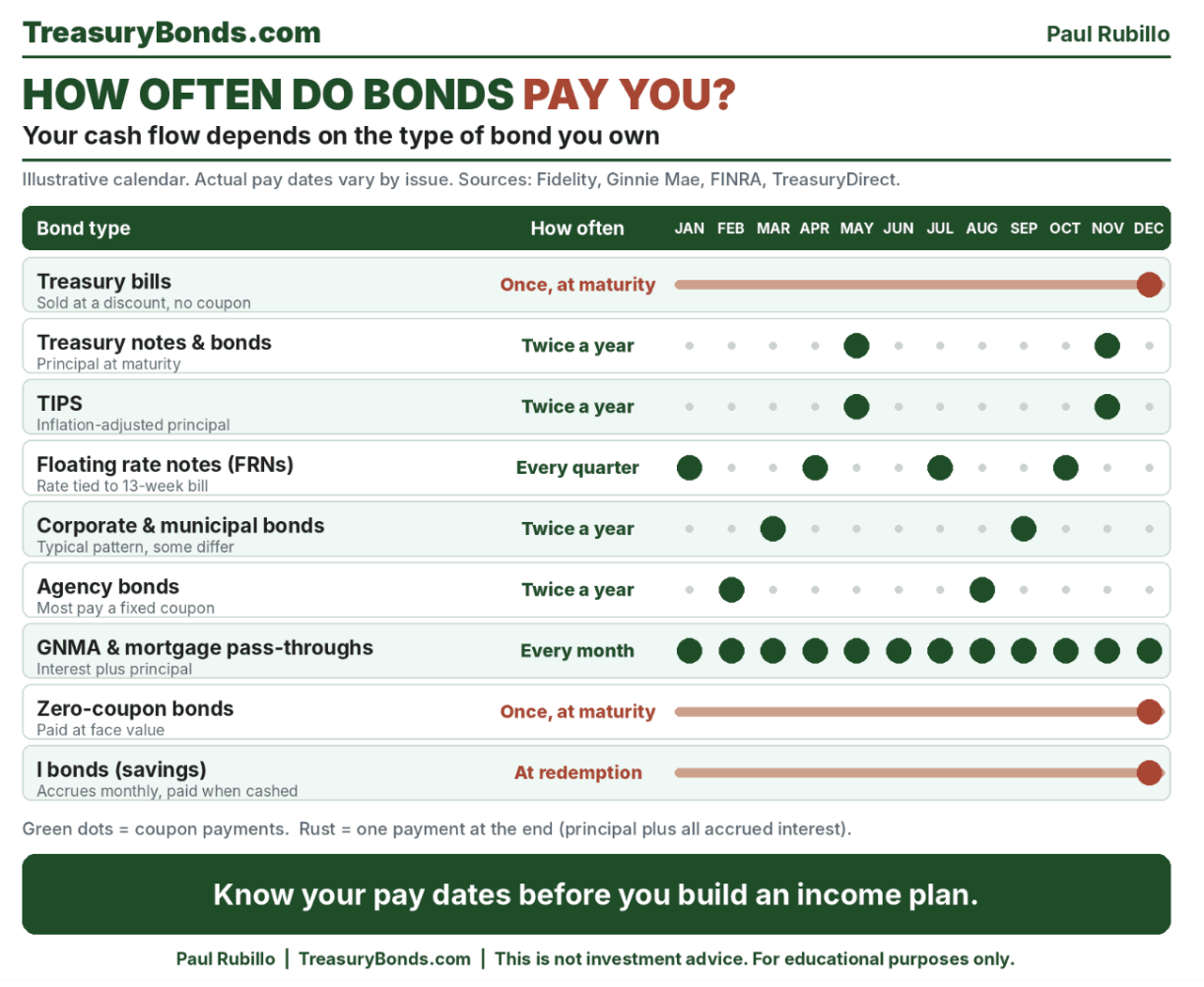
U.S. Treasuries: Mostly Twice a Year
Treasury bills pay no coupon. You buy them at a discount and get face value at maturity, so the interest and principal arrive in one payment.
Treasury notes and bonds pay interest semiannually and return principal at maturity.
TIPS also pay interest semiannually. The principal adjusts with inflation, and at maturity you get the greater of the adjusted principal or the original principal.
Floating rate notes (FRNs) pay interest quarterly. The rate resets based on 13-week Treasury bill rates.
Corporates, Munis and Agencies: Usually Twice a Year
The general rule from FINRA is that a bond’s coupon is “generally paid out semiannually.”
That covers most corporate and municipal bonds, and FINRA says most agency bonds pay a semiannual fixed coupon.
It’s a general rule, though, so check the terms of each issue.
Zero-coupon bonds are the clear exception. They pay nothing along the way and return face value at maturity.
Mortgage-Backed Securities: Every Month
Ginnie Mae describes its securities as passing through principal and interest from borrowers’ mortgage payments to investors monthly.
That monthly check is part interest and part principal, so your principal shrinks over time.
The amount also changes as homeowners prepay or refinance.
I Bonds: Nothing Until You Cash Out
Interest is added to an I bond monthly, but you don’t receive it until you cash the bond.
The minimum holding period is one year.
If you cash it before five years, you forfeit the previous three months of interest.
The Playbook for Fixed Income Investors
Own one bond that pays in May and November and another that pays in February and August, and you get a check every quarter.
More frequent payments give you more chances to reinvest. Reinvesting at higher rates helps, and at lower rates it doesn’t.
Zero-coupon bonds and T-bills can create taxable income before you receive any cash in some account types, so check the tax treatment.
A T-bill or zero-coupon bond gives you a single, known date. That works well for a specific future expense.
Bottom line
Semiannual, quarterly, monthly, and at-maturity bonds each fit a different cash-flow need, and matching the payment schedule to your bills is part of the planning.