
Most investors build a bond ladder by picking maturities and yields.
Fewer ask which account should hold it.
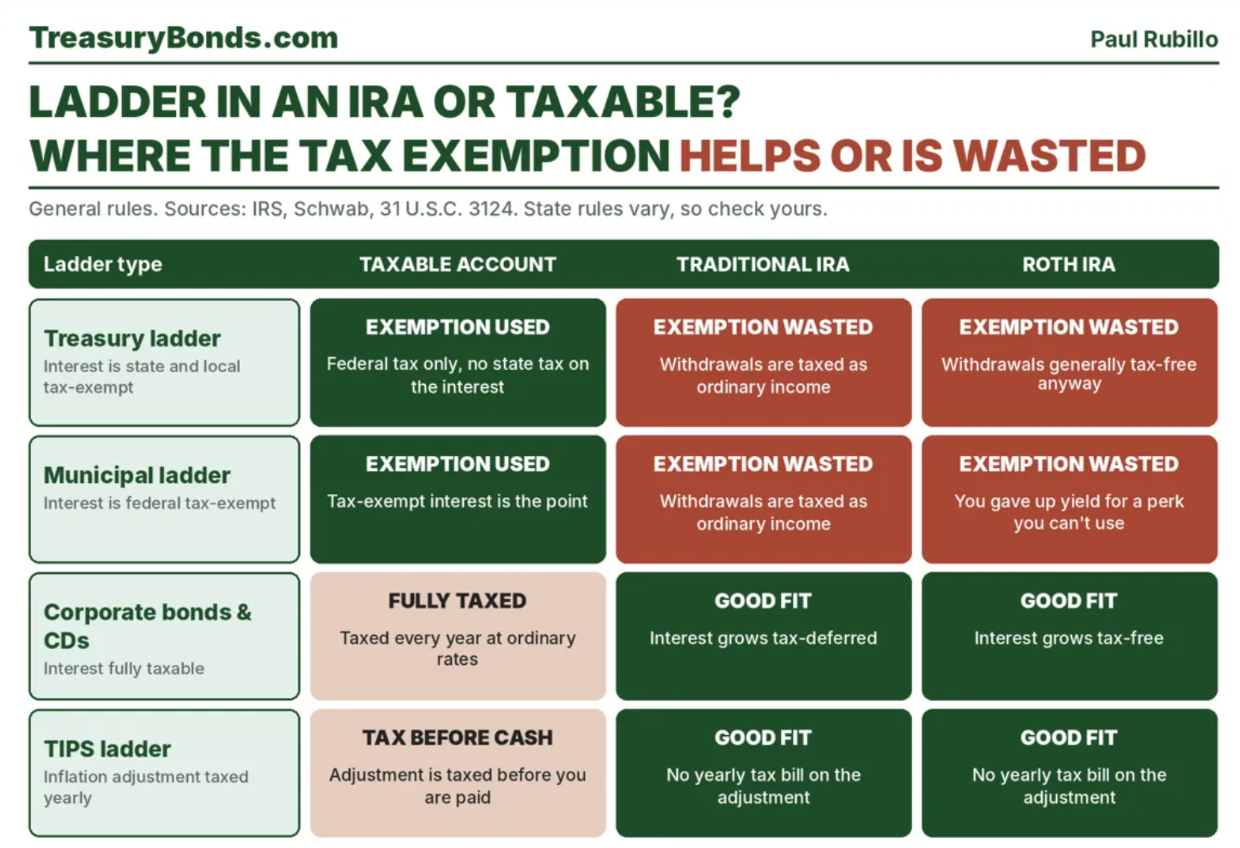
The account matters because Treasury interest carries a state-tax exemption, and that exemption only has value in the right place.
What the exemption actually is
The IRS says Treasury interest “is subject to federal income tax but is exempt from all state and local income taxes.”
Federal law (31 U.S.C. 3124) backs this up, saying U.S. government obligations are exempt from taxation by a state or its political subdivisions.
This only helps if you would otherwise owe state tax on the interest.
Nine jurisdictions have no state tax on interest: Alaska, Florida, Nevada, New Hampshire, South Dakota, Tennessee, Texas, Washington and Wyoming. If you live in one of those, the exemption is worth little wherever you hold the ladder.
Where it helps: the taxable account
In a taxable account, Treasury interest is taxed federally but not by your state.
That is where the exemption earns its keep, especially in a high-tax state.
Muni ladders work the same way for a different tax.
Their interest is “reportable but not taxable at the federal level,” and the exemption is the whole reason to own them.
Where it’s wasted: the IRA
Inside a traditional IRA, the interest isn’t taxed as it’s earned, but withdrawals are taxed as ordinary income, and state taxes may also apply.
Your Treasury interest isn’t taxed as Treasury interest anymore. It becomes IRA money. The exemption you wanted never reaches you.
In a Roth IRA, qualified withdrawals are generally tax-free anyway, so there is no state tax left to avoid.
The same logic hits munis. If you hold munis in an IRA, you accept a lower yield for a tax break the account already gives you.
What belongs in the IRA instead
Fully taxable bonds usually fit better in the IRA. That includes corporate bonds and CDs. TIPS also tend to fit there, because the inflation adjustment is generally taxed each year even though you don’t get the cash until maturity. A ladder of these in an IRA avoids that yearly tax bill.
One more wrinkle: RMDs
A traditional IRA requires minimum distributions starting at age 73.
Missing one triggers a 25% excise tax on the amount not withdrawn, which can drop to 10% if you correct it in time.
A Roth IRA generally has no RMDs for the original owner.
If your ladder’s maturities don’t line up with your RMD needs, you may be forced to sell bonds you wanted to hold.
If you hold Treasuries through a fund or ETF, the state exemption depends on your state’s rules for passing it through. Some states require a minimum share of the fund in qualifying obligations.
Bottom line
Put tax-exempt bonds where you can use the exemption, and put fully taxable bonds where the account shelters them.