Last month, Japan’s 20-year government bond auction drew record demand. This month, the same auction came in below average.
What Happened
Japan sold about ¥525.8 billion of 20-year JGBs at its November auction.
Newsquawk reported a bid-to-cover ratio of 3.64x, down from 5.84x at the prior auction. The average accepted yield was 3.756%, up from 3.723% last month.
The 3.64x also fell below the 12-month average of 3.92x. Buyers bid ¥3.64 for every ¥1 offered, compared with ¥5.84 a month ago.
The Signal Hiding Inside the Auction
The gap between the average and lowest accepted prices widened to its largest in a year.
That suggests some buyers needed a bigger discount to step in, even though the headline demand was still positive.
The timing makes it more notable.
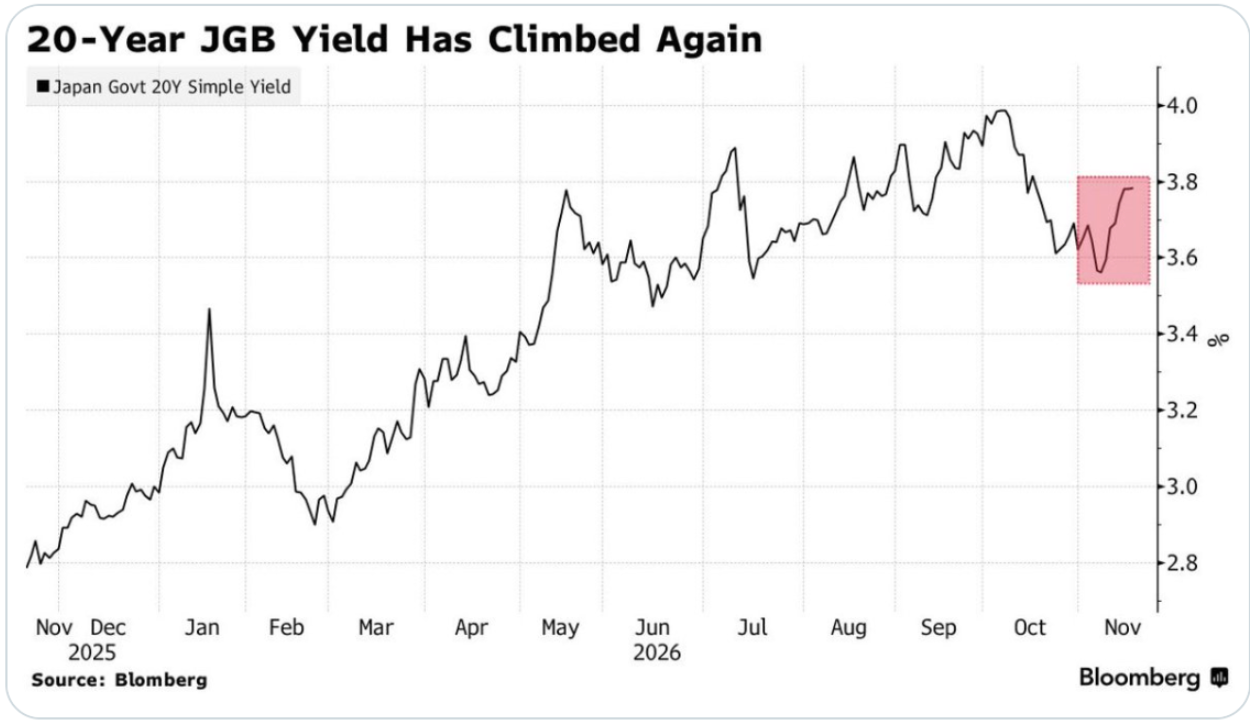
The 20-year yield was already up more than 20 basis points this month, even after dipping to 3.74% on Wednesday.
Demand still came in below average after that rise in yields.
Why the December Budget Matters
Japan’s government is expected to present its December budget.
If it points to more borrowing and demand stays soft, the government may have to pay higher yields to sell its long-term debt.
What This Could Mean for Fixed Income Investors
Japan is a global bond story. Japanese yields have been climbing for a year, and the 20-year yield is up from under 3% in early 2026 on the chart.
A falling bid-to-cover and a wider price gap can show that buyers are getting pickier at long maturities.
The weakness is concentrated in 20-year paper, where buyers take the most interest-rate risk.
U.S. investors can feel the effects. Rising yields abroad can pull on Treasury yields, especially at long maturities.
Watch the next auctions. A rebound in demand would suggest this was a one-off. Another soft result would support the case for higher funding costs.
Bottom Line
The swing from 5.84x to 3.64x in a month is worth watching, especially with Japan’s December budget ahead. The key question is whether the government can keep selling long-term debt at today’s yields.