
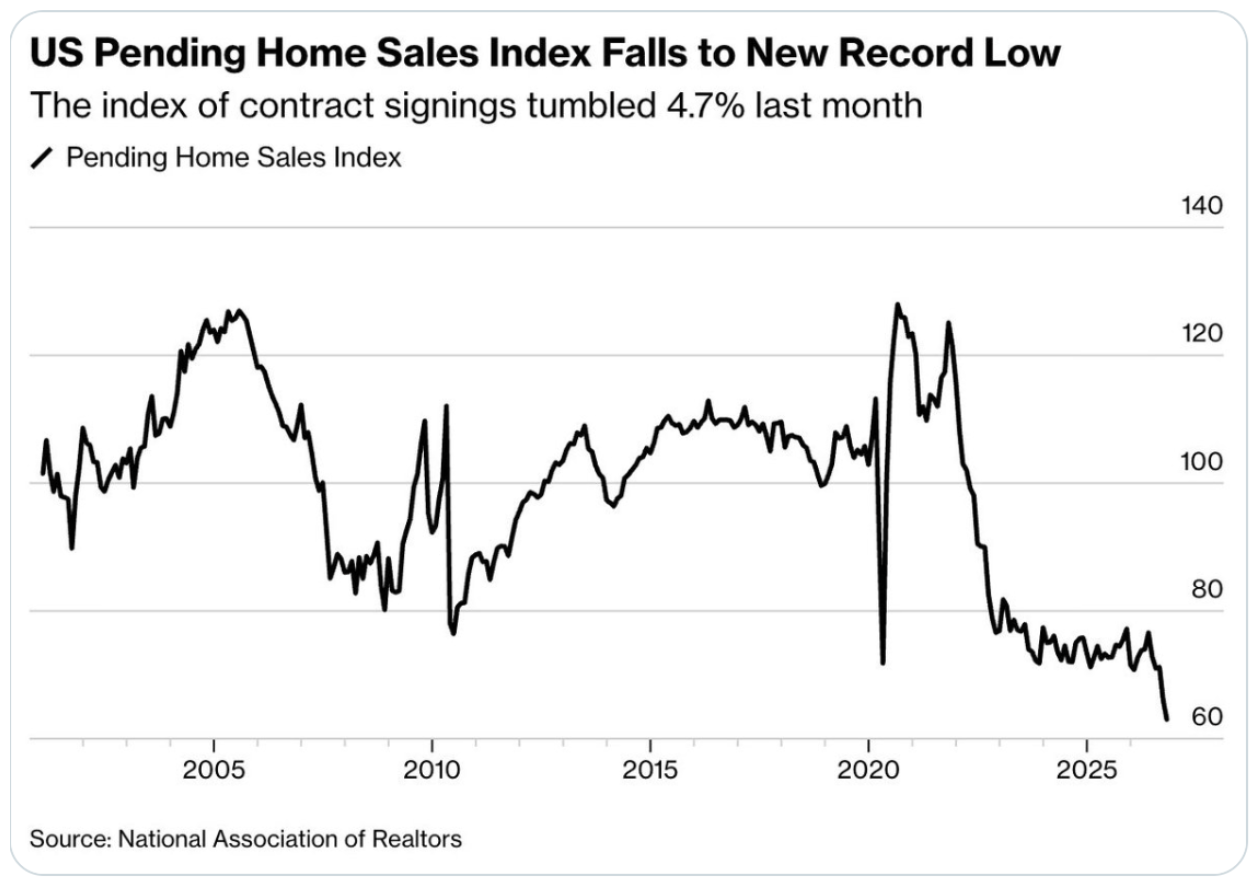
The National Association of Realtors’ Pending Home Sales Index just fell to 63.0, the lowest reading since the data began in 2001. It’s lower than anything we saw during the financial crisis.
What the Numbers Say
The index measures contract signings on existing homes, with 100 representing average activity in 2001.
October’s reading of 63.0 was down 4.7% from September and 16.7% from a year earlier.
Economists had expected a drop of only about 2.0%, so the miss was a big one.
This was the second straight record low.
Every region fell on both measures, with the West down 6.9% on the month and 20.3% on the year, and the South down 6.3% and 18.7%. The Northeast held up best, down 0.8% on the month and 11.1% on the year.
Even the strongest of the 50 largest metros saw annual declines.
Why It Matters for Bond Investors
Pending sales lead existing-home sales by one to two months, because most contracts close in that window.
So October’s weakness points to a soft fourth quarter for closings.
NAR’s chief economist, Lawrence Yun, said annual existing-home sales could end up the lowest since the mid-1990s.
The common thread is borrowing costs.
Mortgage rates track the long end of the Treasury market, and the 10-year yield has been hovering around 5%.
When yields stay that high, monthly payments stay out of reach for many buyers, and owners with low-rate mortgages have little reason to sell.
A Possible Turning Point?
Yun said October could mark the low point in contract signings for this housing cycle, since mortgage rates appear to have topped out.
Sales are back at levels last seen around three decades ago, even though the U.S. population has grown by roughly 75 million.
He suggested either there’s a lot of hidden housing demand waiting to come back, or homeownership is getting out of reach for many Americans.
What's Next?
The pending sales data shows how high long-term yields can feed through to the real economy.
If the slump spreads to broader growth, bond markets may start to price in a slower economy.
A sustained drop in the 10-year yield would be the most direct way to ease the squeeze.
Bottom Line
A record-low reading of 63.0 shows how much high rates have frozen the housing market. For bond investors, the question is whether this is the bottom, as NAR’s economist suggests, or the start of a broader slowdown.