
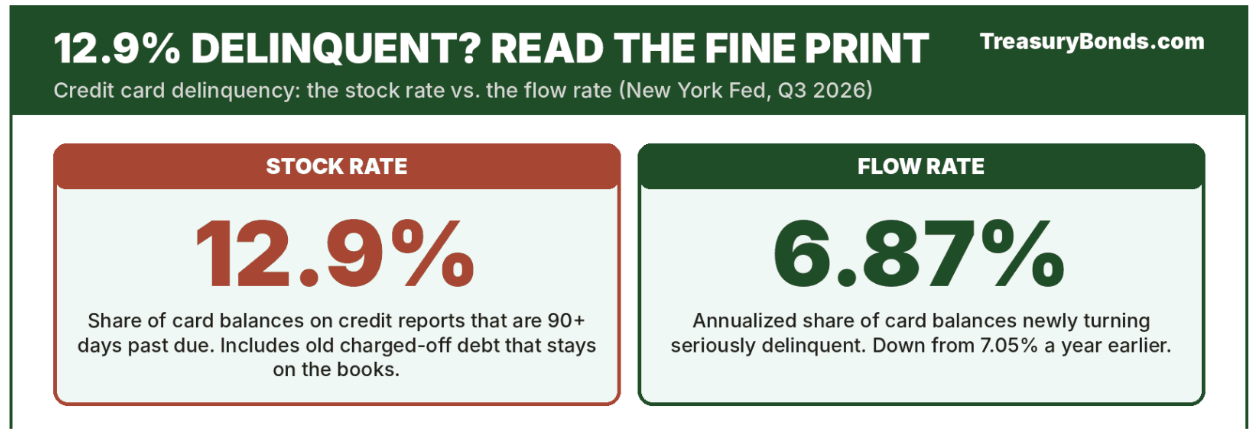
About 12.9% of U.S. credit card balances are now 90 or more days delinquent, close to the highest level since 2011, according to New York Fed data.
What the New York Fed Reported
In its Q3 2026 household debt report on Nov. 10, the New York Fed said total household debt rose $334 billion (1.8%) to $19.1 trillion.
Credit card balances reached $1.29 trillion, up $22 billion in the quarter.
The 12.9% figure is a “stock” measure: the share of all outstanding card balances on credit reports that are 90+ days past due.
A New York Fed research note puts the same measure at 12.8% in the first quarter of 2026, up from 7.6% in the third quarter of 2022.
Why the "Stock Rate" Can Mislead
The New York Fed’s own researchers argue this rise is driven almost entirely by a growing pool of charged-off balances.
These are debts that lenders have written off but continue to report to the credit bureaus.
The share of charged-off debt still reported a year later has risen from about 40% in 2004 to 2012 to about 80% in 2024.
Those old balances stay in the 90+ day bucket, which inflates the stock rate over time.

Where the Stress Does Show Up
The New York Fed reported that 5.0% of outstanding household debt was in some stage of delinquency, up 0.3 percentage points from the prior quarter.
Mortgages saw their flow into serious delinquency rise to 1.60% from 1.28%.
A separate New York Fed analysis points to a wider divide in card delinquency by income, though I haven’t summarized it here.
What This Could Mean for Fixed Income Investors
Consumer credit matters for the bond market. Asset-backed securities and bank credit depend on how well borrowers repay.
New delinquencies are a better read on current household behavior.
Bottom Line
A 12.9% delinquency rate sounds like a crisis, but much of it reflects old charged-off debt that stays on credit reports. I’d still keep an eye on mortgages and lower-income borrowers.