Last year, China sold dollar bonds at the same yield as U.S. Treasuries.
This year, it’s offering about a quarter of a percentage point more.
What China Is Offering
China is marketing up to $2 billion in dollar-denominated sovereign bonds.
Newsquawk reported the plan on Nov. 11, saying the deal would be issued in Hong Kong.
The three-year notes carry an initial yield indication of roughly 5.10%. That’s about 0.25 percentage points above comparable U.S. Treasuries, which are yielding about 4.85%.
For comparison, last year’s sale was bigger and priced tighter.
On Nov. 6, 2025, China’s Ministry of Finance sold $4 billion of dollar bonds, split evenly between three-year and five-year notes.
The three-year notes priced with no yield premium over Treasuries, and the five-year notes priced at 2 basis points over.
Order books reached about $118.2 billion, nearly 30 times the amount sold.
S&P Global Ratings assigned the offering an A+ rating.
Irregular Issuance
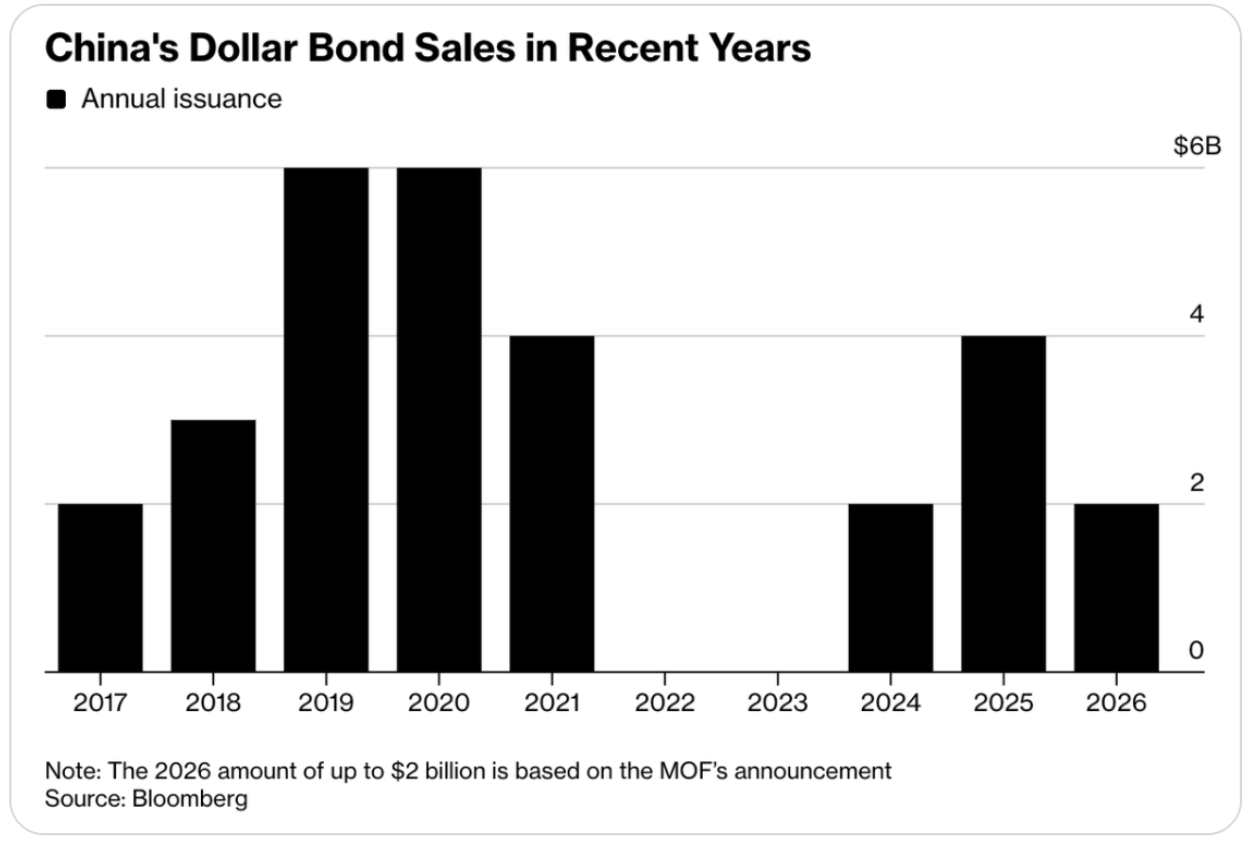
China’s annual dollar bond sales were roughly $2 billion in 2017 and $3 billion in 2018, then climbed to about $6 billion in each of 2019 and 2020.
They fell to about $4 billion in 2021, and there were no sales in 2022 or 2023.
Issuance returned in 2024 at about $2 billion and rose to about $4 billion in 2025.
The 2026 bar of up to $2 billion is based on the Ministry of Finance’s announcement.
So China is back in the market for a third straight year, but with a smaller deal than last year’s.
Why the Premium Matters
A premium of about 25 basis points looks more like the market treating China as a distinct credit.
There are several possible reasons.
The deal might be pricing more fairly after last year’s very strong demand.
Yields might also have risen across the market.
And a smaller issue may simply price differently.
What This Could Mean for Fixed Income Investors
The gap over Treasuries is a quick way to see how much investors want China’s credit.
Treasuries remain the benchmark. The 3-year Treasury is yielding about 4.85%, which sets the floor for the pricing.
Chinese sovereign dollar bonds set a benchmark for corporates. The Ministry of Finance has said it wants to build a curve that Chinese companies can use as a reference.
Last year’s sale followed easing in the U.S.-China trade tensions, so changes in that relationship could influence demand.
Bottom Line
If demand is strong and the spread tightens, it would show that global investors remain comfortable with Chinese government debt.