Millions of homeowners locked in a very low mortgage rate a few years ago, and many of them are now serving time.
They aren’t behind bars, but they’re stuck in an interest rate state prison.
Selling means giving up a cheap loan and taking out a new one at a much higher rate, so many have decided it isn’t worth it.
How Big the Interest Rate Prison Population Is
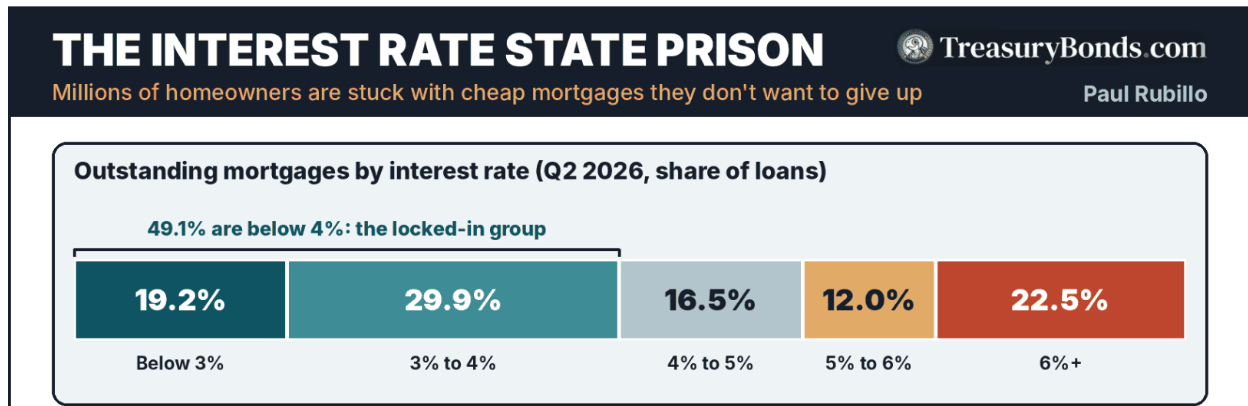
A Realtor.com analysis of the FHFA’s National Mortgage Database found that, as of June 2026, 19.2% of outstanding first-lien mortgages had rates below 3%, and another 29.9% were between 3% and 4%.
That puts about 49% of all mortgages below 4%.
Only 22.5% had a rate of 6% or higher.
For the first time since 2020, more homeowners now have a rate of 6% or higher than a rate below 3%, so the lock-in is slowly easing.
Freddie Mac’s 30-year average was 7.18% in its Nov. 5 survey, down slightly from 7.24% the week before, and it was 7.40% in early October.
A homeowner with a 3% mortgage who moves into a similar house would pay far more every month on the same loan balance, before even counting a higher home price. That’s why moving can feel like a penalty.
The Cost to Everyone Else
The effect spreads beyond the people who are locked in.
When owners stay put, fewer homes come onto the market, which leaves buyers with less to choose from and keeps prices high.
Pending home sales hit a record low in October, according to the National Association of Realtors, and Zillow reports that homebuyer engagement is at its lowest since it began tracking in 2023.
Starter-home buyers have been hit hardest.
Fewer sales also mean less mobility.
People find it harder to move for a job, to downsize, or to upsize for a growing family, which can affect the broader economy.
What This Could Mean for Fixed Income Investors
Mortgage rates follow Treasury yields, so the path of yields decides how long the lock-in lasts.
Mortgage-backed securities behave differently. When homeowners don’t refinance or move, mortgages stay outstanding longer than usual, which affects how those bonds trade.
Weak sales show how higher yields feed through to real activity.
Bottom Line
Until rates fall enough, or until enough people accept higher ones, the housing market will likely stay frozen.