Treasuries had a strong showing on Wednesday, briefly pushing the 10-year and 30-year yields to fresh lows for the month.
The day started with strong gains after another round of selling in Asian equities, led by a 6.2% drop in South Korea’s Kospi. U.S. stocks also started weak before bouncing steadily.
The bond rally came even though the data was hot, and even though the Treasury capped the week’s mixed auction slate with a weak $44 billion 7-year note sale. By the close, the 10-year was back to its starting level, and the 30-year stayed below where it opened.
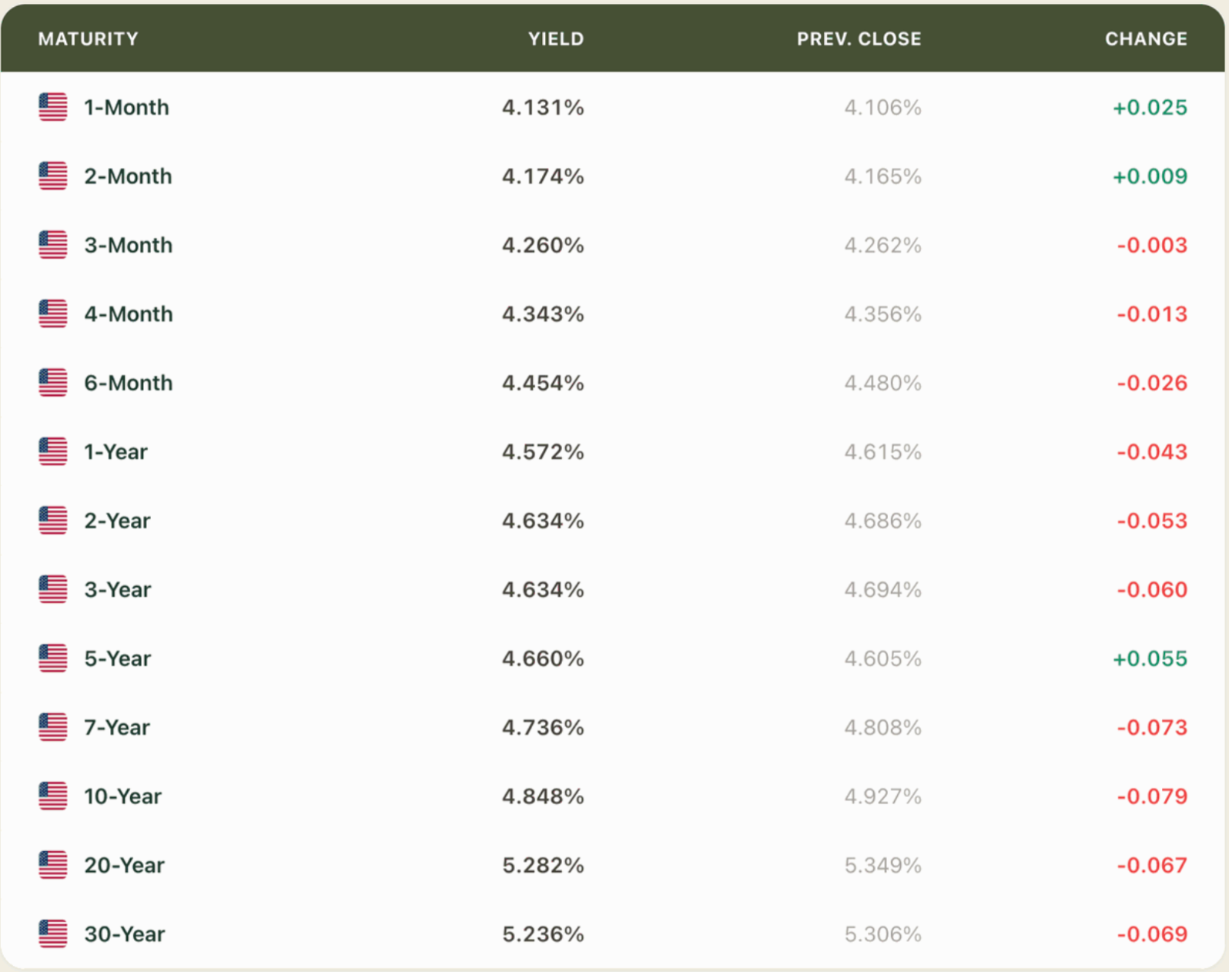
The curve is upward sloping, with the 10-year 21 bps above the 2-year and the 30-year 39 bps above the 10-year (my math from the yields above).
Inflation and growth data: hotter than expected
The data wasn’t what you’d expect on a day yields fell.
Personal income rose 0.7% in October against a 0.3% consensus, and spending rose 0.3% against 0.2%.
The PCE price index rose 0.3% and is now up 3.8% year over year, versus 3.7% in September.
Core PCE rose 0.3% and is up 3.3% year over year, versus 3.1% in September.
Growth was strong too. Q3 GDP was revised up to 4.3% from 3.4% (consensus 3.4%), mostly on investment and consumer spending.
The GDP deflator came in at 1.8%, below the 2.2% advance estimate.
Initial jobless claims fell 13,000 to 189,000 (consensus 200,000), and continuing claims fell 95,000 to 1.697 million, the lowest of the year.
Durable goods orders rose 0.2% (consensus 0.5%), but non-defense capital goods orders excluding aircraft, a proxy for business spending, rose 1.2%.
New home sales jumped 14.2% to 701,000 (consensus 649,000), though September was revised down.
The Fed’s Beige Book showed slight to moderate growth in eight of twelve districts, little change in consumer spending, weaker auto sales and residential real estate, and moderate price increases.
The 7-year auction
The $44 billion 7-year note sale was weak. The high yield was 4.708%, against an average of 4.289% for the prior 12 auctions. The bid-to-cover was 2.43 (average 2.48). Indirect bidders took 58.2% (average 62.9%), and direct bidders took 33.2% (average 25.7%).
Global headlines
The U.S. Trade Representative confirmed new tariffs: 20% on China, 15% on the EU and 35% on Vietnam.
Japan’s Prime Minister Takaichi ordered her Finance Ministry to prepare a second extra budget for FY26.
The ECB reportedly discussed raising minimum reserve requirements for eurozone banks to 2% from 1%, a move that could cut annual bank interest income by about EUR4.4 billion. A formal decision could wait until the December 17 meeting.
Japan’s October corporate services price index rose 4.2% year over year (expected 3.6%).
Australia’s October monthly CPI rose 4.9% year over year (expected 4.7%), and trimmed mean was 3.8% (expected 3.6%).
Germany’s Q3 GDP rose 0.1% quarter over quarter (expected 0.2%).
Commodities and currencies
WTI crude rose 1.9% to $83.67, climbing above $83.
Gold fell 0.7% to $3,538.70 after hitting a fresh 52-week low. Silver also hit a 52-week low, and copper rose 0.7% to $5.42.
The Dollar Index fell 0.2% to 103.64, deepening this week’s reversal from its highest level since March 2025.
EUR/USD rose 0.2% to 1.0980, GBP/USD rose 0.1% to 1.3124, and USD/JPY was unchanged at 159.20.
What it means for fixed income investors
Yields fell on a day of strong growth and hot inflation, which suggests the market was focused on weak global stocks.
A weak 7-year auction shows buyers are demanding higher yields.
A 30-year yield of 5.24% gives long-term income, but it also carries the most price risk if yields rise.
Tariffs, oil above $83 and sticky inflation all point the same way
Bottom line
Treasuries rallied on Wednesday on global equity weakness, even though inflation and growth data were hotter than expected and the 7-year auction was weak. Markets are closed Thursday for Thanksgiving, and Friday is an abbreviated session. The December FOMC meeting is now the key event.