
Most of the talk about AI stocks has been about share prices.
The credit market is now saying something too, and bond investors tend to be less forgiving than stock investors.
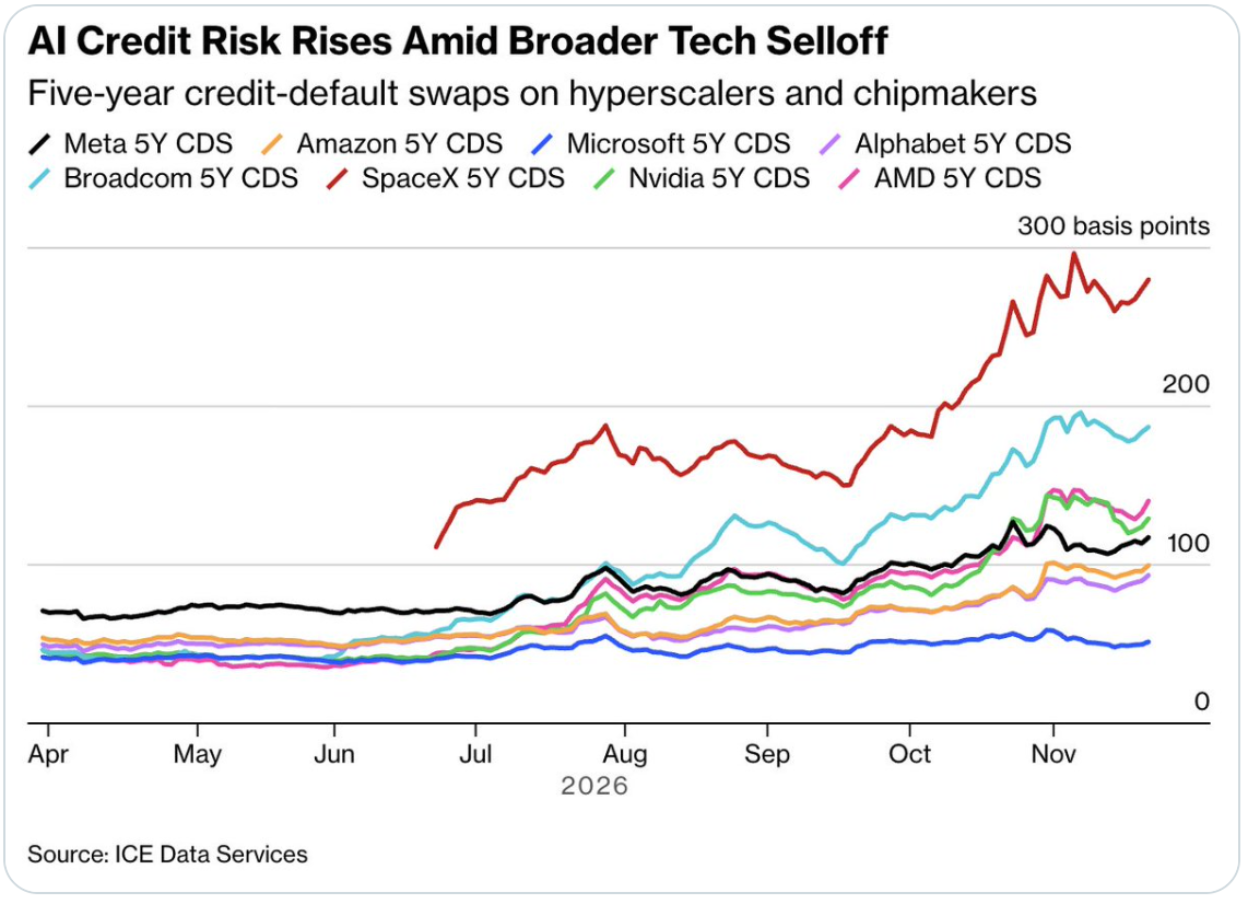
What Default Protection Is Telling Us
Five-year credit default swaps, or CDS, are insurance against a company failing to pay its debt.
When the price goes up, the market sees more risk.
Here is where a few names stand:
- Oracle: 328 basis points
- CoreWeave: 1,233 basis points
- Alphabet: a record 94 basis points
A basis point is one-hundredth of a percent. So CoreWeave’s 1,233 means it costs about 12.3% a year to insure its debt, or roughly $1.23 million a year per $10 million protected.
Oracle’s 328 is about 3.3% a year.
Alphabet’s 94 is under 1%, which is still low in absolute terms.
CoreWeave’s 9% bonds due in 2031 also fell to roughly 80 cents on the dollar. At that price, the bond’s current yield is about 11%.
That is what the market demands to hold the debt.
The weakest credits are rising fastest, while the strongest, like Microsoft, have barely moved.
What This Could Mean for Fixed Income Investors
Credit markets can move before stocks do. Higher default protection costs can be an early sign that lenders are getting more cautious.
Heavy borrowing is part of the story. These companies are funding big data center buildouts partly with debt, which makes their bonds more sensitive to any doubt about the payoff.
A bond trading near 80 cents on the dollar isn’t automatically a bargain. The higher yield is compensation for a higher chance of loss.
Watch the spreads. If default protection costs for the largest names keep climbing, it will matter for the broader corporate bond market.